Jan Vishwas Bill and Decriminalisation of Minor Offences
Source:Indian Express ↗
આ શા માટે મહત્વનું છે
It is critical for understanding India's legislative shift towards trust-based governance, reducing regulatory friction, easing corporate compliance, and reforming the criminal justice system by removing criminal liability for minor, technical infractions.
સારાંશ
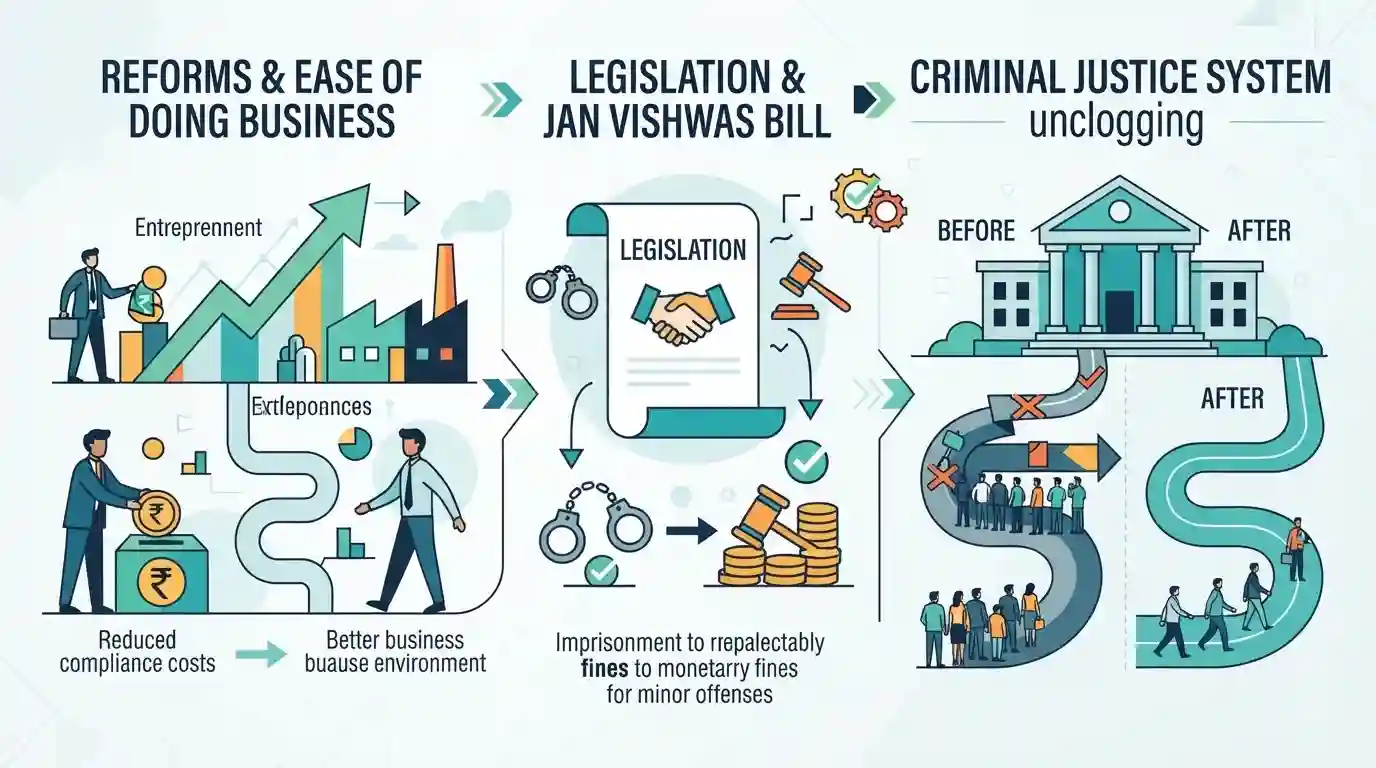
The article explores the Jan Vishwas Bill 2026, which focuses on decriminalising minor offences to improve the ease of doing business, reduce regulatory compliance burdens, and unclog the Indian judicial system by replacing imprisonment clauses with monetary penalties.
મુખ્ય મુદ્દા
- The Jan Vishwas Bill seeks to further decriminalise minor offences to promote ease of doing business and reduce compliance burdens.
- It converts several criminal provisions carrying imprisonment into monetary penalties or administrative mechanisms.
- The legislation addresses over-criminalisation in legacy laws, aiming to unclog the judicial system and foster trust-based governance.
- Key focus areas include shifting from punitive imprisonment for minor, technical, or procedural lapses to civil penalties.
મહત્વપૂર્ણ શબ્દો
Jan Vishwas Bill 2026

A legislative reform in India aimed at trust-based governance, removing criminal imprisonment clauses for minor procedural or technical lapses across multiple central acts and replacing them with civil or monetary penalties.
UPSC context
UPSC GS Paper II (Polity & Governance - Legislation) and GS Paper III (Economy - Reforms & Ease of Doing Business).
Jan Vishwas (Amendment of Provisions) Act 2023
A landmark legislation passed in 2023 that amended 42 central acts to decriminalise and rationalise minor offenses, establishing administrative adjudication mechanisms to ease regulatory compliance and reduce judicial pendency.
UPSC context
Important for UPSC GS Paper II (Governance, statutory frameworks, and reduction of judicial backlog) and economic reforms.
Parliament
The supreme legislative body of India comprising the President, Lok Sabha, and Rajya Sabha, responsible for enacting laws, policy oversight, and constitutional amendments.
UPSC context
Core component of UPSC GS Paper II (Indian Constitution - Features, Functioning, and Conduct of Business).
પ્રિલિમ્સ ટ્રેપ
repeals entire central acts and abolishes all regulatory penalties for business offences
Aspirants often assume the Jan Vishwas Bill repeals entire central acts or completely abolishes all penalties, whereas it specifically replaces criminal imprisonment with monetary/civil penalties for minor procedural lapses.
સંલગ્ન સ્થિર ખ્યાલો
What are the key differences between criminal law and civil/administrative penalties in regulatory governance?
- Punitive Nature: Criminal sanctions involve state prosecution, criminal records, potential imprisonment, and retributive justice aiming at deterrence.
- Compensatory Focus: Civil or administrative penalties involve monetary fines, license suspensions, or warnings imposed by regulators to correct non-compliance without creating a criminal record.
- Judicial Efficiency: Administrative mechanisms lower the burden of proof (preponderance of evidence vs. beyond reasonable doubt) and unclog regular courts.
આંતર-વિષય પેટર્ન
Ease of Doing Business meets Judicial Backlog
Judicial backlog in India is directly worsened by over-criminalisation of procedural lapses in economic laws, leading to under-trial congestion and delayed civil justice delivery.
Administrative Adjudication vs Criminal Prosecution
Administrative adjudication of civil penalties replaces criminal prosecution, reducing discretionary powers of inspectors and curbing systemic red tape for MSMEs.

Jan Vishwas Bill's shift from imprisonment to civil penalties for procedural lapses will feature in Prelims as a governance/polity statement.
સંલગ્ન PYQ · 1
સંલગ્ન PYQ · 1
- 2020MainsGS2
There is a need for simplification of procedure for disqualification of persons found guilty of corrupt practices under the Representation of Peoples Act". Comment.
