Legislative Assembly Proceedings and Expunction Rules
Source:The Hindu ↗
Why It Matters
Understanding the procedural functioning of state and UT assemblies—such as the expunction of unparliamentary remarks, the conduct of Question Hour, and the Speaker's powers to manage records and maintain order—is crucial for the Polity and Governance sections of the UPSC syllabus. It provides real-world context to the functioning of the newly restored J&K Assembly.
Summary
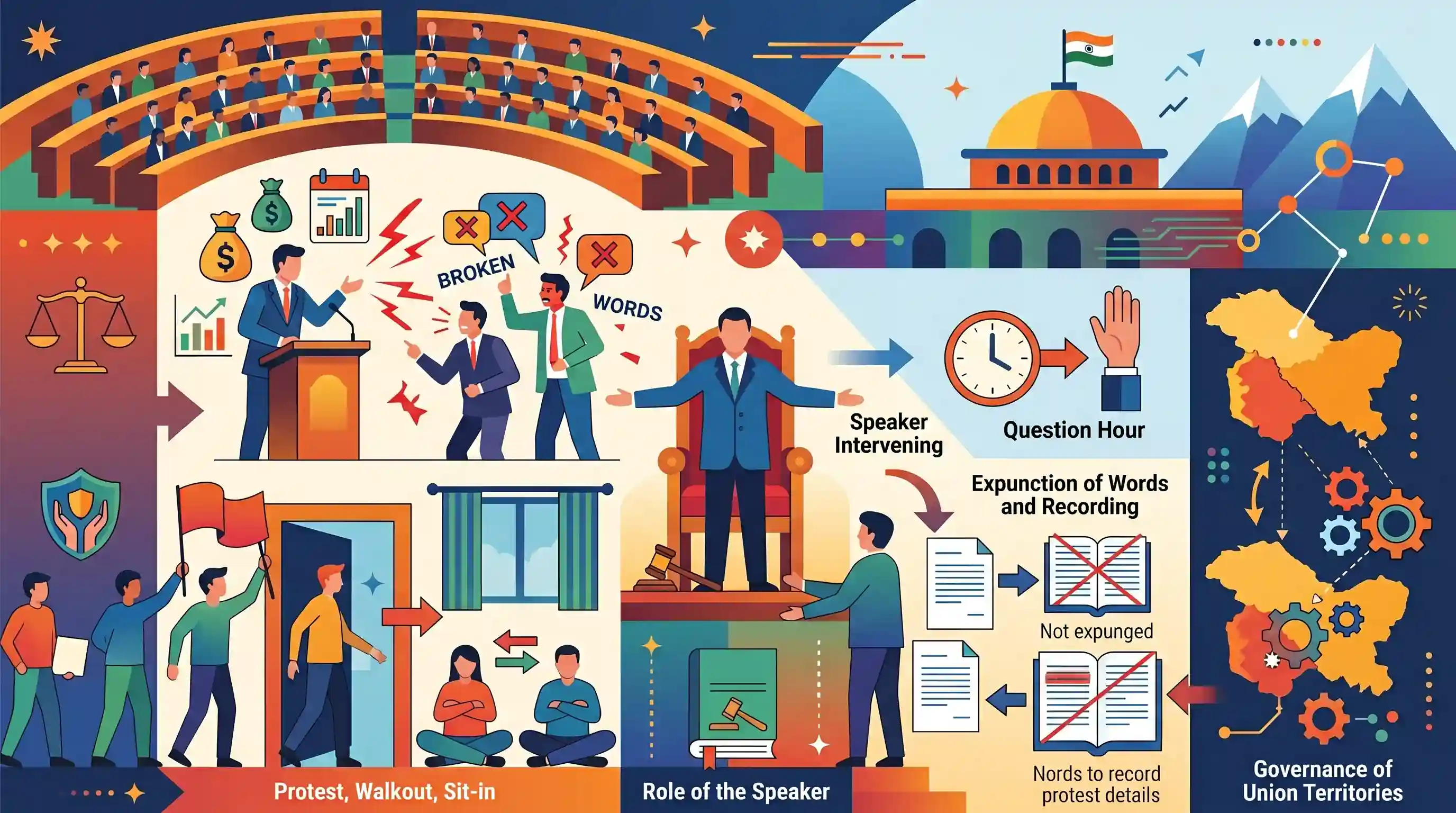
The Jammu and Kashmir Legislative Assembly faced disruptions as BJP members demanded an apology from Chief Minister Omar Abdullah for his alleged 'unparliamentary remarks' made during a Budget discussion. The protest led to a walkout and a sit-in. Speaker Abdul Rahim Rather intervened, urging the continuation of the Question Hour and directing that the protest not be recorded in the official proceedings. A proposal by the Deputy Chief Minister to formally expunge any unparliamentary words used by members was rejected by the opposition. The incident highlights procedural aspects of state legislatures, such as the expunction of words and the regulatory powers of the Speaker.
Key Points
- The Jammu and Kashmir Legislative Assembly witnessed pandemonium as BJP legislators staged a walkout and sit-in, demanding an apology from Chief Minister Omar Abdullah over alleged 'unparliamentary remarks'.
- Speaker Abdul Rahim Rather tried to pacify the legislators to allow the Question Hour to proceed and later instructed that the BJP protest not be recorded in the Assembly's proceedings.
- Deputy Chief Minister Surinder Choudhary proposed that the chair examine all unparliamentary words used by members of both sides and expunge them, a suggestion rejected by the Leader of the Opposition.
Important Terms
Jammu and Kashmir Legislative Assembly

The unicameral legislature for the UT of J&K, established by the 2019 Reorganisation Act and governed by Article 239A of the Constitution.
UPSC context
GS Paper 2: Federalism and UT governance; tests knowledge of the J&K Reorganisation Act and special administrative provisions.
Speaker (Legislative Assembly)
The presiding officer of the Assembly, elected under Article 178, who maintains order, interprets procedural rules, and regulates house conduct.
UPSC context
GS Paper 2: Legislature; focuses on the Speaker's discretionary powers and role in ensuring house decorum.
Expunction of Remarks
The procedural removal of defamatory, indecent, or unparliamentary words from the official record by the order of the presiding officer.
UPSC context
GS Paper 2: Parliamentary proceedings; relates to the Speaker’s authority to maintain the dignity of the House.
Parliamentary Privileges (Article 194)
Special rights and immunities under Article 194 ensuring freedom of speech and protection from judicial scrutiny for state legislators' actions within the House.
UPSC context
GS Paper 2: Indian Constitution; tests understanding of legislative independence and Article 194 vs Article 105.
Question Hour
The first hour of a sitting dedicated to members questioning ministers to ensure executive accountability and elicit information on public issues.
UPSC context
GS Paper 2: Accountability and oversight; a fundamental tool for legislative control over the executive.
Unparliamentary Language
Words or phrases deemed offensive or undignified by the Secretariat; their usage can lead to expunction or disciplinary demands by the Chair.
UPSC context
GS Paper 2: Conduct of Business; relates to the rules of etiquette and the Speaker's regulatory powers.
Prelims Trap
"The media has absolute constitutional protection to publish any statement made by MLAs on the floor of the House."
False. Publishing words explicitly expunged by the Speaker constitutes a breach of parliamentary privilege, overriding general press freedoms for those specific words.
Static Concepts Connected
How does the expunction of unparliamentary words work in Indian legislatures?
- Speaker\'s Discretion: The Speaker/Chairman has absolute discretionary power under the Rules of Procedure to order the expunction of words deemed defamatory, indecent, or unparliamentary.
- Legal Erasure: Once expunged, remarks are marked with asterisks and legally cease to exist in the official legislative records.
- Breach of Privilege: Publishing or broadcasting expunged portions of legislative proceedings constitutes a punishable breach of parliamentary privilege.
What are the core Parliamentary Privileges for State Legislatures (Article 194)?
- Freedom of Speech: Members have absolute immunity from court proceedings for anything said or any vote given in the House or its committees.
- Subject to Rules: This freedom is not absolute in general terms; it is regulated by the Rules of Procedure and standing orders of the specific legislature.
- Publication Immunity: Immunity extends to the publication by or under the authority of a House of any report, paper, votes, or proceedings.
Cross-Topic Patterns
UT Legislature Asymmetry: J&K vs Delhi
J&K\'s legislature lacks power over \'Police\' and \'Public Order\', mirroring Delhi. This structural asymmetry among Union Territories (Delhi, J&K, Puducherry) is a frequent UPSC comparative theme.
Speaker\'s Discretion and Democratic Accountability
The Speaker\'s absolute power to expunge remarks or direct protests off-record ties into broader mains themes regarding the neutrality of presiding officers and the shrinking space for opposition in legislatures.

Expect a statement-based question comparing the legislative limits of J&K with Delhi, paired with the Speaker's rules on expunging remarks.
Linked PYQs · 2
Linked PYQs · 2
- 2025MainsGS2
Discuss the nature of Jammu and Kashmir Legislative Assembly after the Jammu and Kashmir Reorganization Act, 2019. Briefly describe the powers and functions of the Assembly of the Union Territory of Jammu and Kashmir.
- 2019PrelimsGS1
With reference to the Legislative Assembly of a State in India, consider the following statements : 1. The Governor makes a customary address to Members of the House at the commencement of the first session of the year. 2. When a State Legislature does not have a rule on a particular matter, it follows the Lok Sabha rule on that matter. Which of the statements given above is/are correct?
