Human Wildlife Conflict Mitigation Trends in Jammu and Kashmir
Source:Indian Express ↗
Why It Matters
Human-wildlife conflict is a recurring theme in UPSC GS3 (Environment & Biodiversity). J&K's success in reducing these conflicts provides an excellent, data-backed case study for Mains answers on conservation efforts, habitat fragmentation, and effective state-level mitigation strategies.
Summary
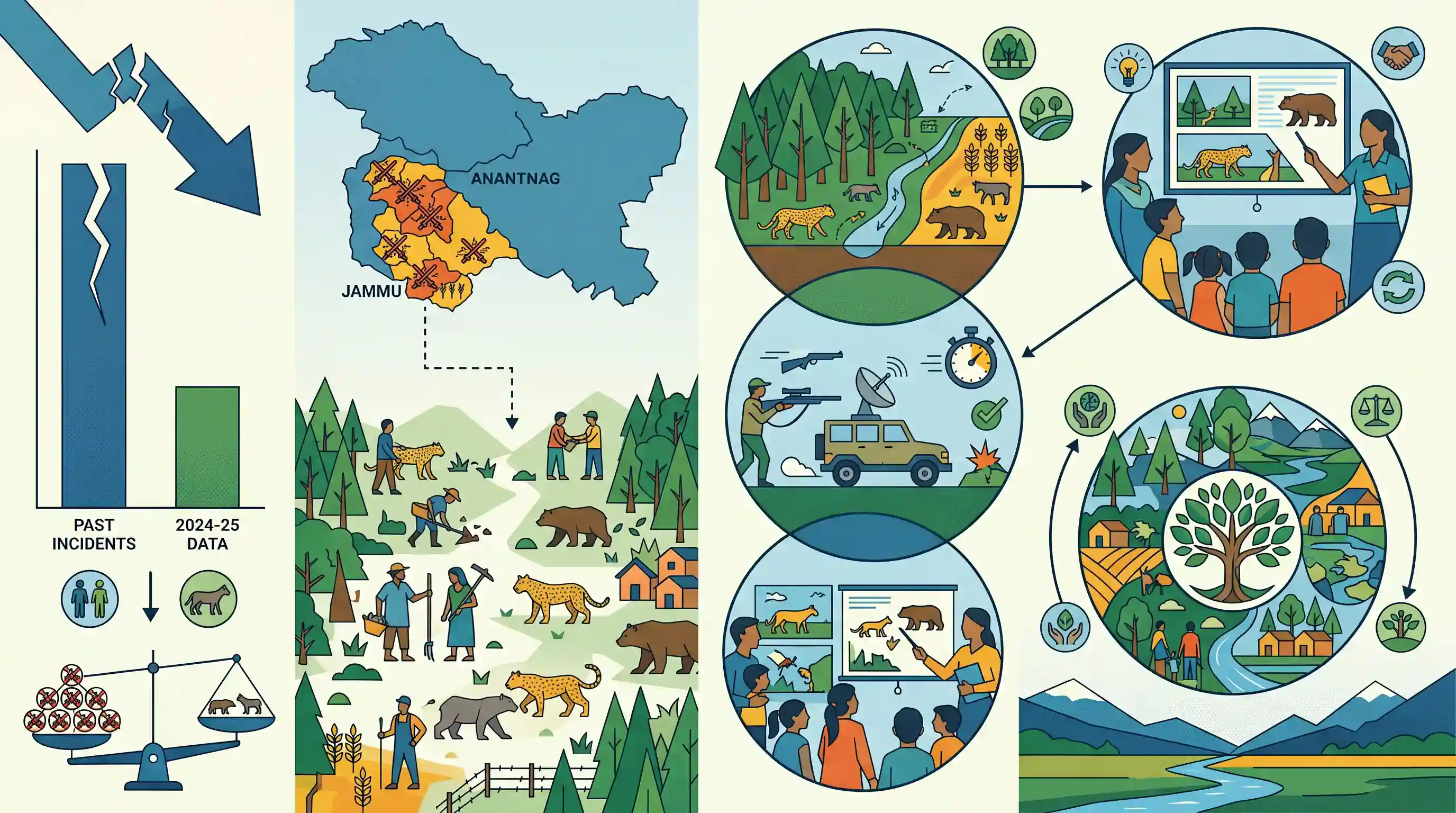
The article highlights the recent trends in human-wildlife conflict (HWC) across Jammu and Kashmir. Despite recording over 15,661 incidents in a two-year span—disproportionately impacting the Anantnag and Jammu districts—the 2024-25 data reveals a noticeable decline in conflicts. This drop is attributed to effective state-led mitigation measures that have reduced both human and animal casualties. The situation underscores the importance of proactive habitat management, rapid response, and community awareness in addressing the growing challenge of man-animal conflict in India's sensitive ecological zones.
Key Points
- Jammu and Kashmir recorded 15,661 incidents of human-wildlife conflict over the past two years, with Anantnag and Jammu regions being the most severely affected.
- Recent data from 2024-25 shows a significant drop in these conflicts, signaling the success of new mitigation strategies.
- Effective interventions typically involve tracking animal movement, deploying rapid response teams, improving fencing, and increasing community awareness.
- The data serves as a critical case study on balancing human security and wildlife conservation in ecologically fragile regions.
Important Terms
Human-Wildlife Conflict (HWC)

Negative interactions between humans and wild animals resulting in loss of life, crops, or property. It arises from habitat fragmentation and human encroachment into wildlife territories.
UPSC context
GS Paper III (Environment); crucial for understanding biodiversity conservation challenges and disaster management frameworks (e.g., Kerala's state-specific disaster declaration).
Wildlife Protection Act, 1972
India's primary legal framework (amended in 2022) for protecting plant and animal species. It establishes Protected Areas and classifies species into Schedules based on the level of protection required.
UPSC context
GS Paper II (Governance) & III (Environment); essential for legal questions on conservation, hunting prohibitions, and the powers of Chief Wildlife Wardens.
Ecologically Sensitive Zones (ESZ)
Notified areas (often 10km) around National Parks and Sanctuaries that act as 'shock absorbers.' They regulate human activity to minimize ecological impact and human-animal encounters.
UPSC context
GS Paper III (Environment); tests knowledge of buffer zones, the Environment (Protection) Act, 1986, and sustainable development.
Habitat Management
Scientific and ecological interventions—such as restoring corridors, creating waterholes, or removing invasive species—to ensure wildlife remains within forest boundaries and has sufficient resources.
UPSC context
GS Paper III (Biodiversity); relevant for mains questions on long-term solutions to man-animal conflict beyond immediate rescue.
Mitigation Measures
Strategies like early warning systems (AI/GPS), solar fencing, and Rapid Response Teams (RRTs) used to prevent or quickly resolve dangerous human-wildlife encounters.
UPSC context
GS Paper III; focuses on technological and community-led interventions to safeguard both livelihoods and wildlife.
Ex-gratia Payment / Compensation
Financial relief provided by the government to victims of wildlife attacks for death, injury, or loss of livestock and crops, aiming to reduce retaliatory killings.
UPSC context
GS Paper II (Social Justice/Governance); relates to state welfare responsibility and administrative response to environmental crises.
Prelims Trap
Human-Wildlife Conflict is a notified National Disaster under the Disaster Management Act, 2005.
HWC is not a notified National Disaster. Certain states (e.g., Kerala) have classified it as a 'state-specific disaster' to mobilize local relief funds.
Static Concepts Connected
What is the statutory basis and purpose of Eco-Sensitive Zones?
- Statutory backing: Notified under the Environment (Protection) Act, 1986—not the Wildlife Protection Act, 1972.
- Primary purpose: They act as 'shock absorbers' or transition zones around Protected Areas to regulate development and mitigate human-wildlife conflict.
- Zoning rules: Prohibits hazardous industries and commercial mining, but allows regulated activities like organic farming and local agriculture.
How is wild animal ownership and conflict compensation managed in India?
- Ownership: Under the Wild Life (Protection) Act, 1972, wild animals are considered the property of the government.
- Compensation: Managing human-wildlife conflict and paying financial compensation for crop, property, or life loss is implemented primarily by State Governments.
Cross-Topic Patterns
HWC classified as Disaster Management
States like Kerala now classify human-wildlife conflict as a 'state-specific disaster' under the DMA 2005, linking biodiversity conservation challenges directly with disaster relief funding mechanisms.
Tech interventions and landscape conservation
Tech interventions like M-STRIPES represent the 3rd National Wildlife Action Plan's shift toward a 'landscape approach', tracking animals proactively beyond the traditional boundaries of protected areas.

Expect a 2026 question testing the legal overlap between the Wildlife Protection Act (ownership) and the Disaster Management Act (HWC).
Linked PYQs · 3
Linked PYQs · 3
- 2022PrelimsGS1
With reference to Indian laws about wildlife protection, consider the following statements : 1. Wild animals are the sole property of the government. 2. When a wild animal is declared protected, such animal is entitled for equal protection whether it is found in protected areas or outside. 3. Apprehension of a protected wild animal becoming a danger to human life is sufficient ground for its capture or killing. Which of the statements given above is/are correct?
- 2014PrelimsGS1
The most important strategy for the conservation of biodiversity together with traditional human life is the establishment of
- 2020MainsGS3
Suggest measures to improve water storage and irrigation system to make its judicious use under depleting scenario.
