India Rejects Pakistan Propaganda at UNHRC Session
Source:Indian Express ↗
Why It Matters
This event highlights India's evolving diplomatic posture (offensive realism) at multilateral forums where it effectively uses economic indices and democratic success (elections, development budgets) to counter state-sponsored propaganda. It provides strong talking points for GS2 (Bilateral/Multilateral relations) and GS3 (Winning hearts and minds in J&K).
Summary
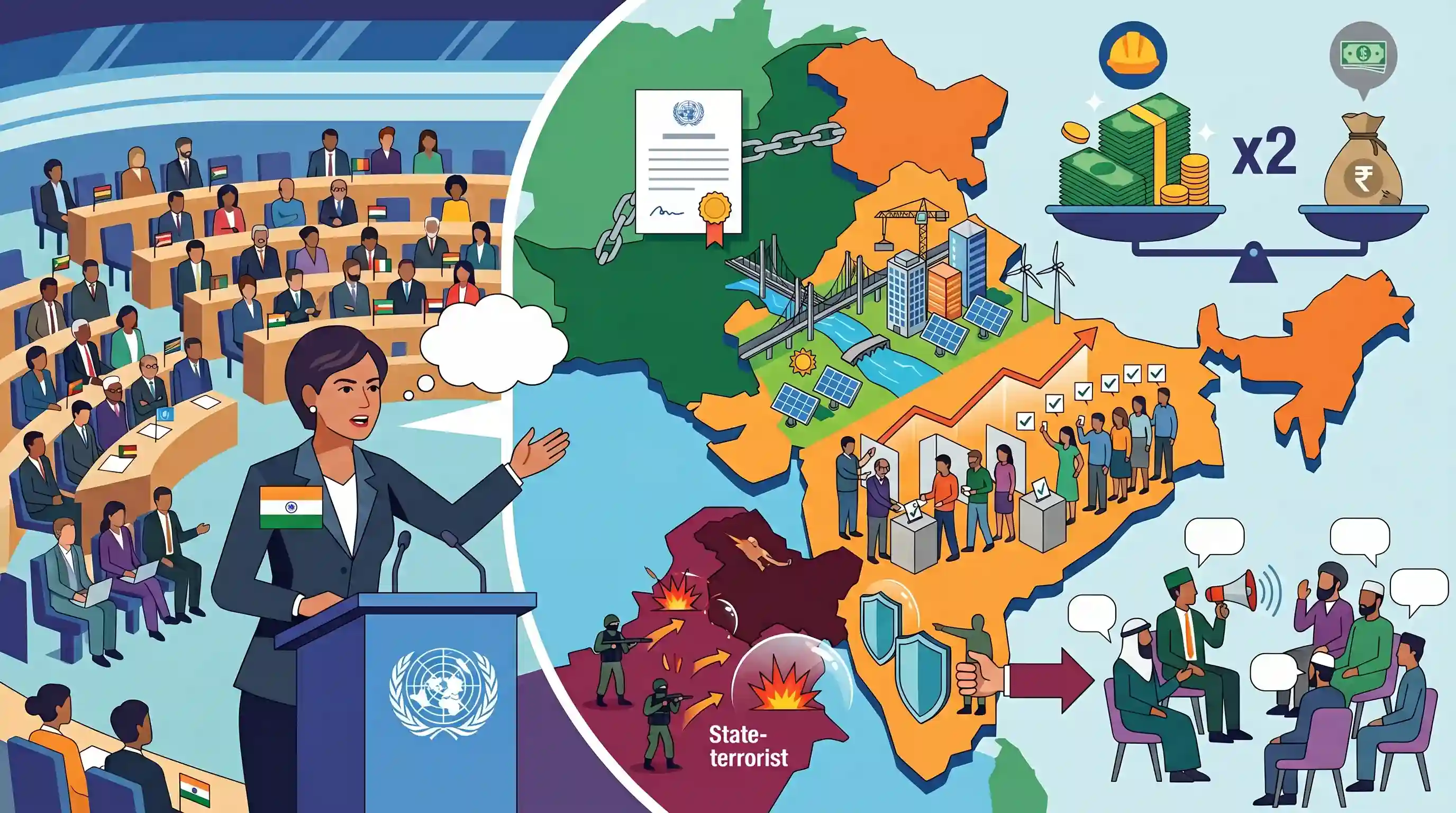
At the 61st UNHRC session in Geneva, India delivered a sharp rebuttal to Pakistan's propaganda regarding Jammu and Kashmir, characterizing it as a 'la-la land' narrative. Emphasizing rapid infrastructure growth, Indian diplomat Anupama Singh highlighted that J&K's development budget alone is double the IMF bailout Pakistan recently requested. India firmly reiterated that J&K is an integral part of the nation by virtue of the Indian Independence Act of 1947. By citing record voter turnout in recent elections, India demonstrated the region's commitment to democracy and its rejection of Pakistan's state-sponsored terrorism. Furthermore, India urged Pakistan to vacate occupied territories (PoK) and criticized the Organisation of Islamic Cooperation (OIC) for serving as an uncritical 'echo chamber' for Pakistani rhetoric.
Key Points
- India exercised its Right of Reply at the 61st session of the UNHRC in Geneva to strongly rebut Pakistan's allegations regarding Jammu and Kashmir.
- India dismissed Pakistan's claims—such as calling the Chenab rail bridge a 'photoshop invention'—as a 'la-la land' narrative disconnected from reality.
- Highlighting economic contrasts, India noted that J&K's development budget is double the size of the $7-billion IMF bailout Pakistan recently sought.
- India reaffirmed that the erstwhile princely state of J&K legally and irrevocably acceded to India under the framework of the Indian Independence Act of 1947.
- The record voter turnout in recent J&K Assembly elections was presented as clear evidence of the local population embracing democracy and rejecting cross-border terrorism.
- India demanded that Pakistan cease its state-sponsored terrorism, halt human rights violations in PoK, and vacate Indian territories under its illegal occupation.
- The Organisation of Islamic Cooperation (OIC) was also rebuked by India for acting as an 'echo chamber' that amplifies Pakistan's factually incorrect rhetoric.
Important Terms
Indian Independence Act of 1947

The 1947 British Parliament Act that created independent India and Pakistan, ending British suzerainty over princely states and allowing them to join either dominion.
UPSC context
GS Paper 1 (Modern History); defines the legal and territorial framework of the Indian Union's birth.
Instrument of Accession
A legal document used by rulers of princely states to join the Union of India. Maharaja Hari Singh signed it for J&K in October 1947.
UPSC context
GS Paper 2 (Polity); the foundational legal basis for Jammu and Kashmir's integration into India.
United Nations Human Rights Council (UNHRC)
A United Nations body of 47 states tasked with promoting and protecting human rights globally and addressing situations of human rights violations.
UPSC context
GS Paper 2 (International Institutions); crucial for understanding India's multilateral diplomacy and human rights framework.
Organisation of Islamic Cooperation (OIC)
The second-largest intergovernmental organization after the UN, comprising 57 member states, aiming to represent the collective voice of the Muslim world.
UPSC context
GS Paper 2 (International Groupings); relevant for India's foreign policy and managing diplomatic relations with Islamic nations.
International Monetary Fund (IMF)
An international financial institution that monitors global economic stability and provides short-term financial assistance (bailouts) to countries facing balance-of-payments crises.
UPSC context
GS Paper 3 (Economy); important for global financial governance and its impact on regional economic stability.
Prelims Trap
"India holds observer status in the Organisation of Islamic Cooperation (OIC)."
India is neither a member nor an observer in the OIC, despite its large Muslim population. Pakistan has historically leveraged its position to block Indian participation.
Static Concepts Connected
How did the Indian Independence Act of 1947 address the integration of Princely States?
- Lapse of Paramountcy: British suzerainty and all treaty obligations over the 565 princely states lapsed completely on August 15, 1947.
- Three Options: States were given the legal choice to accede to the Dominion of India, accede to Pakistan, or remain fully independent.
- Instrument of Accession: Rulers executed this legal document to join a dominion, typically surrendering jurisdiction over Defence, External Affairs, and Communications.
What is the membership structure of the UN Human Rights Council (UNHRC)?
- Election & Size: It consists of 47 Member States elected directly and individually by a secret ballot of the UN General Assembly.
- Term Limits: Members serve three-year terms and are not eligible for immediate re-election after serving two consecutive terms.
- Geographic Quotas: Seats are allotted based on equitable geographical distribution (e.g., Africa, Asia-Pacific, Eastern Europe, Latin America).
Cross-Topic Patterns
Border Infra as Internal Security Tool
The Chenab rail bridge is not just an engineering marvel; it acts as a strategic integration tool, bridging the 'psychological gap' and countering separatist narratives in internal security paradigms.
OIC Rhetoric vs. Middle East Bilateral Ties
Despite the OIC's institutional anti-India stance on Kashmir (driven by Pakistan), India's bilateral strategic and economic partnerships with key OIC pillars like the UAE and Saudi Arabia are at an all-time high.

Expect a mixed Prelims question coupling the historical legalities of the Instrument of Accession with UNHRC or OIC membership rules.
Linked PYQs · 4
Linked PYQs · 4
- 2023MainsGS3
Winning of 'Hearts and Minds' in terrorism-affected areas is an essential step in restoring the trust of the population. Discuss the measures adopted by the Government in this respect as part of the conflict resolution in Jammu and Kashmir.
- 2020MainsGS3
Analyze internal security threats and transborder crimes along Myanmar, Bangladesh and Pakistan borders including Line of Control (LoC). Also discuss the role played by various security forces in this regard.
- 2021MainsGS3
Analyse the multidimensional challenges posed by external state and non-state actors, to the internal security of India. Also discuss measures required to be taken to combat these threats.
- 2025MainsGS1
Trace India's consolidation process during early phase of independence in terms of polity, economy, education and international relations.
