Interstate Terror Module Busted by Jammu Police
Source:The Hindu ↗
Why It Matters
The article provides a real-world example of how external non-state actors (LeT) utilize local conduits across multiple states to build logistical networks and evade law enforcement. It serves as an excellent case study for Mains GS3 questions on the nexus between organized crime (fake passports/logistics) and terrorism, as well as the challenges in border management and the vital role of inter-agency coordination.
Summary
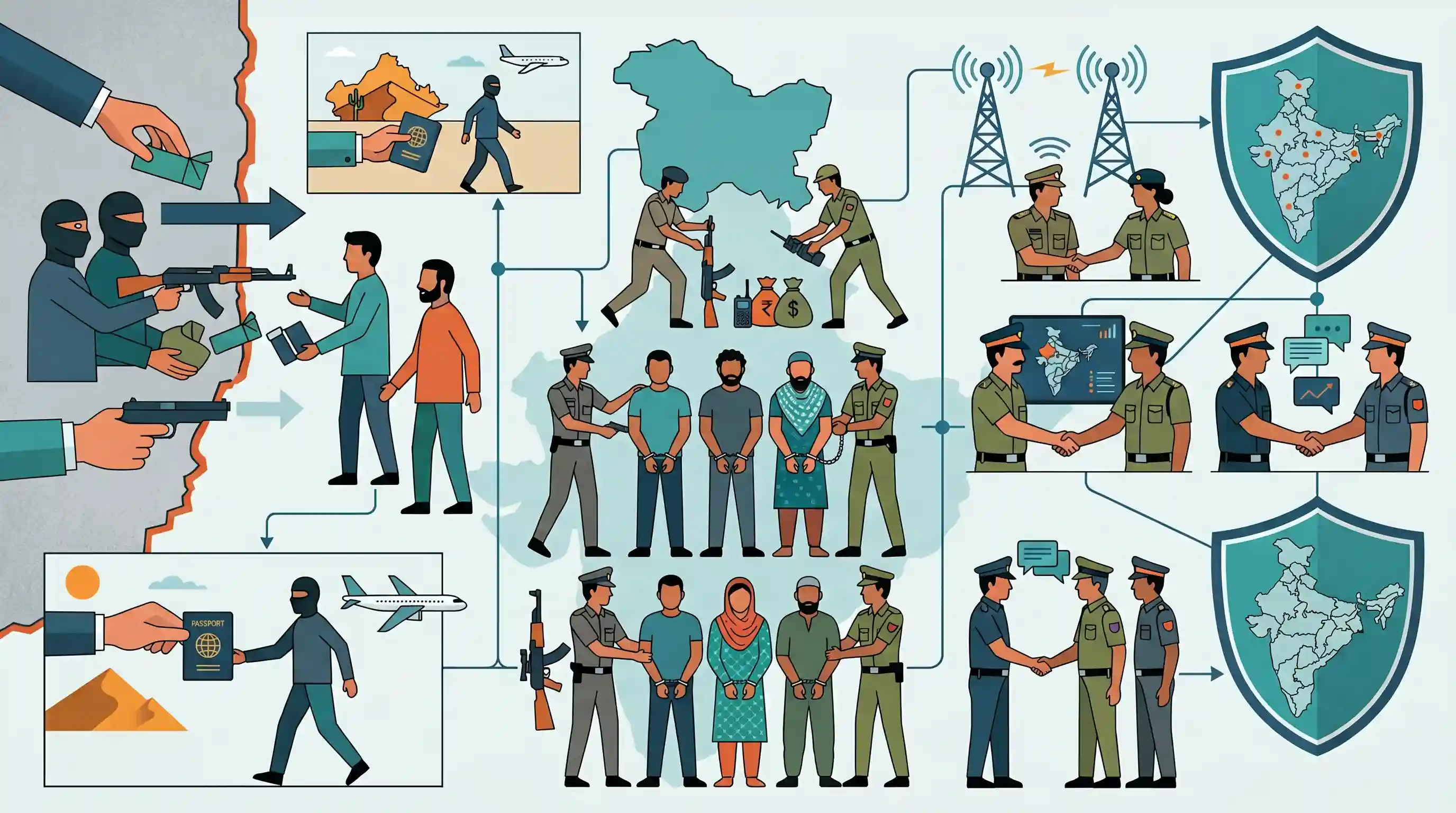
The Jammu and Kashmir Police successfully busted an inter-state Lashkar-e-Taiba (LeT) terror module, resulting in the arrest of five individuals, including two Pakistani nationals. The raids, conducted across Kashmir, Haryana, Punjab, and Rajasthan, exposed a deep-rooted logistical network facilitating cross-border terrorism. Alarmingly, the probe uncovered that a wanted Pakistani terrorist managed to procure a passport through local conduits in Rajasthan and flee the country. This operation highlights the intricate linkages between local elements and external non-state actors, emphasizing the urgent need for enhanced inter-state police coordination and intelligence sharing to safeguard India's internal security.
Key Points
- Jammu and Kashmir Police dismantled a Lashkar-e-Taiba (LeT) inter-state terror module, arresting five individuals, including two Pakistani nationals.
- The terror network spanned multiple states—including Kashmir, Haryana, Punjab, and Rajasthan—providing logistical support, safe havens, and weapons.
- The investigation revealed that a wanted Pakistani terrorist successfully procured a passport using local conduits in Rajasthan, reportedly enabling his escape from India.
- This incident underscores critical vulnerabilities in internal security, emphasizing the dangerous nexus between local criminal facilitators and cross-border terrorists.
- The operation highlights the necessity of seamless inter-state intelligence sharing and police coordination to counter pan-India terror networks.
Important Terms
Lashkar-e-Taiba (LeT)

A major Pakistan-based Islamist militant organization targeting Jammu and Kashmir. Designated globally as a terrorist group, it is responsible for major attacks like 26/11 Mumbai.
UPSC context
GS Paper III (Internal Security); essential for studying cross-border terrorism and threats from external non-state actors.
Non-State Actors
Entities or individuals independent of sovereign state governments that influence security, such as extremist groups or criminal syndicates that challenge a nation's stability.
UPSC context
GS Paper III; directly addressed under 'Role of external state and non-state actors in creating challenges to internal security'.
Border Management
A comprehensive strategy involving infrastructure and surveillance to secure national borders against infiltration, smuggling, and illegal migration while facilitating legitimate movement.
UPSC context
GS Paper III; a key topic focusing on security challenges and their management in diverse border areas.
Organized Crime-Terrorism Nexus
A symbiotic relationship where criminal syndicates provide financial and logistical support (e.g., fake documents, smuggling routes) to terrorist groups for mutual benefit.
UPSC context
GS Paper III; relevant for the syllabus topic 'Linkages of organized crime with terrorism'.
Inter-State Coordination
Collaborative efforts between police forces of different states and central agencies to investigate crimes spanning multiple jurisdictions and share security intelligence.
UPSC context
GS Paper III; crucial for questions on police reforms, federalism in security, and inter-agency synergy.
Intelligence Sharing
The systematic exchange of security-related information among various intelligence and law enforcement agencies to preempt threats and coordinate swift counter-terror responses.
UPSC context
GS Paper III; part of the mandate of various security forces and agencies in preventing internal security threats.
Prelims Trap
Central agencies like NIA require prior consent from state governments to conduct raids on inter-state terror modules.
While Police is a State subject, the NIA Act grants the National Investigation Agency concurrent jurisdiction to investigate scheduled offenses nationwide without state consent.
Static Concepts Connected
How does organized crime act as a force multiplier for terrorism?
- Document Forgery: Syndicates provide fake passports, Aadhaar, and voter IDs, allowing terrorists to cross borders, create sleeper cells, and evade detection.
- Financial Logistics: Hawala networks, drug trafficking, and arms smuggling are routinely leveraged by non-state actors to bypass formal banking and fund terror operations.
- Safe Havens: Local criminal conduits offer safe houses, transport, and localized geographical knowledge to external infiltrators, facilitating pan-India strikes.
What institutional frameworks exist for inter-agency intelligence sharing in India?
- Multi-Agency Centre (MAC): A nodal body under the Intelligence Bureau (IB) designed for daily intelligence coordination among central agencies, armed forces, and state police.
- NATGRID: Provides core security and intelligence agencies with real-time access to centralized databases, covering telecom, banking, and immigration records.
- CCTNS: Links police stations nationwide to digitize and share FIRs and criminal records, essential for tracking inter-state offenders.
Cross-Topic Patterns
Federalism vs. Internal Security policing
Inter-state modules exploit fragmented state jurisdictions (Police is a State subject). This links GS3 security challenges directly to GS2 federalism, highlighting the need for concurrent jurisdiction via agencies like NIA.
Digital Identity and E-Governance vulnerabilities
Terrorists bypassing passport verification highlights gaps in physical vetting processes, demanding tighter E-Governance integration between Passport Seva, local intelligence, and the CCTNS database.

Mains 2026 will likely feature a 15-marker on how local organized criminal networks (document forgery/logistics) sustain external terror.
Linked PYQs · 4
Linked PYQs · 4
- 2021MainsGS3
Analyse the multidimensional challenges posed by external state and non-state actors, to the internal security of India. Also discuss measures required to be taken to combat these threats.
- 2021MainsGS3
Analyse the complexity and intensity of terrorism, its causes, linkages and obnoxious nexus. Also suggest measures required to be taken to eradicate the menace of terrorism.
- 2020MainsGS3
Analyze internal security threats and transborder crimes along Myanmar, Bangladesh and Pakistan borders including Line of Control (LoC). Also discuss the role played by various security forces in this regard.
- 2020MainsGS3
For effective border area management, discuss the steps required to be taken to deny local support to militants and also suggest ways to manage favourable perception among locals.
