Jammu and Kashmir Bill proposes new administrative divisions
Source:Indian Express ↗
Why It Matters
This issue touches upon the themes of state/UT administrative reorganization, decentralization for better governance, and the socio-political impact of regionalism. It is highly relevant for GS-1 (Regionalism), GS-2 (Governance and Administration), and GS-3 (Internal Security in Border Regions).
Summary
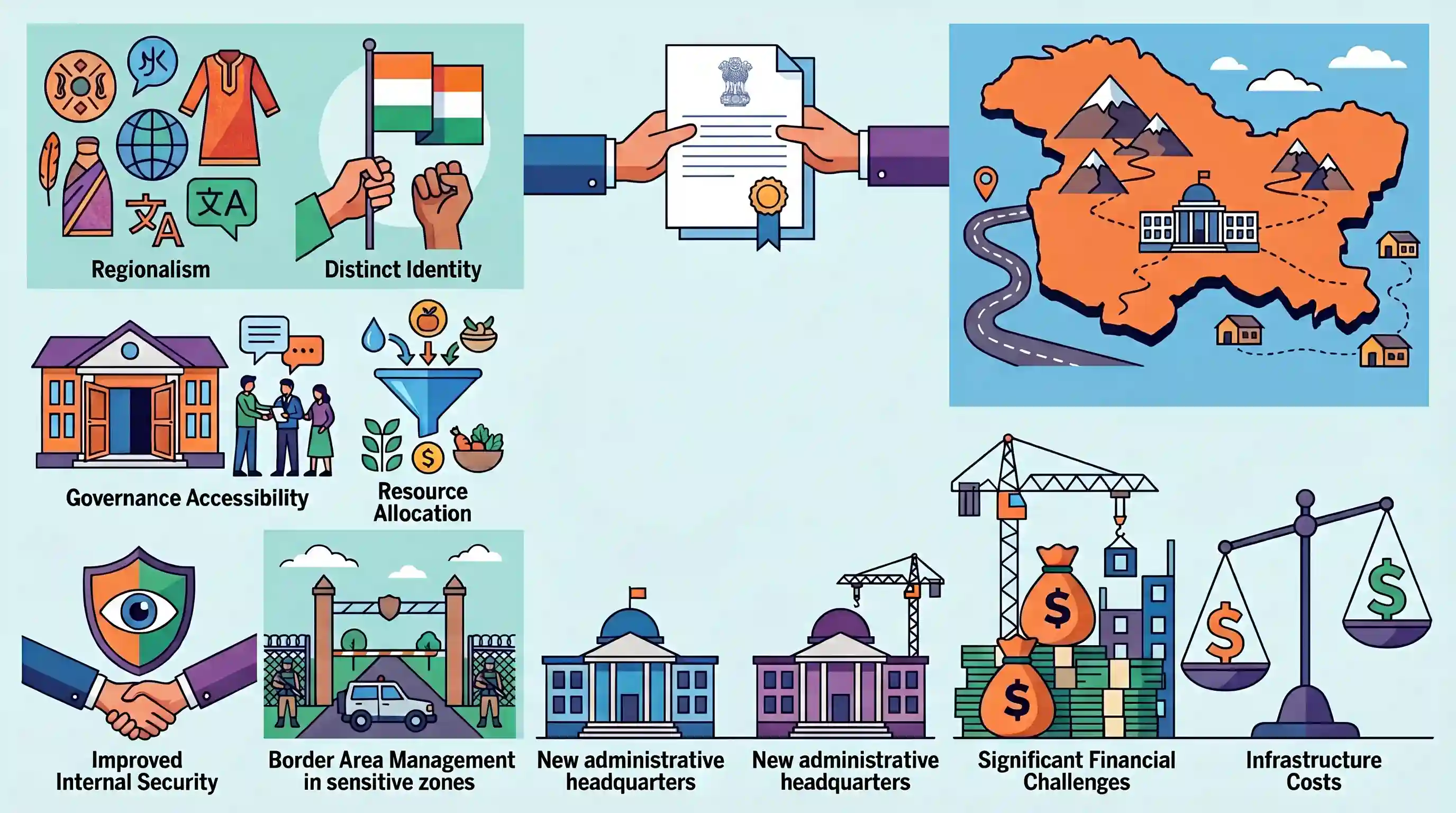
A Bill has been proposed seeking separate administrative divisional status for the Pir Panjal and Chenab Valley regions in Jammu and Kashmir. Currently forming part of the larger Jammu division, these geographically rugged and remote regions have long demanded administrative decentralization to improve governance accessibility and resource allocation. The demand is driven by the region's distinct cultural and linguistic identity, reflecting a strong undercurrent of regionalism. While granting divisional status would bring administration closer to the people and potentially improve internal security dynamics by addressing local grievances in sensitive border areas, it also presents significant financial challenges due to the costs associated with establishing new administrative infrastructure.
Key Points
- Administrative Restructuring: The proposed Bill seeks to carve out the Pir Panjal and Chenab Valley regions from the existing Jammu division and grant them separate divisional status.
- Geographical Rationale: The rugged, mountainous terrain and vast distance from Jammu city result in administrative hurdles, making decentralization essential for accessible public service delivery.
- Regionalism and Identity: The demand is deeply rooted in the distinct linguistic, cultural, and demographic identities of these hilly regions, driving regional political mobilization.
- Financial Implications: Establishing new divisions necessitates setting up separate divisional headquarters, requiring substantial capital for infrastructure and ongoing administrative expenditure.
- Security and Development: Better governance and resource allocation in these border and conflict-sensitive areas can improve local perceptions, aiding border area management and internal security.
Important Terms
Jammu and Kashmir Territorial Administrative Reorganisation Bill, 2026

A legislative proposal (2026) introduced to create separate administrative divisions for Pir Panjal and Chenab Valley and 16 new districts to enhance governance in remote regions.
UPSC context
GS Paper II: Governance and Administrative Decentralisation; tests knowledge of regional reorganisation and administrative efficiency in mountainous terrains.
Pir Panjal Division
A proposed administrative unit in Jammu comprising the twin border districts of Rajouri and Poonch, characterized by rugged terrain and distinct cultural identity.
UPSC context
GS Paper II: Regionalism and Internal Security; relevant for border area management and sub-regional aspirations.
Chenab Valley Division
A mountainous region in Jammu comprising Doda, Kishtwar, and Ramban districts, currently part of the Jammu division but seeking separate administrative status.
UPSC context
GS Paper I: Regionalism; GS Paper II: Federalism and sub-regional administrative demands in Jammu and Kashmir.
Private Member’s Bill
A bill introduced in the legislature by a member who is not part of the Council of Ministers; its passage is rare.
UPSC context
GS Paper II: Parliament and State Legislatures; tests knowledge of legislative procedures and the role of the opposition.
Jammu and Kashmir Reorganisation Act, 2019
Parliamentary legislation that bifurcated the state of Jammu and Kashmir into two Union Territories—J&K (with legislature) and Ladakh (without legislature).
UPSC context
GS Paper II: Indian Constitution; landmark act affecting the federal structure and special status of J&K.
Section 36(b) of J&K Reorganisation Act
A provision requiring the Lieutenant Governor’s recommendation for any Bill or amendment in the J&K Assembly that involves financial obligations.
UPSC context
GS Paper II: Executive vs Legislature powers in Union Territories; critical for understanding fiscal federalism in UTs.
Administrative Decentralisation
The process of redistributing administrative functions and powers away from a central authority to regional or local levels.
UPSC context
GS Paper II: Issues and challenges pertaining to the federal structure and devolution of powers.
Prelims Trap
"The Pir Panjal range forms a prominent part of the Greater Himalayas."
Pir Panjal is actually the longest and most significant range of the Lesser (Middle) Himalayas, not the Greater Himalayas. It geographically divides the Kashmir Valley from the Jammu region.
Static Concepts Connected
What is the geographical significance of the Pir Panjal Range?
- Lesser Himalayas: It is the largest and longest range of the Lesser (Middle) Himalayas, generally extending from the Jhelum river to the upper Beas.
- Natural Barrier: It acts as a physical barrier separating the Kashmir Valley to the north from the Jammu plains to the south.
- Key Passes: Important passes cutting through this range include Banihal Pass (connecting Jammu to Srinagar) and Pir Panjal Pass.
How are new administrative districts and divisions created in India?
- State Executive Power: State governments can create, alter, or abolish districts or divisions primarily via executive orders or by passing a law in the state assembly.
- No Central Role: The Central government has no direct role in creating districts, though the Union Home Ministry must clear renaming proposals.
- J&K UT Exception: Under the J&K Reorganisation Act, 2019, any legislative Bill with financial implications (like establishing new divisional infrastructure) requires the prior approval of the L-G.
Cross-Topic Patterns
Border Governance vs. Insurgency
Administrative decentralization in Rajouri-Poonch directly addresses GS3 (Internal Security) themes by bridging governance deficits to deny local support to trans-border militancy.
L-G powers in Union Territories
Creating new administrative divisions involves significant financial expenditure, triggering the J&K Reorganisation Act's mandate for prior L-G approval, linking to GS2 UT federalism debates.

Expect a Prelims pairing of Pir Panjal geography (Lesser Himalayas/passes) with J&K Reorganisation Act provisions on L-G financial powers.
Linked PYQs · 4
Linked PYQs · 4
- 2013MainsGS1
Growing feeling of regionalism is an important factor in generation of demand for a separate State. Discuss.
- 2016MainsGS1
What is the basis of regionalism? Is it that unequal distribution of benefits of development on regional basis eventually promotes regionalism? Substantiate your answer.
- 2020MainsGS3
For effective border area management, discuss the steps required to be taken to deny local support to militants and also suggest ways to manage favourable perception among locals.
- 2024MainsGS3
India has a long and troubled border with China and Pakistan fraught with contentious issues. Examine the conflicting issues and security challenges along the border. Also give out the development being undertaken in these areas under the Border Area Development Programme (BADP) and Border Infrastructure and Management (BIM) Scheme.
