Kupwara Infiltration Attempt and Border Security Operations
Source:The Hindu ↗
Why It Matters
Infiltration bids along the LoC present a persistent internal security threat. Examining such incidents is essential for understanding the complexities of border management, counter-terrorism operations, and the role of intelligence and security forces in volatile border regions.
Summary
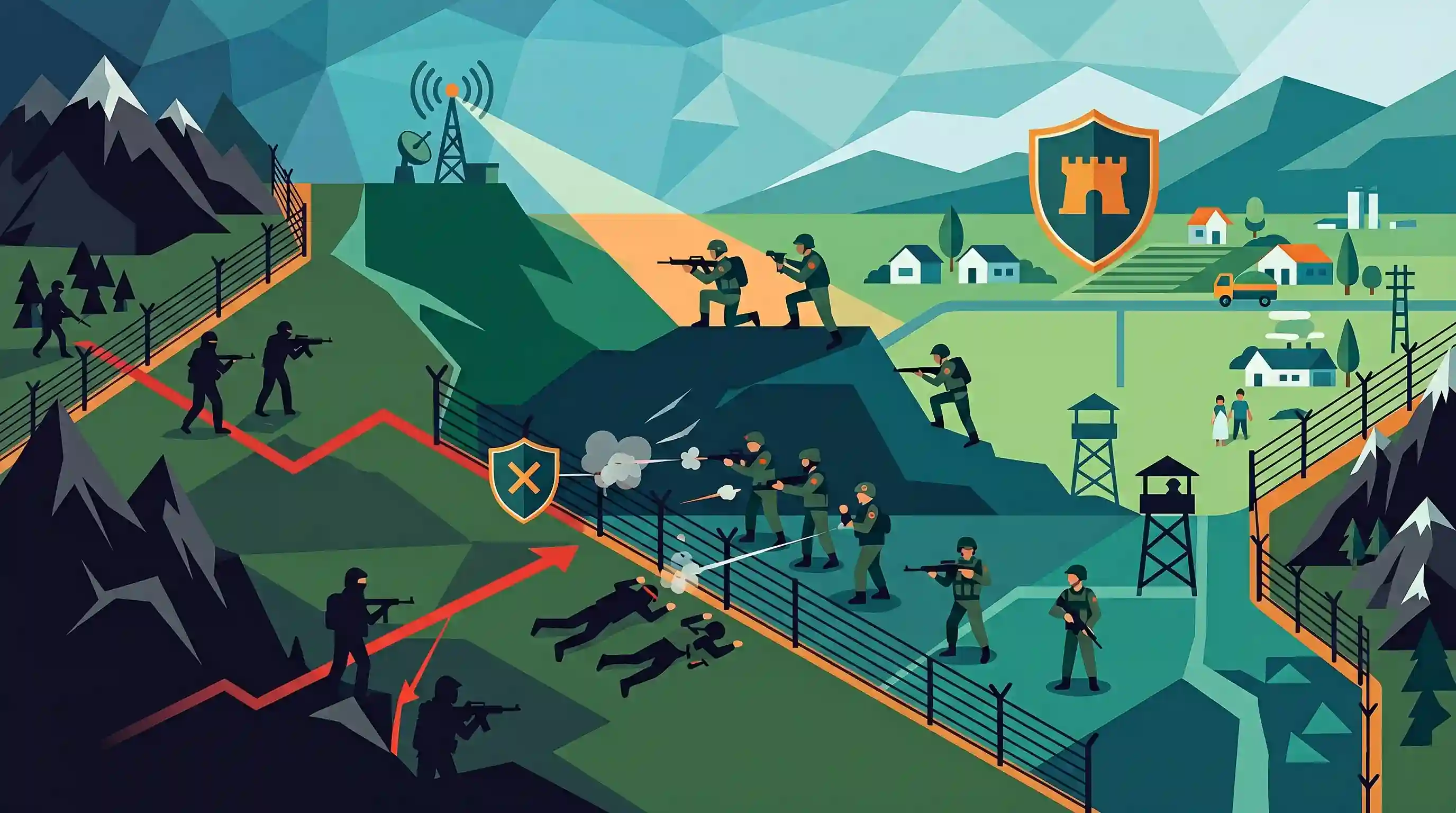
Security forces successfully foiled an infiltration bid along the Line of Control in the Keran sector of J&K's Kupwara district, killing two unidentified terrorists. The joint operation, led by the Army's Chinar Corps based on specific intelligence, underscores ongoing cross-border terrorism threats and the active role of security grids in maintaining internal security and border management in the region.
Key Points
- Two unidentified terrorists were neutralized in a foiled infiltration attempt along the Line of Control (LoC) in Kupwara district of Jammu & Kashmir.
- The joint anti-infiltration operation was launched in the Keran sector following specific intelligence inputs.
- The Srinagar-based Chinar Corps executed the operation, exchanging fire with the terrorists after challenging suspicious activity.
- The successful operation highlights the continuous threat of cross-border infiltration and the vigilance of security forces along the border.
Important Terms
Chinar Corps (XV Corps)

The XV Corps of the Indian Army, headquartered in Srinagar, responsible for military operations, counter-insurgency, and maintaining the Line of Control (LoC) across the Kashmir Valley.
UPSC context
GS Paper III: Internal Security. Tests knowledge of specialized military formations and their roles in conflict zones like J&K.
Line of Control (LoC)
The de facto military boundary between India and Pakistan in Jammu and Kashmir, established under the 1972 Simla Agreement; it is not an internationally recognized border.
UPSC context
GS Paper III: Border Management. Key for understanding territorial disputes, ceasefire violations, and counter-infiltration strategies.
Cross-border Terrorism
Terrorism where movements, personnel, or support originate from one country to carry out attacks in another, often as a 'proxy war' strategy to destabilize a region.
UPSC context
GS Paper III: Internal Security. Vital for discussing state-sponsored militancy and challenges from non-state actors.
Keran Sector
A strategic sub-sector in J&K's Kupwara district along the LoC, historically sensitive as a major infiltration route for militants due to its dense forests and proximity to PoK.
UPSC context
GS Paper III: Internal Security. Exemplifies specific geographical challenges in counter-infiltration and border security operations.
Indian Army
The land-based branch of the Indian Armed Forces, primarily tasked with territorial integrity, border defense, and assisting civil authorities during internal security crises or disasters.
UPSC context
GS Paper III: Role of Security Forces. Fundamental to understanding India's national defense architecture and internal security mandate.
Border Management
The systematic effort to secure a nation's borders against illegal activities like infiltration, smuggling, and trans-border crimes while facilitating legitimate trade and travel.
UPSC context
GS Paper III: Internal Security. Core topic regarding infrastructure, technological solutions, and coordination between different security agencies.
Prelims Trap
"The Border Security Force holds primary and independent command over the Line of Control (LoC)."
The Indian Army has primary operational command over the LoC. BSF independently guards the International Boundary but operates under Army control at the LoC.
Static Concepts Connected
What constitutes the multi-tier security grid along the Line of Control (LoC)?
- Zero Line: The Indian Army maintains primary deployment directly on the border for counter-infiltration.
- Middle Tier: BSF operates under Army control, heavily utilizing the Anti-Infiltration Obstacle System (AIOS) to plug gaps.
- Hinterland: J&K Police, intelligence agencies, and Village Defence Committees handle internal counter-insurgency and local intelligence gathering.
How does seasonal geography impact cross-border infiltration dynamics in J&K?
- Pre-winter surge: Infiltration attempts traditionally spike before heavy winter snowfall blocks high-altitude passes in the Pir Panjal ranges.
- Riverine vulnerabilities: Water bodies like the Kishanganga river create natural, unfenced gaps that infiltrators frequently exploit.
- Topographic cover: Rugged mountainous terrain and dense forests provide natural concealment, complicating purely technology-based surveillance.
Cross-Topic Patterns
Smart Borders + Mountain Geography
GS3 regularly tests border management. Technological fixes like AIOS or CIBMS must be analyzed against the physical geography of J&K's rugged passes and riverine gaps.

Expect a GS3 mains question evaluating traditional troop deployments versus smart border tech (AIOS/CIBMS) in rugged terrains like J&K.
Linked PYQs · 2
Linked PYQs · 2
- 2020MainsGS3
Analyze internal security threats and transborder crimes along Myanmar, Bangladesh and Pakistan borders including Line of Control (LoC). Also discuss the role played by various security forces in this regard.
- 2023MainsGS3
Winning of 'Hearts and Minds' in terrorism-affected areas is an essential step in restoring the trust of the population. Discuss the measures adopted by the Government in this respect as part of the conflict resolution in Jammu and Kashmir.
