Justice Navlekar Committee Review of Jammu and Kashmir Demography
Source:Indian Express ↗
हे का महत्त्वाचे आहे
Demographic changes in strategically sensitive border areas like Jammu & Kashmir present profound national security and political challenges. Understanding the mandate of the Justice Navlekar Committee and the complexities surrounding the identification, documentation (like PRCs and ration cards), and management of undocumented immigrants is highly relevant for GS Paper 3 (Internal Security) and GS Paper 2 (Governance & Citizenship).
सारांश
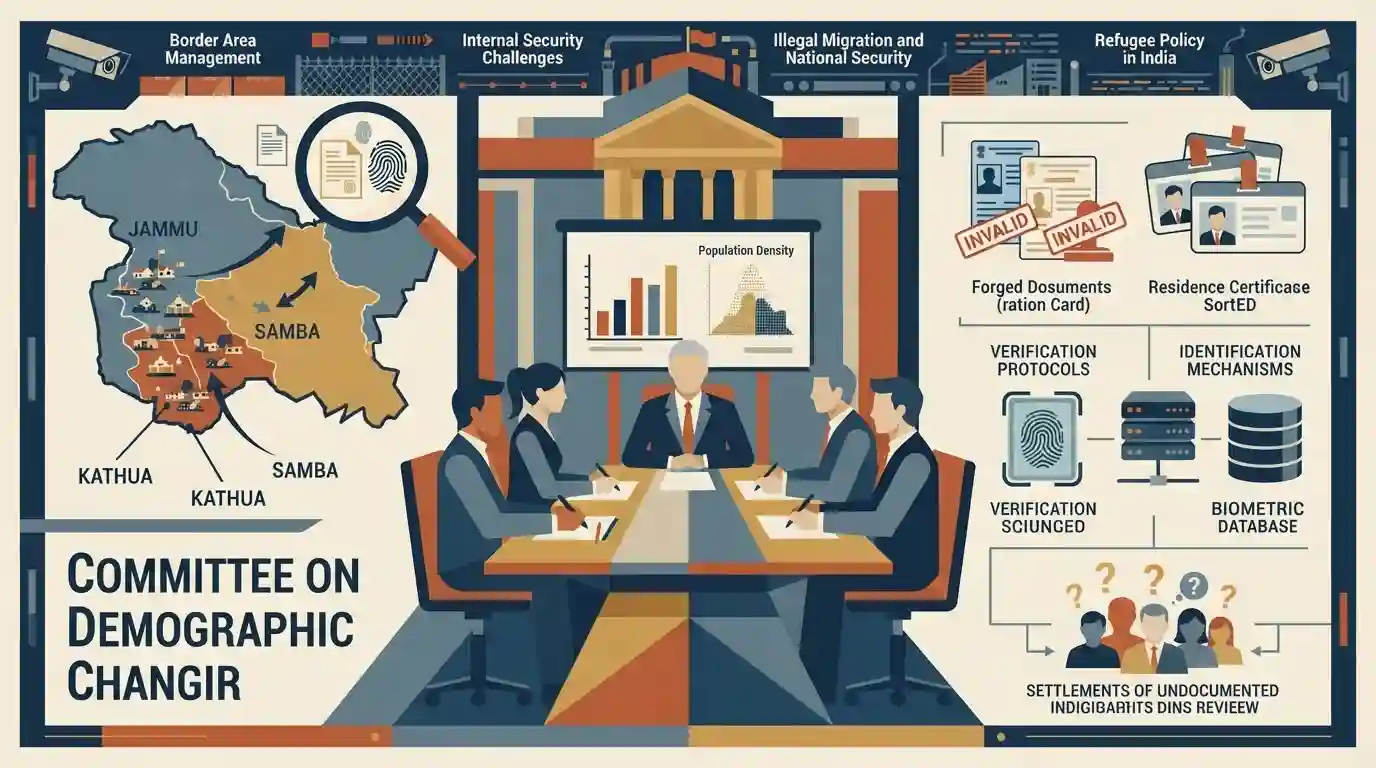
A four-member central Committee on Demographic Change, led by retired Justice Prakash Prabhakar Navlekar, visited Jammu and Kashmir in August 2026. Formed as part of a high-powered demography mission announced by PM Narendra Modi to curb 'illegal infiltration', the committee is evaluating claims of unnatural demographic shifts and security vulnerabilities. It focuses heavily on undocumented Rohingya and Bangladeshi settlements in Jammu, Samba, and Kathua districts. The panel is reviewing verification protocols, addressing the issue of illegal settlers obtaining domestic documents like ration cards and permanent resident certificates, and framing identification mechanisms.
मुख्य मुद्दे
- A four-member central Committee on Demographic Change, headed by retired Justice Prakash Prabhakar Navlekar, visited Jammu and Kashmir (J&K) to evaluate claims of unnatural demographic shifts and security implications.
- The committee was set up in May 2026, following Prime Minister Narendra Modi's announcement of a 'high-powered demography mission' to tackle 'illegal infiltration' in border regions during his preceding Independence Day address.
- The panel's primary focus is on border areas and localities in the Jammu division (especially Jammu, Samba, and Kathua districts) with reported undocumented Rohingya and Bangladeshi settlements.
- Official estimates suggest there are around 13,700 illegal settlers across these three districts. The police routinely verify UN mission documents of these groups.
- Key administrative and security concerns include undocumented migrants possessing official Indian documents like ration cards and the now-defunct permanent resident certificates (PRCs) issued by revenue officials.
- The committee held discussions with UT Chief Secretary Atal Dulloo, DGP Nalin Prabhat, and other political and local stakeholders to review current verification protocols and construct identification mechanisms.
महत्त्वाच्या संज्ञा
Committee on Demographic Change

A central committee constituted in May 2026 under retired Justice P.P. Naolekar to analyze demographic changes caused by illegal migration and recommend administrative, policy, and legislative solutions.
UPSC context
GS Paper III (Internal Security). Tests understanding of demographic shifts, border management challenges, and state-level policy interventions.
high-powered demography mission
A national initiative announced by PM Modi in 2025 to address security, administrative, and developmental concerns arising from illegal immigration and population shifts in border regions.
UPSC context
GS Paper III (Internal Security). Focuses on border area management, national security challenges posed by infiltration, and policy responses.
Rohingya
A persecuted Muslim ethnic minority from Myanmar's Rakhine state. Under Indian law, they are classified as illegal migrants rather than formal refugees.
UPSC context
GS Paper II (Polity & IR). Tests understanding of human rights, the non-refoulement principle, and India's neighborhood relations.
Refugee Policy in India
An ad-hoc framework governed by the Foreigners Act, 1946, as India lacks a statutory domestic refugee law and is not a 1951 Refugee Convention signatory.
UPSC context
GS Paper II (Polity & Governance). Assesses understanding of constitutional morality, Article 21 rights, and migrant categorization.
पूर्वपरीक्षा सापळा
India legally distinguishes between 'refugees' and 'illegal immigrants' under domestic statutory frameworks for UNHCR-registered individuals.
India is not a party to the 1951 Convention; domestic law (Foreigners Act 1946) classifies all undocumented foreigners as 'illegal migrants' regardless of UNHCR status.
संबंधित स्थिर संकल्पना
What is the primary domestic statutory framework governing foreigners in India?
- Foreigners Act 1946: Empowers the Central Government to regulate the entry, stay, detention, and deportation of all non-citizens.
- Passport Act 1920: Mandates valid travel documents for entering India and penalizes illegal entries or overstays.
- Citizenship Act 1955: Defines 'illegal migrants' and prevents them from acquiring Indian citizenship through naturalization or registration.
Why has India not signed the 1951 Refugee Convention?
- Security concerns: Porous borders and geopolitically volatile neighborhoods make mandatory non-refoulement obligations a perceived threat to national security.
- Sovereignty flexibility: Allows India to handle refugee inflows bilaterally and adjust humanitarian responses on a case-by-case basis.
- Resource constraints: Socio-economic challenges limit the state's capacity to guarantee uniform legal rights and welfare to large refugee populations.
आंतर-विषय नमुने
Demography and frontier security
Unnatural demographic shifts in border districts are increasingly evaluated through an internal security lens, connecting local population dynamics to national sovereignty.
Federalism and citizenship documents
Friction arises when state-level administrative bodies issue local documentation (like ration cards) to individuals whom the Union classifies as illegal immigrants.

The Navlekar Committee & High-Powered Demography Mission will likely be framed around smart border tech and internal security in 2026.
संबंधित PYQ · 3
संबंधित PYQ · 3
- 2020MainsGS3
Analyze internal security threats and transborder crimes along Myanmar, Bangladesh and Pakistan borders including Line of Control (LoC). Also discuss the role played by various security forces in this regard.
- 2020MainsGS3
For effective border area management, discuss the steps required to be taken to deny local support to militants and also suggest ways to manage favourable perception among locals.
- 2024MainsGS3
India has a long and troubled border with China and Pakistan fraught with contentious issues. Examine the conflicting issues and security challenges along the border. Also give out the development being undertaken in these areas under the Border Area Development Programme (BADP) and Border Infrastructure and Management (BIM) Scheme.
