Jammu Court Denies Bail in Farooq Abdullah Attack Case
Source:Indian Express ↗
ఇది ఎందుకు ముఖ్యం
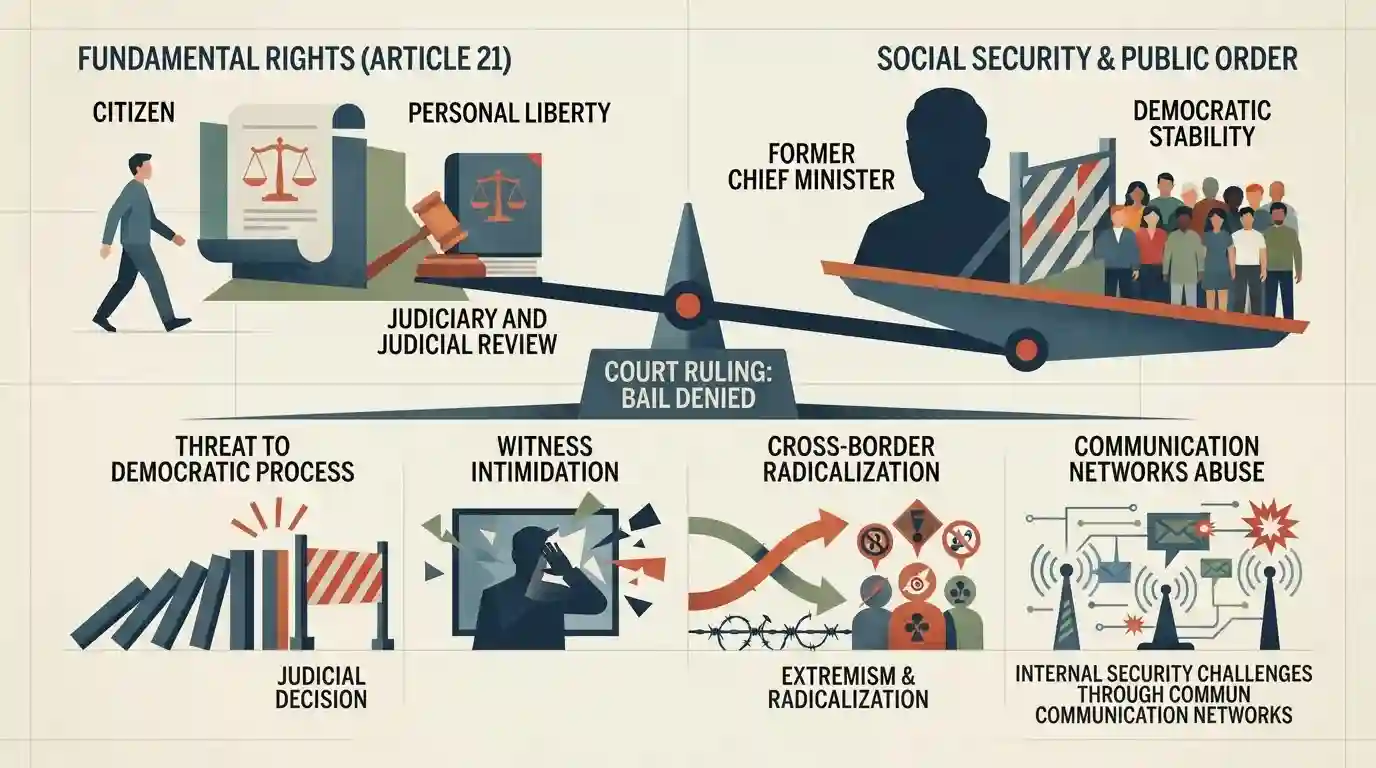
The judgment serves as a strong case study for GS Paper II on how the judiciary balances Fundamental Rights (Article 21) with public order and national security. It also highlights the broader implications of political violence and cross-border radicalization on democratic stability, which is relevant for GS Paper III (Internal Security).
సారాంశం
A special court in Jammu denied bail to a man accused of attempting to assassinate former Jammu and Kashmir Chief Minister Farooq Abdullah. The court ruled that the right to personal liberty under Article 21 must be balanced with social security, emphasizing that politically motivated attacks threaten democratic stability and public order. The judge observed that releasing the accused could intimidate witnesses and undermine the judicial process in a case of massive public importance, while also noting the role of cross-border radicalization in driving such militancy.
ముఖ్య అంశాలు
- A Jammu court denied bail to an accused in the assassination attempt on former J&K Chief Minister Farooq Abdullah, calling it an assault on public order and democratic stability.
- The court emphasized that individual liberty under Article 21 is not absolute and must be balanced against the need for social security and public order.
- The judge noted that political assassinations destabilize democracy and cannot be treated merely as attacks on individuals, given their massive public impact.
- The accused blamed Abdullah for militancy and minority migration in Kashmir, reflecting narratives propagated by cross-border forces that radicalize youth.
- The court expressed concern that granting bail in cases with such high stakes could terrorize witnesses and public officials, hindering the judicial process.
ముఖ్యమైన పదాలు
Article 21 of the Constitution

A fundamental right guaranteeing that no person shall be deprived of their life or personal liberty except according to procedure established by law. Courts balance this individual liberty against broader public order and social security.
UPSC context
GS Paper 2 (Fundamental Rights). Tests the dynamic interpretation of individual liberty versus state security and public order.
Ranbir Penal Code
The primary criminal code previously applicable in the erstwhile state of Jammu and Kashmir. It was repealed in 2019 following the abrogation of Article 370 and replaced by the national criminal code.
UPSC context
GS Paper 2 (Polity/Constitution). Tests historical knowledge of J&K's special status and its subsequent legal integration with India.
Arms Act, 1959
A central legislation regulating the acquisition, possession, manufacture, and sale of firearms and ammunition in India. It prescribes stringent penalties to curb illegal weapons, ensuring national and internal security.
UPSC context
GS Paper 3 (Internal Security). Tests the legal framework governing firearms, crucial for countering militancy and organized crime.
Jammu and Kashmir Police
The primary law enforcement agency of the Union Territory of J&K. It plays a critical role in maintaining public order, gathering vital human intelligence, and conducting counter-insurgency operations alongside Central Armed Police Forces.
UPSC context
GS Paper 3 (Internal Security). Tests the operational role of local police in counter-terrorism and intelligence gathering frameworks.
ప్రిలిమ్స్ ఉచ్చు
Statutory restrictions under UAPA Section 43D(5) completely oust the power of Constitutional Courts to grant bail under Article 21.
In K.A. Najeeb (2021), the SC held that statutory restrictions cannot override constitutional courts' power to protect Article 21 rights against prolonged pre-trial detention.
అనుసంధానమైన స్థిర భావనలు
What is the 'Prima Facie True' test under UAPA bail jurisprudence?
- Origin and Scope: Derived from the SC's 2019 Watali judgment, requiring bail rejection if prosecution allegations are broadly believable.
- No Mini-Trial: The court must look at case diaries and reports at face value without evaluating evidence admissibility.
How does Article 21 balance individual liberty with national security?
- Procedural Safeguards: Article 21 is subject to the 'procedure established by law', which must be just, fair, and reasonable.
- State Interest: The state can restrict personal liberty to protect public order and national sovereignty under reasonable restrictions.
- Speedy Trial Doctrine: In K.A. Najeeb, the SC held that statutory restrictions cannot perpetuate indefinite incarceration without trial.
అంతర-అంశ నమూనాలు
Judicial discretion vs Anti-terror laws
Bridges GS2 fundamental rights with GS3 security, examining how courts balance strict statutory anti-terror bail bars against the constitutional right to personal liberty.
Digital radicalization and hybrid threats
Connects cross-border proxy warfare with domestic communication networks, focusing on how external state-sponsored actors exploit historical grievances to radicalize youth online.

The conflict between UAPA's strict bail provisions and Article 21's speedy trial right is primed for a GS2/GS3 comparison in 2026.
అనుసంధాన PYQలు · 4
అనుసంధాన PYQలు · 4
- 2024MainsGS2
Right to privacy is intrinsic to life and personal liberty and is inherently protected under Article 21 of the constitution. Explain. In this reference discuss the law relating to D.N.A. testing of child in the womb to establish its paternity.
- 2023MainsGS2
“The Constitution of India is a living instrument with capabilities of enormous dynamism. It is a constitution made for a progressive society.” Illustrate with special reference to the expanding horizons of the right to life and personal liberty.
- 2024PrelimsGS1
Under which of the following Articles of the Constitution of India, has the Supreme Court of India placed the Right to Privacy ?
- 2019MainsGS3
Cross-border movement of insurgents is only one of the several security challenges facing the policing of the border in North-East India. Examine the various challenges currently emanating across the India-Myanmar border. Also, discuss the steps to counter the challenges.
