Bridge Collapse In Jammu Highlights Infrastructure Safety Gaps
Source:Indian Express ↗
Why It Matters
The incident is a practical case study for GS-3 Disaster Management and Infrastructure, illustrating the cascading effects of natural disasters (flash floods) on structural stability and the critical need for resilient infrastructure design. It also touches upon the occupational hazards faced by informal workers (GS-1/GS-3), emphasizing the importance of comprehensive disaster resilience frameworks.
Summary
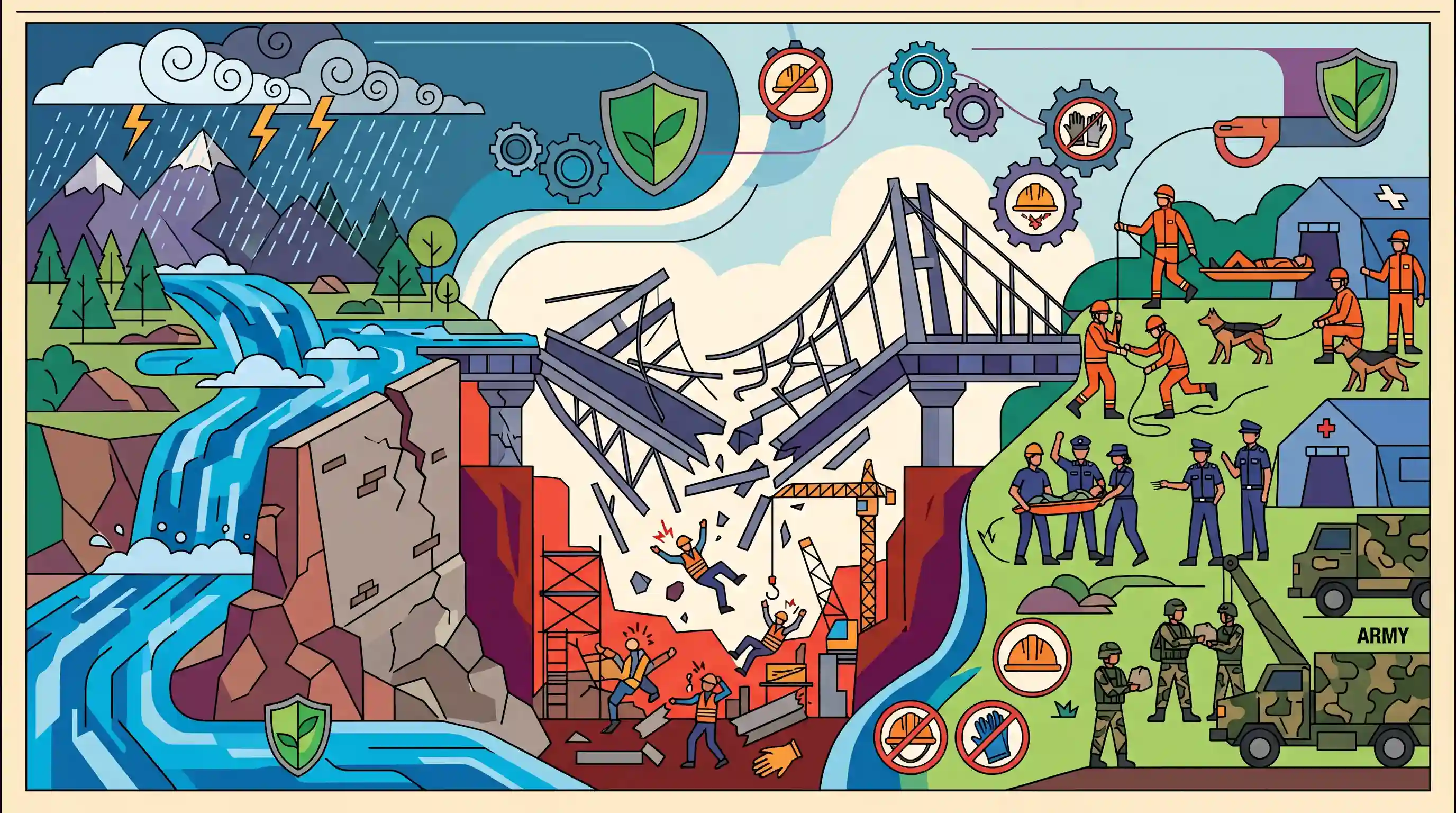
The collapse of a bridge during the repair of a flash flood-damaged retaining wall in Jammu's Bantalab area highlights significant concerns regarding infrastructure resilience, post-disaster rehabilitation, and the occupational safety of construction workers. The incident, which caused casualties among laborers, triggered a coordinated rescue operation involving the SDRF, police, and the Army. It underscores the vulnerabilities of infrastructure to climate-induced extreme weather events like flash floods and emphasizes the necessity for stringent safety protocols during post-disaster reconstruction to prevent secondary disasters and protect informal workers.
Key Points
- A bridge collapsed in Jammu's Bantalab area during the repair of a retaining wall damaged by 2025 flash floods, resulting in casualties among laborers.
- The incident underscores the cascading risks of extreme weather events, such as flash floods, which compromise the structural integrity of public infrastructure.
- Rescue operations were promptly coordinated by the SDRF, Police, and the Army, demonstrating a multi-agency approach to disaster response and mitigation.
- The tragedy brings to light systemic gaps in the occupational safety of informal construction laborers working on vulnerable and post-disaster rehabilitation projects.
Important Terms
State Disaster Response Force (SDRF)

Specialized units raised under the Disaster Management Act, 2005, for rapid, state-level response to disasters. They complement the NDRF by providing localized search, rescue, and immediate relief operations.
UPSC context
GS Paper 3 (Disaster Management). Tests knowledge of India’s tiered institutional framework for emergency response and state-level operational preparedness.
Infrastructure Resilience
The capacity of structural systems to withstand, adapt to, and recover quickly from climate shocks or disasters. It focuses on maintaining essential services and minimizing economic disruptions through risk-informed design.
UPSC context
GS Paper 3 (Infrastructure). Tests understanding of sustainable development and the importance of climate-proofing critical public assets in disaster-prone zones.
Flash Floods
Sudden, high-velocity flooding occurring within six hours of intense rainfall or cloudbursts. Characterized by rapid water rise and debris transport, they are particularly destructive in mountainous terrains and urban areas.
UPSC context
GS Paper 1 (Geography) and Paper 3 (Environment). Tests awareness of localized extreme weather events and regional disaster vulnerability.
Occupational Safety, Health and Working Conditions (OSH) Code, 2020
A consolidated legal framework regulating workplace safety standards. It protects construction and informal workers by mandating employer accountability, health standards, and welfare provisions in hazardous working environments.
UPSC context
GS Paper 2 (Social Justice/Governance). Tests knowledge of labor reforms, worker welfare, and the state’s role in protecting vulnerable informal labor.
Coalition for Disaster Resilient Infrastructure (CDRI)
An India-led global partnership launched in 2019 to promote resilient infrastructure. It facilitates knowledge sharing and disaster-risk integration into infrastructure planning, financing, and management across member nations.
UPSC context
GS Paper 3 (Disaster Management/IR). Tests awareness of India’s global leadership in climate adaptation and international resilience frameworks.
Build Back Better (BBB)
A recovery approach emphasizing that post-disaster reconstruction should improve infrastructure resilience beyond pre-disaster levels. It aims to reduce future vulnerability by integrating safety and sustainability into rehabilitation.
UPSC context
GS Paper 3 (Disaster Management). Tests understanding of the recovery and reconstruction phase of the disaster management cycle.
Prelims Trap
The Sendai Framework for Disaster Risk Reduction is a legally binding international treaty.
The Sendai Framework (2015-2030) is a voluntary, non-binding agreement. Aspirants often confuse it with binding international environmental conventions.
Static Concepts Connected
What is the 'Build Back Better' (BBB) approach in Disaster Management?
- Definition: A recovery approach integrating disaster risk reduction measures into the restoration of physical infrastructure and societal systems.
- Sendai Framework: Adopted as Priority 4 under the UN Sendai Framework for Disaster Risk Reduction (2015-2030).
- NDMA Guidelines: Forms a central guiding principle in India's National Disaster Management Plan for effective post-disaster reconstruction.
What is the statutory basis of the State Disaster Response Force (SDRF)?
- Statutory Basis: Mandated by the Disaster Management Act, 2005, requiring State Governments to raise their own specialized response forces.
- Deployment: Coordinated by the State Executive Committee; deployed alongside local police, NDRF, and the Armed Forces during emergencies.
- Funding: Operations are financed through the State Disaster Response Fund, with cost-sharing between the Centre and States.
Cross-Topic Patterns
Cascading disasters + Climate risks
Flash floods compromising structural integrity, leading to subsequent collapses during repairs, illustrate cascading risks. UPSC often links extreme weather events directly with secondary infrastructure failures.
Informal Labor + OSH Code 2020
The vulnerability of unorganized sector laborers during high-risk post-disaster repairs connects disaster management directly to the enforcement of the Occupational Safety, Health and Working Conditions (OSH) Code, 2020.

Expect a Mains question linking Sendai Framework's 'Build Back Better' principles to cascading climate disasters & infrastructure resilience.
Linked PYQs · 4
Linked PYQs · 4
- 2023MainsGS3
Dam failures are always catastrophic, especially on the downstream side, resulting in a colossal loss of life and property. Analyze the various causes of dam failures. Give two examples of large dam failures.
- 2019MainsGS3
Vulnerability is an essential element for defining disaster impacts and its threat to people. How and in what ways can vulnerability to disasters be characterized? Discuss different types of vulnerability with reference to disasters.
- 2024MainsGS3
What is disaster resilience? How is it determined? Describe various elements of a resilience framework. Also mention the global targets of Sendai Framework for Disaster Risk Reduction (2015–2030).
- 2012MainsGS1
Keeping in view the informal sector's share in the total workforce of the country, critically examine the relevant inclusive measures initiated by the Government of India and their effectiveness.
