Security Forces Launch Massive Anti-Terror Crackdown in Jammu Region
Source:The Hindu ↗
Why It Matters
It demonstrates the active, intelligence-led counter-terrorism grid in Jammu and Kashmir. For UPSC aspirants, it provides a contemporary example of how security forces coordinate to neutralize the support structures (OGWs) of cross-border terrorism, a critical aspect of internal security (GS-3).
Summary
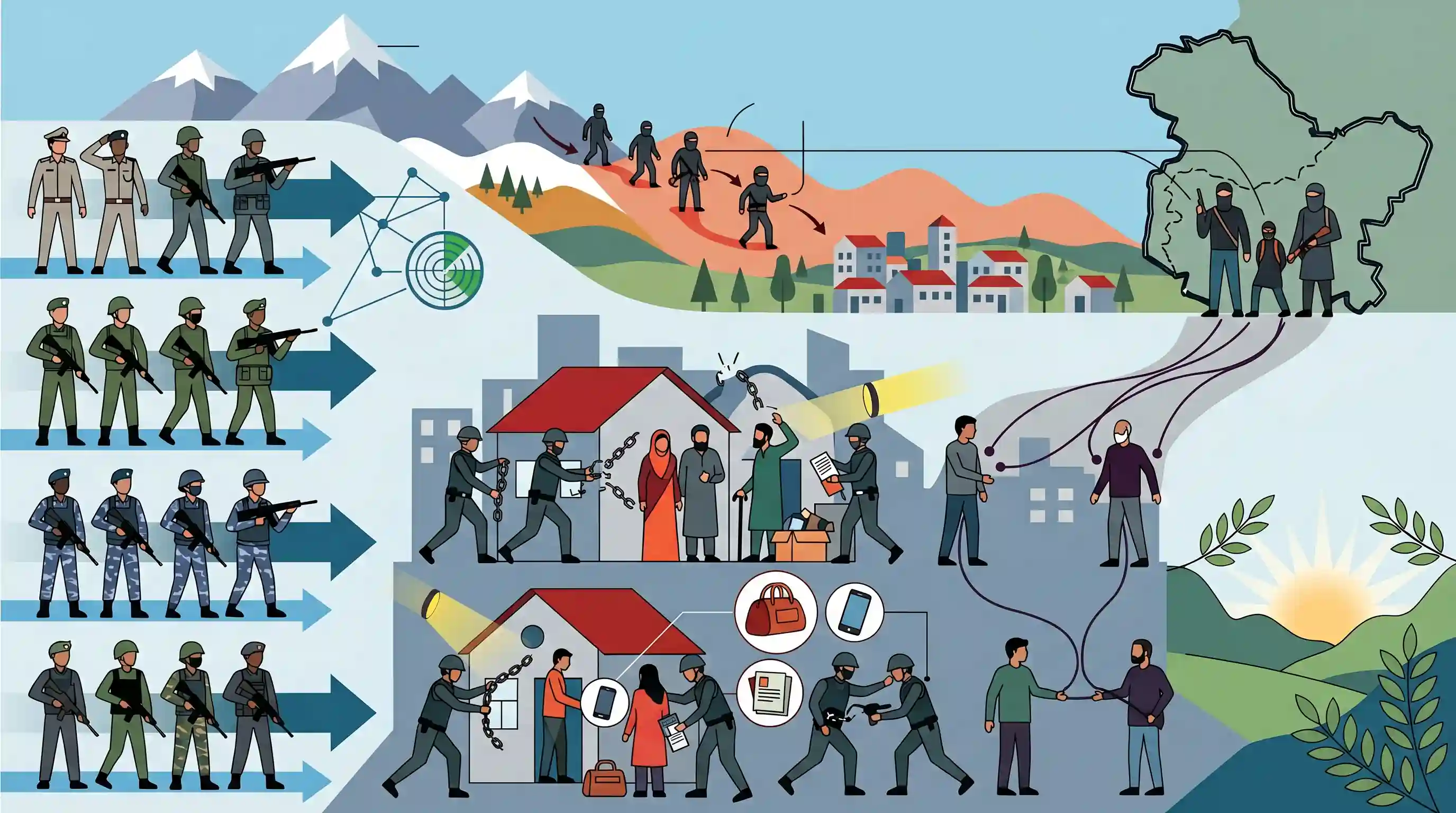
Security forces in Jammu and Kashmir have launched an extensive crackdown across several districts in the Jammu region to dismantle terror networks. The joint operations, involving the Police, Army, CRPF, and Special Operations Group (SOG), target local terrorists operating from Pakistan and their overground workers (OGWs). Triggered by intelligence suggesting terrorists are moving from higher reaches to the plains for winter hideouts, the forces have searched the premises of relatives and associates of terrorists camping in Pakistan Occupied Kashmir (PoK), seizing potential evidence like mobile phones to ensure regional stability.
Key Points
- A massive cordon and search operation is underway across multiple districts in the Jammu region, targeting local terrorists operating from Pakistan and their overground workers (OGWs).
- Intelligence reports indicate that terrorists in higher altitudes are seeking winter hideouts in the plains, prompting intensified security measures.
- Joint teams comprising the Police, Army, CRPF, and Special Operations Group (SOG) are conducting the raids to neutralize anti-national networks.
- Searches at homes of relatives and known associates of terrorists currently in Pakistan Occupied Kashmir led to the seizure of mobile phones and other materials to trace potential evidence of unlawful activities.
Important Terms
National Investigation Agency (NIA)

India's premier federal counter-terrorism agency, established after the 2008 Mumbai attacks. It investigates offences affecting national security, sovereignty, and integrity, possessing pan-India jurisdiction to probe terror-linked crimes without requiring state government consent.
UPSC context
GS Paper 3: Internal Security. Tests understanding of statutory bodies and the federal security architecture.
Overground Workers (OGWs)
Civilians who provide critical logistical, financial, and informational support to terrorist groups without directly engaging in armed violence. They act as the invisible infrastructure for insurgency, facilitating movement, shelter, and intelligence.
UPSC context
GS Paper 3: Internal Security. Focuses on the ecosystem of terrorism and challenges of asymmetrical warfare.
Special Operations Group (SOG)
An elite counter-insurgency and tactical unit of the Jammu and Kashmir Police. Established in 1994, it specializes in intelligence-driven strikes, high-risk raids, and urban warfare to dismantle regional terror modules.
UPSC context
GS Paper 3: Role of Security Forces. Tests knowledge of specialized state police units in conflict zones.
Central Reserve Police Force (CRPF)
India's largest Central Armed Police Force (CAPF) under the Ministry of Home Affairs. It is the lead agency for internal security, managing counter-militancy, riot control, and security for elections and vital installations.
UPSC context
GS Paper 3: Security Forces and their Mandate. Fundamental to the CAPF structure and domestic stability.
Indian Army
The ground-based branch of the Indian Armed Forces. In J&K, it executes major counter-terrorism operations (CI/CT) and maintains border sanctity, frequently collaborating with local police and CAPFs.
UPSC context
GS Paper 3: Internal Security and Border Management. Essential for the integrated grid against cross-border threats.
Internal Security
The maintenance of peace and order within a nation's borders through sovereign security agencies. In J&K, this involves countering hybrid warfare, radicalization, and external-aided insurgency.
UPSC context
GS Paper 3: Internal Security Challenges. The core thematic area for non-traditional security threats.
Prelims Trap
The NIA requires prior consent from the State Government to initiate terror investigations within that state's boundaries.
The NIA Act 2008 grants the agency concurrent jurisdiction. It can investigate scheduled offenses (like terrorism) anywhere in India without prior permission from the respective state government.
Static Concepts Connected
What is the mandate and jurisdiction of the National Investigation Agency (NIA)?
- Establishment: Created under the NIA Act 2008 following the 26/11 Mumbai attacks as India's central counter-terrorism law enforcement agency.
- Jurisdiction: Enjoys concurrent jurisdiction to investigate scheduled offenses across all states without state consent, applying even to Indian citizens abroad.
- Scheduled Offenses: Investigates crimes under UAPA, hijacking, counterfeit currency, human trafficking, and cyber-terrorism.
Who are Overground Workers (OGWs) in the context of insurgency?
- Definition: Non-combatant sympathizers who do not actively participate in armed encounters but form the logistical backbone of terror networks.
- Key Functions: Provide safe houses, handle terror financing, radicalize youth, and gather human intelligence (HUMINT) on security force movements.
- Legal Framework: They are primarily prosecuted under the Unlawful Activities (Prevention) Act (UAPA) and local preventive detention laws like the J&K PSA.
Cross-Topic Patterns
Geography's role in counter-insurgency grids
Heavy snowfall in the upper reaches of the Pir Panjal forces terrorists into the Jammu plains (Doda, Rajouri). UPSC frequently tests this intersection of physical geography and seasonal border management.
Evolution from OGWs to Hybrid Terrorists
Security forces face a new challenge in 'hybrid terrorists'—unlisted individuals who carry out standalone attacks and slip back into normal life, blurring the lines between traditional OGWs and combatants.

Expect a 2026 question analyzing the shifting geography of insurgency in J&K (Jammu focus) and the evolving role of Overground Workers.
Linked PYQs · 3
Linked PYQs · 3
- 2019MainsGS3
The banning of 'Jamaat-e-Islami' in Jammu and Kashmir brought into focus the role of over-ground workers (OGWs) in assisting terrorist organizations. Examine the role played by OGWs in assisting terrorist organizations in insurgency affected areas. Discuss measures to neutralize influence of OGWs.
- 2023MainsGS3
What are the internal security challenges being faced by India? Give out the role of Central Intelligence and Investigative Agencies tasked to counter such threats.
- 2020MainsGS3
Analyze internal security threats and transborder crimes along Myanmar, Bangladesh and Pakistan borders including Line of Control (LoC). Also discuss the role played by various security forces in this regard.
