Jammu and Kashmir and the Constitutional Debate on Statehood
Source:The Hindu ↗
ఇది ఎందుకు ముఖ్యం
The unprecedented downgrading of a State to a Union Territory and the subsequent functioning of its Legislative Assembly offer a real-world case study for UPSC aspirants on constitutional provisions (Article 3, Article 370), the asymmetrical federal structure of India, and the division of powers between the Centre (via the LG) and a UT legislature.
సారాంశం
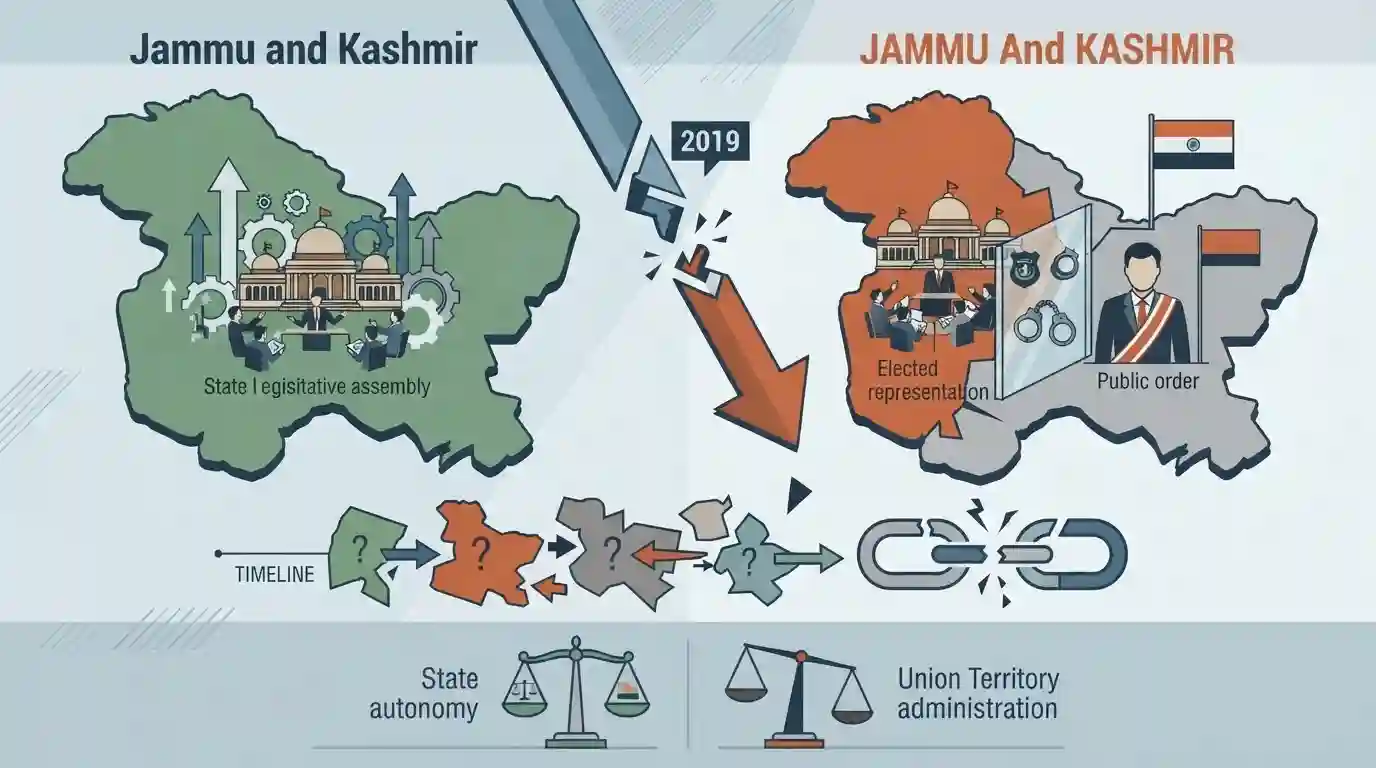
The article analyzes the ongoing struggle to restore statehood to Jammu and Kashmir following its reorganization into a Union Territory in 2019. It highlights the constitutional and political implications of this delayed restoration, noting the severely curtailed powers of the newly elected J&K Legislative Assembly under the UT framework. With crucial subjects like police and public order under the Lieutenant Governor's control, the article explores the federalism concerns and democratic deficits caused by downgrading a state to a UT. It underscores the political tension between regional parties demanding immediate statehood and the central government's ambiguous timeline.
ముఖ్య అంశాలు
- In 2019, Jammu and Kashmir was stripped of its special status under Article 370 and downgraded from a State to a Union Territory (UT) with a legislature through the J&K Reorganisation Act.
- Despite repeated assurances from the central government and observations from the Supreme Court, the restoration of full statehood to J&K remains unfulfilled.
- As a UT, the J&K Legislative Assembly has severely restricted powers; critical subjects like public order and police are directly controlled by the Lieutenant Governor (LG), who represents the Centre.
- The prolonged UT status raises significant concerns regarding democratic representation, the federal structure of the Constitution, and the centralization of power.
- Regional political parties in J&K continue to aggressively demand the immediate restoration of statehood as a fundamental requirement for meaningful self-governance.
ముఖ్యమైన పదాలు
Article 370

A temporary provision in the Indian Constitution that granted special autonomous status to Jammu and Kashmir, limiting Parliament's legislative power. It was rendered inoperative by the Union government in August 2019.
UPSC context
GS Paper II (Indian Constitution - Significant Provisions); tests understanding of asymmetric federalism and constitutional integration.
Jammu and Kashmir Reorganisation Act, 2019
A parliamentary act that bifurcated the former state of Jammu and Kashmir into two Union Territories: Jammu and Kashmir (with a legislature) and Ladakh (without a legislature).
UPSC context
GS Paper II (Federal Structure and Reorganisation); tests Parliament's powers to alter state boundaries and its federal implications.
Jammu and Kashmir Legislative Assembly
The unicameral legislature of the Union Territory of Jammu and Kashmir. Under the UT framework, its legislative authority excludes crucial subjects like police and public order.
UPSC context
GS Paper II (State Legislatures); tests knowledge of UT legislative frameworks, democratic delegation, and executive-legislative balance.
Supreme Court of India
The highest judicial body in India, which in 2023 upheld the abrogation of Article 370 and directed the timely conduct of assembly elections and early restoration of J&K's statehood.
UPSC context
GS Paper II (Judiciary); tests the judiciary's role in constitutional review, safeguarding federalism, and executive oversight.
ప్రిలిమ్స్ ఉచ్చు
The Legislative Assembly of the UT of Jammu and Kashmir is constitutionally barred from legislating on Public Order, Police, and Land.
Unlike Delhi (Article 239AA), which is constitutionally barred from legislating on Police, Public Order, and Land, the J&K Reorganisation Act, 2019 only excludes Police and Public Order. J&K's Assembly retains power over Land.
అనుసంధానమైన స్థిర భావనలు
What are the procedures and limits of state reorganisation under Article 3?
- Parliamentary Power: Parliament can form new states, alter boundaries, or change names of existing states by a simple majority via ordinary legislative process.
- Presidential Reference: The Bill requires prior recommendation of the President, who refers it to the affected State Legislature for expressing its views within a specified timeframe.
- Non-Binding Views: The views of the State Legislature are purely recommendatory and not binding on the President or Parliament.
How do Articles 239A and 239AA differ in governing Union Territories?
- Article 239A: Created by the 14th Amendment (1962) for Puducherry, it enables Parliament to create a legislature or council of ministers via ordinary law. It applies to J&K.
- Article 239AA: Inserted by the 69th Amendment (1991) specifically for Delhi, directly establishing its legislative structure and carving out Land, Police, and Public Order.
- Constitutional Rigidity: Article 239A leaves the design of J&K's legislative powers to Parliament's discretion via ordinary law, while 239AA embeds Delhi's restrictions directly in the Constitution.
అంతర-అంశ నమూనాలు
Asymmetric federalism vs. National security
The J&K UT framework highlights the tension between providing democratic regional representation and maintaining centralized control over strategic border regions vulnerable to external security threats.
Subordinate rules and executive centralisation
Amending Transaction of Business Rules to expand the Lieutenant Governor's control over civil services and anti-corruption mirrors executive conflicts seen in Delhi under Article 239AA.

Expect a multi-statement question contrasting Articles 239A and 239AA, testing the legislative competency of J&K versus Delhi.
అనుసంధాన PYQలు · 3
అనుసంధాన PYQలు · 3
- 2025MainsGS2
Discuss the nature of Jammu and Kashmir Legislative Assembly after the Jammu and Kashmir Reorganization Act, 2019. Briefly describe the powers and functions of the Assembly of the Union Territory of Jammu and Kashmir.
- 2016MainsGS2
To what extent is Article 370 of the Indian Constitution, bearing marginal note "Temporary provision with respect to the State of Jammu and Kashmir", temporary? Discuss the future prospects of this provision in the context of Indian polity.
- 2024MainsGS2
What changes has the Union Government recently introduced in the domain of Centre-State relations ? Suggest measures to be adopted to build the trust between the Centre and the States and for strengthening federalism.
