Restoration of Statehood for Jammu and Kashmir
Source:Indian Express ↗
Why It Matters
The restoration of statehood to a Union Territory is a unique constitutional process. Understanding the political and legal nuances of the J&K Reorganisation Act, 2019, and the subsequent path to statehood is highly relevant for GS Paper 2 questions on federalism, the powers of Parliament under Article 3, and Centre-State political dynamics.
Summary
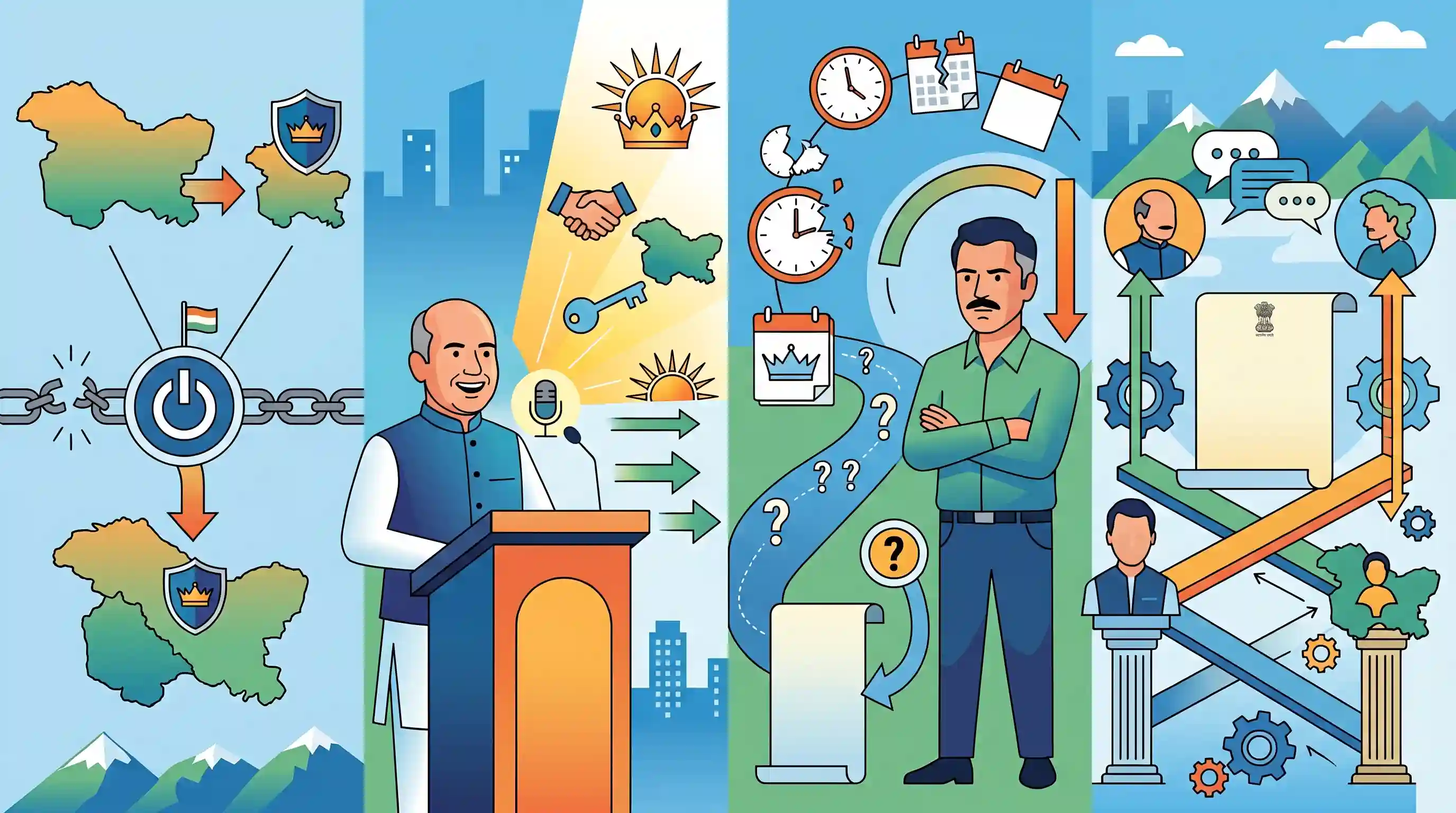
A Union Minister has announced that a decision on restoring Jammu and Kashmir's statehood will be taken soon, fulfilling a long-standing demand following the 2019 abrogation of Article 370. However, prominent J&K leader Omar Abdullah responded with caution, highlighting the prolonged wait of over a year and a half for the Centre to act on its assurances. The development underscores the ongoing political dialogue regarding J&K's constitutional status and the broader federal relationship between the Union Government and the Union Territory.
Key Points
- A Union Minister indicated that the Central Government will soon make a decision regarding the restoration of statehood to Jammu and Kashmir.
- J&K leader Omar Abdullah expressed caution regarding the timeline, pointing out that the region has already been waiting for over a year and a half for this promised restoration.
- The political dialogue highlights the ongoing friction and negotiations between the Centre and the Union Territory's elected leadership over constitutional status.
- Restoring statehood is the anticipated next constitutional step following the J&K Reorganisation Act of 2019, which downgraded the state into two Union Territories.
Important Terms
Jammu and Kashmir Reorganisation Act, 2019

A landmark 2019 law that bifurcated the former State of Jammu and Kashmir into two Union Territories: Jammu & Kashmir (with legislature) and Ladakh (without legislature).
UPSC context
GS Paper II: Reorganization of states, federalism, and the administrative transition of J&K from a state to a Union Territory.
Article 370
A temporary constitutional provision that formerly granted Jammu and Kashmir special autonomy and a separate constitution. It was effectively abrogated by Presidential orders in August 2019.
UPSC context
GS Paper II: Significant for constitutional amendments, special provisions for states, and the 2023 Supreme Court verdict upholding its abrogation.
Article 3 of the Indian Constitution
Constitutional provision empowering Parliament to form new states, alter areas, or change boundaries. It is the legal mechanism required to restore statehood to Jammu and Kashmir.
UPSC context
GS Paper II: Tests knowledge of the Union and its territory and the procedure for creating/altering states.
National Conference (NC)
A prominent regional political party in Jammu and Kashmir, founded in 1932. It played a pivotal role in the state's accession and subsequent democratic history.
UPSC context
GS Paper II: Regional political parties and their role in the federal and democratic landscape of India.
Statehood
A status within the Indian Union where a territory possesses its own elected government and legislative powers over subjects in the State List.
UPSC context
GS Paper II: Federalism and the distinction between the powers of States versus Union Territories.
Asymmetric Federalism
A type of federalism where some subnational units have more autonomy or different powers than others, exemplified by J&K’s former special status.
UPSC context
GS Paper II: Advanced conceptual understanding of the Indian federal structure and its unique regional exceptions.
Prelims Trap
"Like Delhi, the UT of Jammu and Kashmir lacks legislative competence over Public Order, Police, and Land."
False. Unlike Delhi (Article 239AA), the J&K Assembly retains legislative power over 'Land'. It only lacks jurisdiction over 'Police' and 'Public Order'.
Static Concepts Connected
How does Article 3 govern the alteration of state boundaries and status?
- Parliamentary authority: Parliament can form new states or alter areas, boundaries, and names via a simple majority, making it an ordinary legislative process outside Article 368.
- Prior recommendation: Bills seeking such alteration require the President's prior recommendation before being introduced in Parliament.
- State Legislature views: The President must refer the bill to the concerned State Legislature, though its views or rejection are not binding on Parliament.
What distinguishes the UT frameworks of Article 239A and 239AA?
- Article 239A: Framework for Puducherry, applied statutorily to J&K. J&K's assembly legislates on State/Concurrent lists except 'Police' and 'Public Order', but retains power over 'Land'.
- Article 239AA: Constitutionally entrenched special status for the NCT of Delhi. Its assembly explicitly cannot legislate on 'Public Order', 'Police', and 'Land'.
- Lieutenant Governor Discretion: In UTs, the Lieutenant Governor acts as the administrator and enjoys substantially wider discretionary powers compared to a regular State Governor.
Cross-Topic Patterns
Asymmetric Federalism (Article 371)
The removal of J&K's special status is often tested conceptually alongside the ongoing protective provisions under Article 371 for North Eastern and western Indian states.
Executive Assurances in Constitutional Law
The 2023 Supreme Court verdict upheld J&K's UT status by heavily relying on the executive's assurance of future statehood, sparking broader debates on the limits of judicial review.

Expect a comparative prelims question in 2026 contrasting the legislative powers of Delhi (Art 239AA), Puducherry, and J&K (Art 239A).
Linked PYQs · 3
Linked PYQs · 3
- 2025MainsGS2
Discuss the nature of Jammu and Kashmir Legislative Assembly after the Jammu and Kashmir Reorganization Act, 2019. Briefly describe the powers and functions of the Assembly of the Union Territory of Jammu and Kashmir.
- 2016MainsGS2
To what extent is Article 370 of the Indian Constitution, bearing marginal note "Temporary provision with respect to the State of Jammu and Kashmir", temporary? Discuss the future prospects of this provision in the context of Indian polity.
- 2024MainsGS2
What changes has the Union Government recently introduced in the domain of Centre-State relations ? Suggest measures to be adopted to build the trust between the Centre and the States and for strengthening federalism.
