Political discourse over land legislation in Jammu and Kashmir
Source:Indian Express ↗
Why It Matters
The issue highlights the operational dynamics of the newly reconstituted Jammu and Kashmir Legislative Assembly and the challenges of enacting land legislation in a politically and communally sensitive Union Territory. It is highly relevant for GS2 (powers of the UT Assembly) and GS3 (land reforms and state administration).
Summary
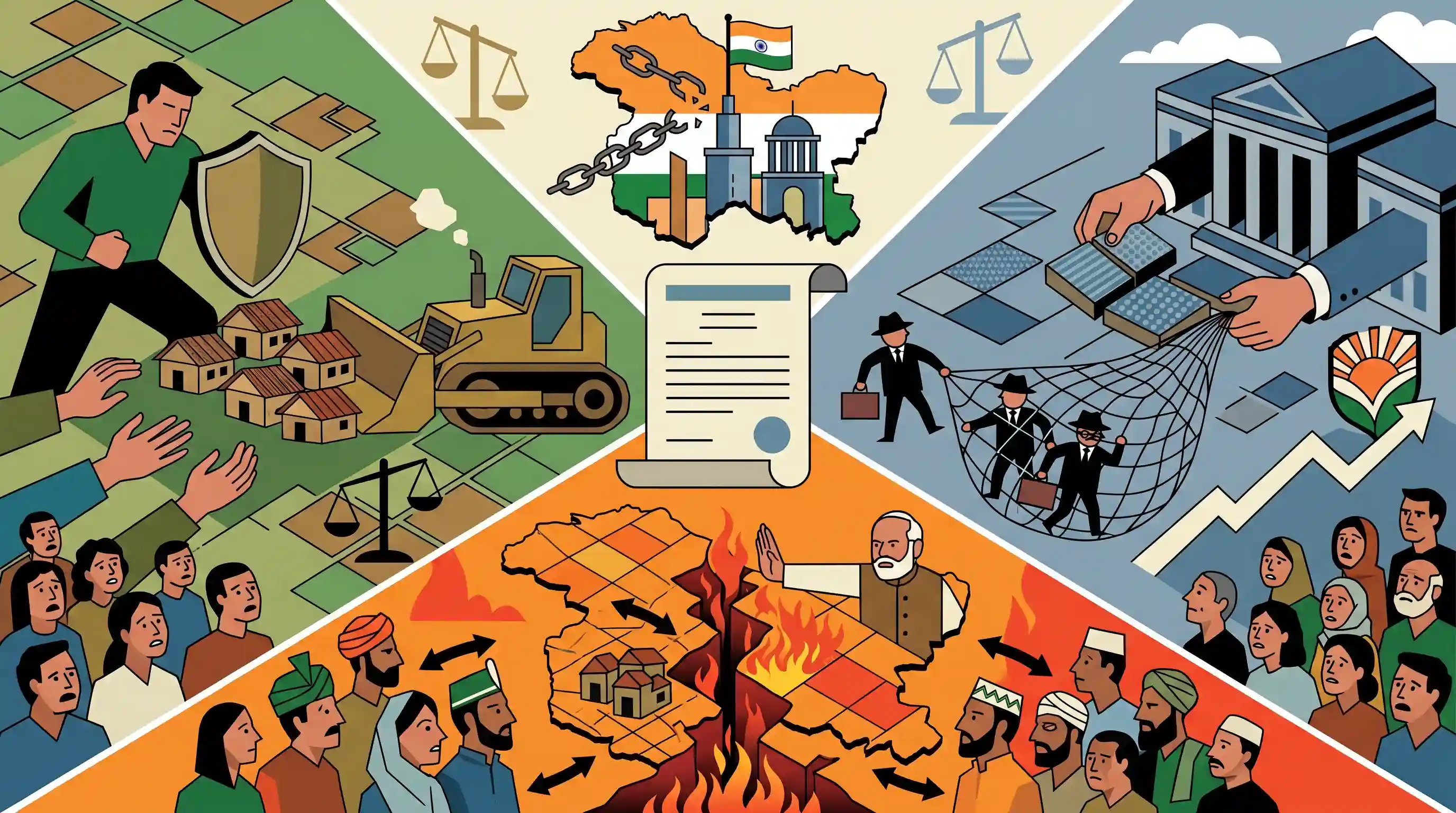
The article examines the political discourse surrounding a proposed land bill in Jammu and Kashmir, highlighting how different parties are weaponizing the legislation for political messaging. The PDP advocates for the protection of marginalized occupants through 'anti-bulldozer' promises, while the ruling National Conference (NC) focuses on the necessity of tackling the 'land mafia' to reclaim state resources. Meanwhile, the BJP has communalized the discourse by alleging 'land jihad'. These competing narratives reflect the deep-seated anxieties over land ownership, demographic shifts, and governance in the Union Territory following the abrogation of Article 370 and the subsequent restructuring of legislative powers.
Key Points
- A recently proposed land-related bill in Jammu and Kashmir has sparked polarized political rhetoric among regional and national parties.
- The Peoples Democratic Party (PDP) frames the legislation around an 'anti-bulldozer' narrative, advocating for protection against state-led eviction drives targeting alleged encroachers.
- The National Conference (NC) counters this by focusing on the 'land mafia', emphasizing the need to protect public resources and state land from organized illegal occupation.
- The Bharatiya Janata Party (BJP) introduces a communal dimension by labeling the issue as 'land jihad', reflecting apprehensions regarding demographic changes.
- The debate underscores the complex governance and legislative challenges for the J&K Assembly in managing land rights, rule of law, and regional identity politics.
Important Terms
J&K Land Rights and Regularisation Bill, 2025

A proposed 2025 private member's bill seeking to regularize land holdings for occupants with 30+ years of possession. It aims to grant ownership rights and halt arbitrary evictions and demolitions.
UPSC context
Relevant for GS Paper II (Government Policies) and GS Paper III (Land Reforms). Tests understanding of legislative attempts to protect property rights post-Article 370.
Land Jihad
A communal narrative alleging that a specific community (typically Muslims) systematically encroaches on government land to alter regional demographics. It is frequently invoked by the BJP to oppose land regularization.
UPSC context
Relevant for GS Paper I (Social Empowerment/Communalism). Tests ability to analyze how communal rhetoric influences public policy and legislative debates in sensitive regions.
J&K Land Grants Rules, 2022
Administrative rules that ended the automatic renewal of land leases, transitioning to a system of fresh online auctions at market rates. They replaced the more liberal 1960 lease framework.
UPSC context
Critical for GS Paper II (Polity) and GS Paper III (Economy). Tests knowledge of executive overreach vs. legislative intent in Union Territory administration.
Anti-Bulldozer Bill
The formal name for the J&K Land Rights and Regularisation Bill, 2025, used by the PDP to signal protection for marginalized occupants against state-led demolition drives.
UPSC context
Relevant for GS Paper II (Governance). Evaluates understanding of 'bulldozer justice' discourse and the legal safeguards required to protect the Right to Shelter (Article 21).
Roshni Act (2001)
A 2001 law (now struck down) that allowed occupants of state land to gain ownership by paying a fee. It remains a primary point of comparison for new land legislation.
UPSC context
Historical context for GS Paper III (Land Reforms). Tests understanding of the failures and controversies of past land vesting schemes in J&K.
Prelims Trap
"Like Delhi, the Legislative Assembly of the Union Territory of Jammu & Kashmir lacks power to legislate on Land."
Unlike Delhi, which excludes Public Order, Police, AND Land from its Assembly's purview, the J&K Reorganisation Act 2019 only excludes Public Order and Police. J&K can legislate on Land.
Static Concepts Connected
How do the legislative powers of J&K differ from Delhi and Puducherry?
- Jammu & Kashmir: The J&K Assembly can legislate on State List subjects EXCEPT Public Order and Police (Entries 1 and 2). It retains power over Land.
- Delhi: Article 239AA specifically excludes Public Order, Police, and Land (Entries 1, 2, and 18) from the Delhi Legislative Assembly's purview.
- Puducherry: The Assembly can legislate on any State or Concurrent List subject without constitutionally specified categorical exclusions, though laws remain subject to Parliamentary supremacy.
What are the constitutional protections against arbitrary property demolitions?
- Article 21: The Supreme Court has ruled that the Right to Life includes the Right to Shelter, preventing punitive state evictions without due process.
- Separation of Powers: Extrajudicial demolitions by the executive usurp the judiciary's exclusive role in determining guilt and administering punishment.
- SC Guidelines (2024): Recent rulings mandate a 15-day prior notice, a personal hearing, and video recording of demolitions to check executive arbitrariness.
Cross-Topic Patterns
Federalism and Asymmetric UT Powers
The contrasting legislative capacities over 'Land' between Delhi and J&K frequently feature as comparative constitutional questions in both Prelims and Mains GS2.
Judicial Review of Executive Action
The 'bulldozer justice' debate ties into broader GS2 themes of executive overreach, separation of powers, and the Supreme Court's push to institutionalize procedural safeguards for Article 21.

Expect a comparative multi-statement Prelims question testing the exact State List exclusions (Police, Public Order, Land) across Delhi, J&K, and Puducherry.
Linked PYQs · 3
Linked PYQs · 3
- 2025MainsGS2
Discuss the nature of Jammu and Kashmir Legislative Assembly after the Jammu and Kashmir Reorganization Act, 2019. Briefly describe the powers and functions of the Assembly of the Union Territory of Jammu and Kashmir.
- 2024MainsGS3
What were the factors responsible for the successful implementation of land reforms in some parts of the country? Elaborate.
- 2023MainsGS3
State the objectives and measures of land reforms in India. Discuss how land ceiling policy on landholding can be considered as an effective reform under economic criteria.
