Jalalabad in Shahjahanpur district to be renamed as Parshurampuri
Source:The Hindu ↗
Why It Matters
The administrative renaming of cities, districts, and towns in Uttar Pradesh is a frequent topic in UPPSC State GK and Current Affairs. Additionally, Shahjahanpur district is highly significant in the UPPSC curriculum as the birthplace of key Kakori Train Action revolutionaries like Ram Prasad Bismil, making it a critical hub of state-specific history and culture.
Summary
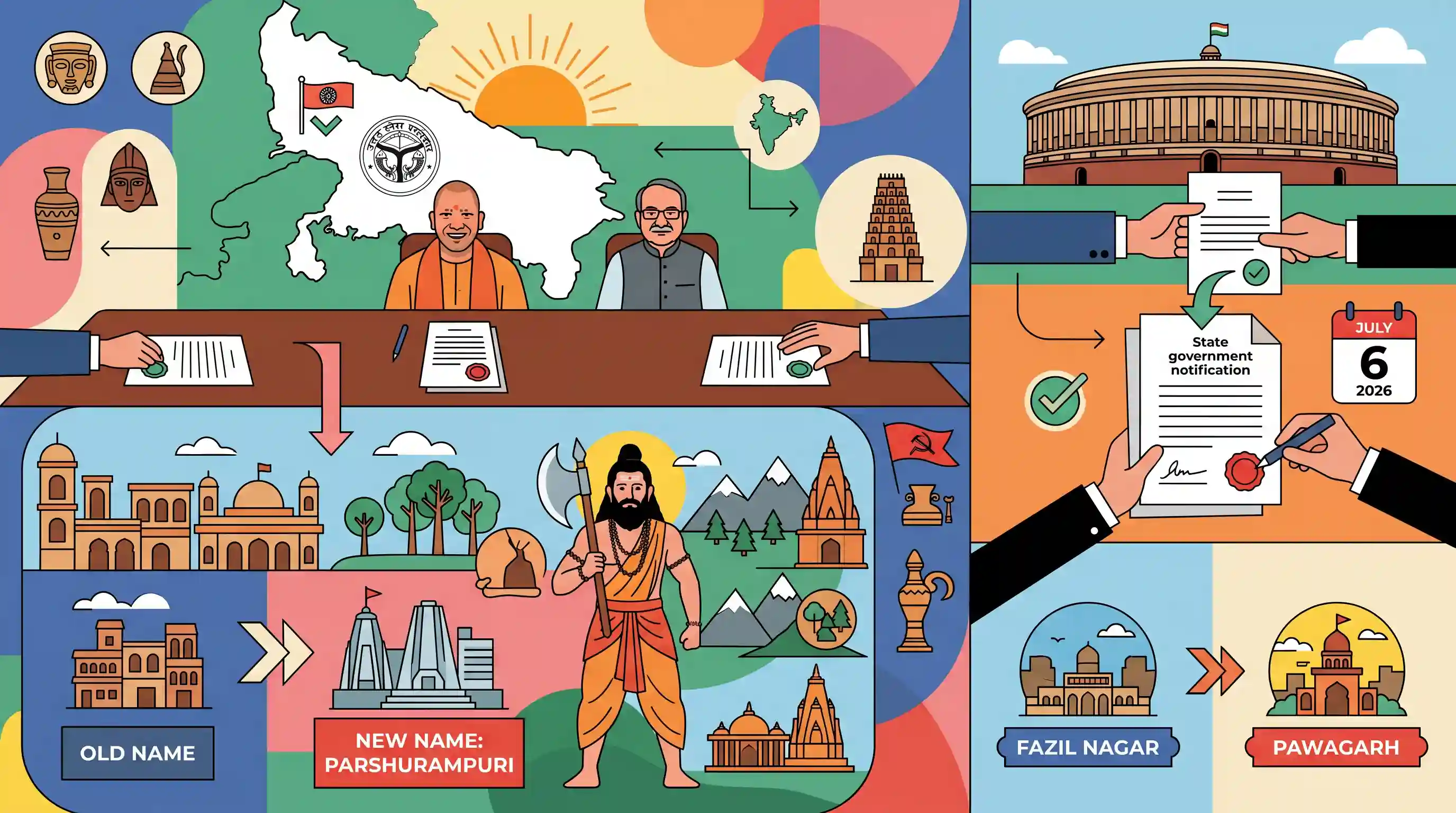
The Uttar Pradesh government, led by CM Yogi Adityanath, approved the renaming of Jalalabad town in Shahjahanpur district to 'Parshurampuri' to honor it as the mythological birthplace of Bhagwan Parshuram. The decision, announced by Finance Minister Suresh Kumar Khanna on July 6, 2026, followed clearance from the Government of India and will be finalized with a formal state notification. Additionally, Fazil Nagar town is slated to be renamed Pawagarh.
Key Points
- The Uttar Pradesh Cabinet approved a proposal to rename the town of Jalalabad in the Shahjahanpur district to 'Parshurampuri'.
- Jalalabad is traditionally and mythologically revered as the birthplace of Bhagwan Parshuram, the sixth incarnation of Lord Vishnu.
- The renaming proposal received clearance from the Government of India before being approved by the state cabinet on July 6, 2026.
- UP Finance Minister Suresh Kumar Khanna announced the Cabinet decision, stating that further administrative and legal formalities will culminate in a formal notification to update official records.
- The article also mentions a separate proposal by Chief Minister Yogi Adityanath to rename Fazil Nagar town to 'Pawagarh'.
Important Terms
Renaming of Places in India

The constitutional and administrative procedure where state governments propose name changes of cities or districts, requiring clearance and a 'No Objection Certificate' (NOC) from the Union Ministry of Home Affairs.
UPSC context
GS Paper II: Indian Polity; tests understanding of federalism, administrative procedures, and executive guidelines for altering local names.
Bhagwan Parshuram
The sixth incarnation of Lord Vishnu in Hinduism, known as a warrior-sage (Brahma-Kshatriya) and Chiranjeevi (immortal) who restored cosmic dharma by vanquishing oppressive Kshatriya rulers.
UPSC context
GS Paper I: Indian Culture; tests knowledge of Puranic mythology, avatars of Vishnu, and sacred cultural geography.
Shahjahanpur
A district in Uttar Pradesh historically called the "City of Martyrs," renowned for its major role in the 1857 Uprising and as the home of key revolutionaries like Ram Prasad Bismil and Ashfaqulla Khan.
UPSC context
GS Paper I: Modern Indian History; tests knowledge of revolutionary movements and key centers of the 1857 Rebellion.
State Cabinet
The core executive committee of a state's Council of Ministers, headed by the Chief Minister, responsible for shaping policies, approving administrative decisions, and initiating local legislative measures.
UPSC context
GS Paper II: State Executive; tests knowledge of the executive machinery, constitutional provisions (Articles 163-164), and state governance.
No Objection Certificate (NOC) for Renaming
A mandatory clearance granted by the Union Ministry of Home Affairs to a state government, verifying that a proposed place-name change does not conflict with existing database records of federal departments.
UPSC context
GS Paper II: Center-State Relations; tests understanding of administrative coordination, central oversight, and MHA procedures in renaming places.
Prelims Trap
Renaming a district or city within a State requires a constitutional amendment enacted by Parliament under Article 3.
Article 3 of the Constitution governs the renaming or altering of States. Renaming a city, town, or railway station is an executive action of the State Government, requiring only an NOC from the Ministry of Home Affairs.
Static Concepts Connected
What is the administrative procedure for renaming cities and districts in India?
- State vs Parliament: Renaming a State requires Parliament to pass a bill under Article 3 of the Constitution. Renaming a city or district is entirely within the domain of the State Government.
- MHA Clearance: The State Government must send its proposal to the Union Ministry of Home Affairs (MHA) to obtain a mandatory 'No Objection Certificate' (NOC).
- Inter-Ministerial Check: The MHA consults other central departments, including the Ministry of Railways, Department of Posts, and Survey of India, to ensure no duplicate names or administrative conflicts arise.
What is the historical significance of Pawa in Ancient Indian History?
- Malla Capital: Pawa was one of the two capital cities of the Malla Mahajanapada, a powerful ancient oligarchic republic (Gana-sangha) in eastern Uttar Pradesh.
- Mahavira Nirvana: Pawa is highly sacred to Jains as the place where Lord Mahavira, the 24th Tirthankara, attained Nirvana (liberation).
- Buddha Last Meal: According to Buddhist texts, Gautam Buddha took his last meal (offered by Cunda the blacksmith) at Pawa, fell ill, and then traveled to nearby Kusinara for his Mahaparinirvana.
Cross-Topic Patterns
Ancient heterodox sects & spatial geography
The transition of ancient Pawa (Fazil Nagar) and Kusinara maps the precise convergence of Buddhist and Jain canonical geographies within the ancient Malla republican confederacy.
PRASHAD Scheme & strategic borders
Developing Parshuram Kund on Arunachal's Lohit River under PRASHAD highlights how national pilgrimage schemes are leveraged for strategic infrastructure in sensitive border regions.

Expect questions contrasting Article 3 constitutional state-renaming processes with the MHA-led NOC executive procedure for districts.
Linked PYQs · 2
Linked PYQs · 2
- 2021UPPSC_PRELIMSGS1
Ministry of Culture, Government of India as part of Azadi ka Amrit Mahotsav celebrated the birth anniversary of Saheed Ram Prasad Bismil in June, 2021 at which one of the following places in Uttar Pradesh ?
- 2011UPPSC_PRELIMSGS1
Who among the following was the one to have escaped being hanged in the 'Kakori Conspiracy Case'?
