UN Address on Global Order and Supply Security
Source:Indian Express ↗
Why It Matters
This article captures India's diplomatic messaging at premier multilateral platforms like the UN regarding global supply chain vulnerabilities (food, fuel, fertilizer) and the reform of international institutions, which is a core component of GS2 International Relations syllabus.
Summary
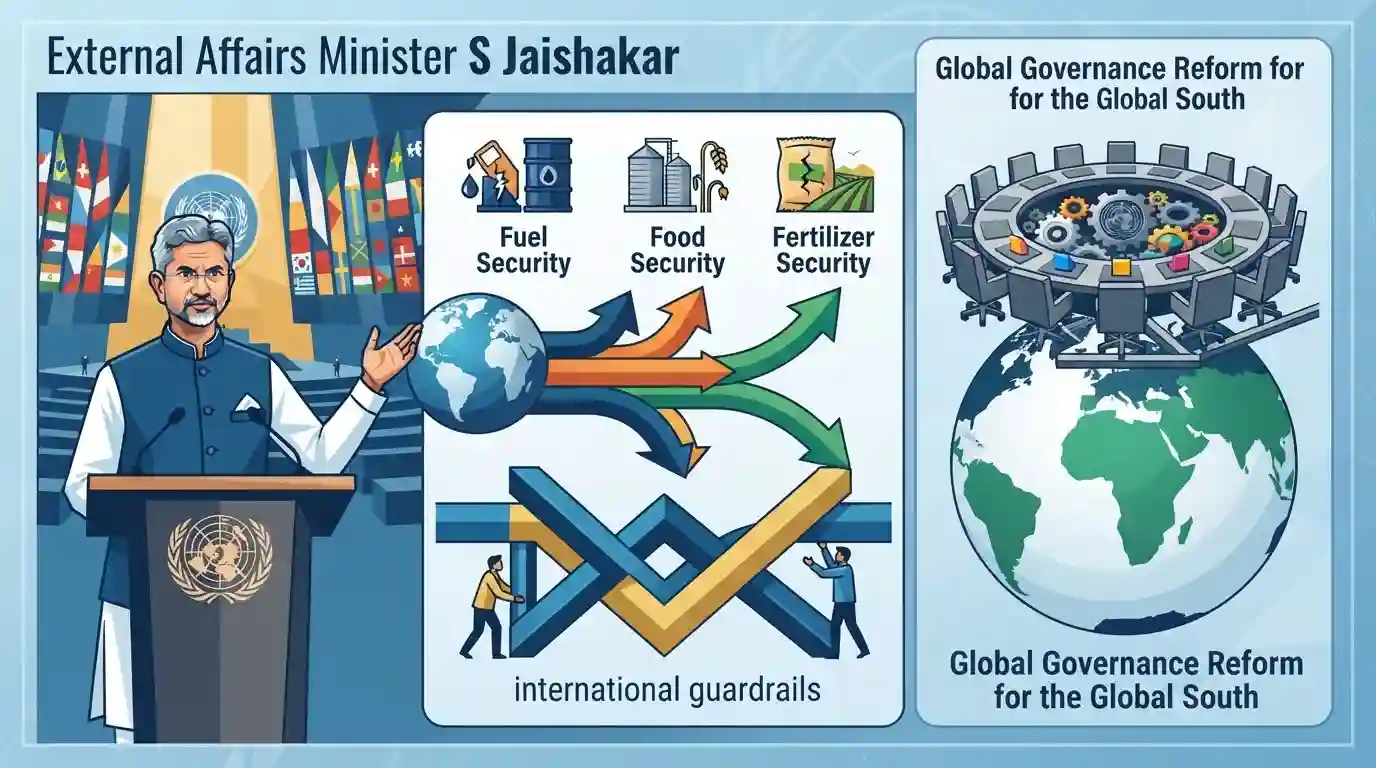
External Affairs Minister S Jaishankar's address at the United Nations focused on the cascading crises affecting fuel, food, and fertilizer security due to global conflicts. He stressed the necessity of establishing international guardrails and reforming global governance structures to support the interests of the Global South.
Key Points
- External Affairs Minister S Jaishankar addressed the United Nations, highlighting the severe global impact of ongoing conflicts on fuel, food, and fertilizer security.
- He emphasized the urgent need for guardrails in the current global order to manage geopolitical tensions and protect vulnerable developing nations.
- The speech underscored India's consistent stance on reforming multilateral institutions to make them more representative and responsive to contemporary realities.
Important Terms
United Nations

An international organization founded in 1945, committed to maintaining international peace, security, and friendly relations among nations while promoting global cooperation on economic, social, and humanitarian issues.
UPSC context
GS Paper II (International Relations): Essential for questions on global governance, multilateral institutions, and India's multilateral diplomacy at the UN.
Global South
A geopolitical and economic grouping of developing, emerging, and low-income countries, predominantly located in Asia, Africa, and Latin America, advocating for equity, reformed multilateralism, and development justice.
UPSC context
GS Paper II (International Relations): Important for India's foreign policy objectives, multilateral groupings, and leadership of developing nations.
4F Crisis
The compounding crises of food, fuel, fertilizer, and finance facing developing nations due to geopolitical conflicts, climate shocks, and supply-chain disruptions.
UPSC context
GS Paper II & III (IR and Economy): Tests awareness of non-traditional security threats, food security, and global supply chain vulnerabilities affecting developing countries.
Prelims Trap
India has officially renounced the veto power demand for new permanent members of the UNSC.
Aspirants often assume India seeks a permanent UNSC seat *without* veto power, but India's official stance maintains that new permanent members must possess all prerogatives of existing members, including the veto.
Static Concepts Connected
What are the core arguments and proposals for UNSC (United Nations Security Council) reforms?
- Geographic balance: Permanent expansion, representing emerging developing nations like India, Brazil, Japan, and Germany (G4).
- Historical injustice: Addressing the over-representation of Western powers and complete exclusion of the African continent from permanent seats.
- Veto reform: Modifying or restricting veto power use in cases of mass atrocities to prevent paralysis of the UN security apparatus.
Cross-Topic Patterns
UN Multilateralism + WTO Trade & Debt
India's advocacy for the Global South at the UN mirrors its financial positions in WTO ministerial and G20 debt-relief negotiations.
Global Food-Fuel-Fertilizer Security + Domestic Fiscal Pressures
The 4F crisis connects geopolitics with domestic inflation, food security (NFSA), and fertilizer subsidy fiscal management.

UNSC reform + Global South representation likely to feature as a statement-based question linking post-WWII architecture to modern geopolitics.
Linked PYQs · 2
Linked PYQs · 2
- 2019MainsGS2
‘The long-sustained image of India as a leader of the oppressed and marginalised nations has disappeared on account of its new found role in the emerging global order.’ Elaborate.
- 2023MainsGS2
‘Virus of Conflict is affecting the functioning of the SCO’ In the light of the above statement point out the role of India in mitigating the problems.
