India South Korea Strategic Partnership and Indo Pacific Ties
Source:The Hindu ↗
Why It Matters
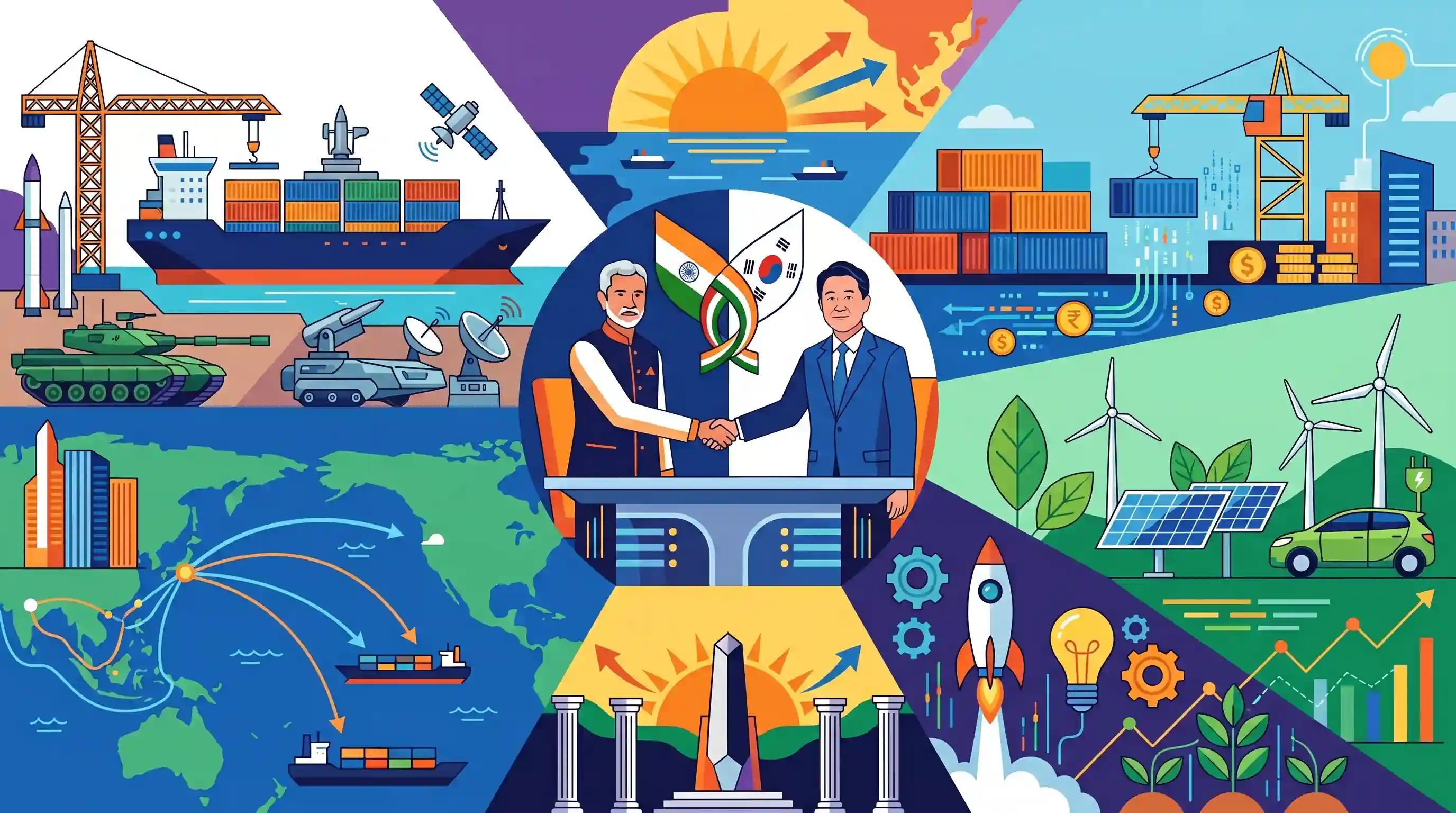
Deepening ties with advanced Asian economies like South Korea is a critical pillar of India's Act East policy. It supports India's strategic goals in the Indo-Pacific, enhances supply chain resilience, and brings crucial investments and technology in defense manufacturing and clean energy.
Summary
External Affairs Minister S. Jaishankar met South Korean Foreign Minister Cho Hyun-dong in Seoul to deepen the Special Strategic Partnership between the two countries. The dialogue focused on enhancing cooperation across trade, investment, defense technology (including shipbuilding), clean energy, and startups. Both leaders also exchanged views on broader geopolitical issues, particularly concerning stability in the Indo-Pacific and West Asia. The visit built upon the momentum of South Korean President Lee Jae-myung's previous state visit to India and highlighted the inauguration of the Indian War Memorial in Seoul to honor historical military ties.
Key Points
- External Affairs Minister S. Jaishankar and South Korean FM Cho Hyun-dong discussed expanding the India-South Korea Special Strategic Partnership.
- The talks covered bilateral trade, investment, startups, fintech, clean energy, and defense technology.
- Strategic discussions included regional geopolitical developments, specifically focusing on the Indo-Pacific and tensions in West Asia.
- There is a significant thrust toward maritime cooperation, particularly in shipbuilding and supply chain resilience.
- The historical bond was reaffirmed with the inauguration of the Indian War Memorial in Seoul by Defence Minister Rajnath Singh.
Important Terms
Special Strategic Partnership (India-South Korea)

A bilateral relationship status elevated in 2015, prioritizing high-level political, defense, and economic engagement. It focuses on advanced technology (semiconductors), shipbuilding, and regional security alignment.
UPSC context
GS Paper II (International Relations); tests understanding of bilateral frameworks and strategic depth beyond traditional diplomacy.
Act East Policy
India's proactive diplomatic framework (launched 2014) to enhance economic, strategic, and cultural ties with the Indo-Pacific. South Korea is a key technological and industrial pillar of this policy.
UPSC context
GS Paper II (Foreign Policy); tests knowledge of regional engagement and evolution from Look East to Act East.
Comprehensive Economic Partnership Agreement (CEPA)
A trade agreement in force since 2010 covering goods, services, and investment. Current negotiations aim to upgrade the pact to address India’s trade deficit and include digital trade.
UPSC context
GS Paper III (Economy/Trade); focuses on bilateral trade imbalances and Free Trade Agreement (FTA) structures.
Indo-Pacific Strategy
A geopolitical framework for a free, open, and rules-based maritime order. India and South Korea's strategies converge here to ensure supply chain resilience and maritime security.
UPSC context
GS Paper II (Global Geopolitics); examines regional power dynamics and maritime security cooperation.
Global Pivotal State (GPS) Strategy
South Korea’s 2022 foreign policy doctrine to expand its global strategic footprint. It aligns with India's Act East Policy through shared democratic values and regional stability.
UPSC context
GS Paper II (Bilateral Relations); tests understanding of partner countries' specific strategic doctrines.
Shipbuilding Cooperation
A strategic pillar focusing on joint naval production. South Korea’s advanced maritime expertise supports India’s 'Maritime India Vision 2030' and defense indigenization goals.
UPSC context
GS Paper III (Indigenization of Technology); covers defense manufacturing and self-reliance (Atmanirbhar Bharat).
Prelims Trap
"India deployed active combat troops under the United Nations Command during the Korean War."
India maintained non-alignment and did not send combat troops to the Korean War. Instead, it sent a medical unit (60 Parachute Field Ambulance) and chaired the NNRC.
Static Concepts Connected
How does a Comprehensive Economic Partnership Agreement (CEPA) differ from a standard Free Trade Agreement?
- Broader scope: CEPAs are broader, covering trade in goods, services, investments, and comprehensive economic cooperation, whereas traditional FTAs primarily focus on reducing tariffs on goods.
- Regulatory harmony: CEPAs often feature deep regulatory harmonization, mutual recognition agreements, and intellectual property rights cooperation.
- Key examples: India currently has active CEPAs with South Korea (signed 2009), Japan, and the United Arab Emirates.
What was India's role in the Neutral Nations Repatriation Commission (NNRC) in Korea?
- NNRC Chairmanship: India chaired the NNRC, set up after the Korean War armistice to decide the fate of thousands of prisoners of war (POWs) who refused repatriation.
- Custodian Force: India contributed the Custodian Force (led by Maj. Gen. S.P.P. Thorat) to securely hold and manage the POWs without using lethal force.
Cross-Topic Patterns
Aligning Act East & Indo-Pacific
India's 'Act East Policy' structurally converges with South Korea's Indo-Pacific strategy, reflecting a shared priority to secure maritime supply chains and reduce regional economic over-dependence on China.
Defense Tech Transfers & Make in India
South Korea's technology transfer for the K-9 Vajra howitzer exemplifies a successful 'Make in India' defense indigenization model, contrasting with traditional buyer-seller defense procurement relationships.
Shipbuilding & Maritime Amrit Kaal
Collaborating with South Korea on commercial shipbuilding and maritime expertise directly supports India's 'Maritime Amrit Kaal Vision 2047' goal to drastically scale up domestic shipbuilding capacity.

Expect a multi-statement Prelims question mixing India's historical role in the Korean War (NNRC) with the India-South Korea CEPA upgrade.
Linked PYQs · 2
Linked PYQs · 2
- 2016MainsGS2
Evaluate the economic and strategic dimensions of India's Look East Policy in the context of the post Cold War international scenario.
- 2024MainsGS2
‘The West is fostering India as an alternative to reduce dependence on China's supply chain and as a strategic ally to counter China's political and economic dominance.’ Explain this statement with examples.
