Jaishankar Defends India Strategic Autonomy at Munich
Source:The Hindu ↗
Why It Matters
Understanding India's balancing act between traditional partnerships (like Russia for energy) and emerging strategic alliances (like the US and Europe) is crucial for GS-2 International Relations. It highlights how India utilizes informal groupings (Quad, BRICS) and mega-connectivity projects (IMEC) to maintain strategic autonomy and secure national interests in a multipolar world.
Summary
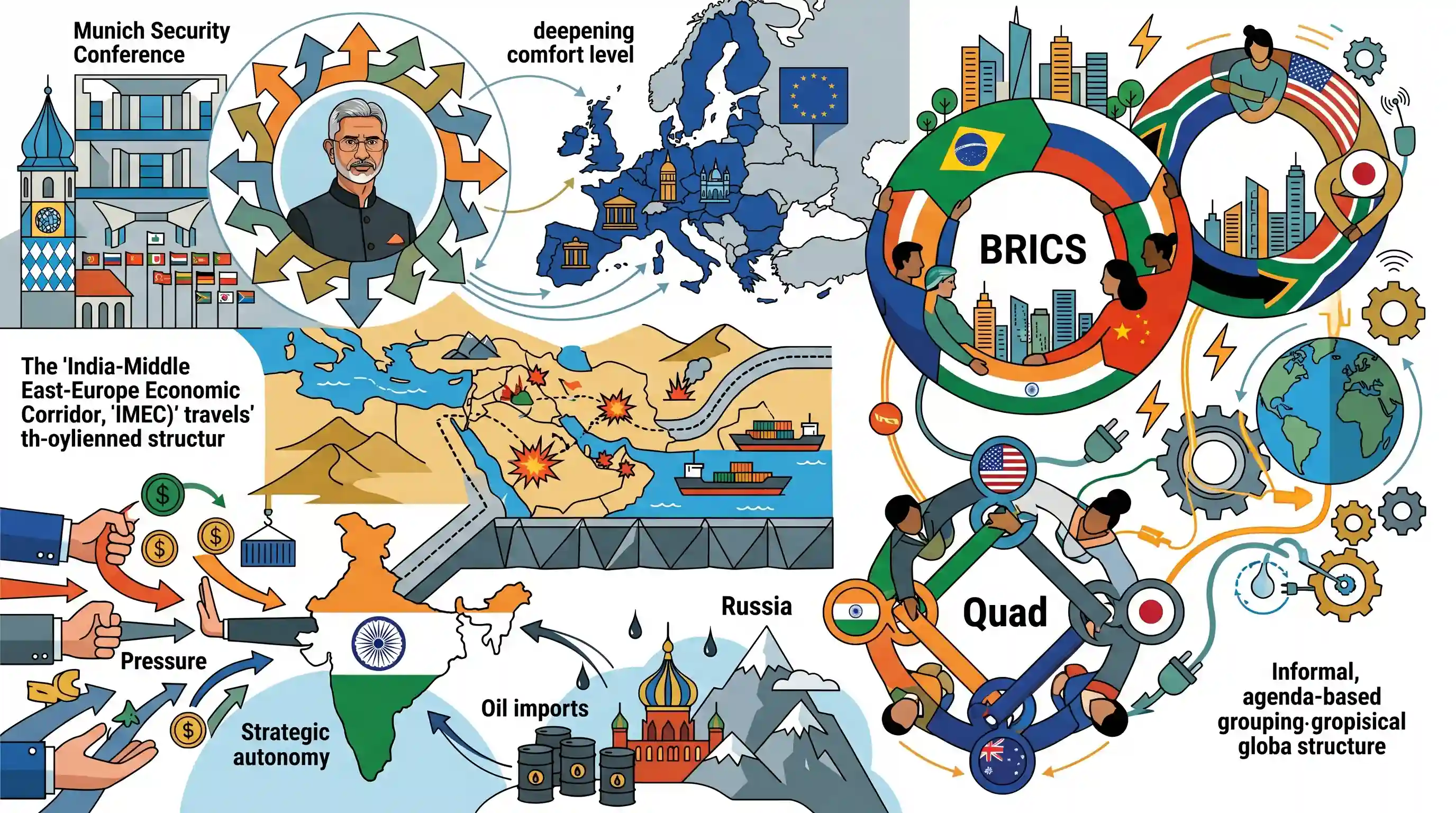
At the Munich Security Conference, External Affairs Minister S. Jaishankar emphasized the need to deepen the "comfort level" in India-Europe relations. He defended India's strategic autonomy amid assertions that the US administration's trade deals could force India to curb Russian oil imports. Jaishankar pointed out that agenda-based informal groupings (like the Quad and BRICS) are increasingly shaping the geopolitical architecture in response to global structural shifts. Additionally, he noted that while progress on the India-Middle East-Europe Economic Corridor (IMEC) has slowed due to conflict in West Asia, its fundamental rationale remains strong.
Key Points
- External Affairs Minister S. Jaishankar strongly defended India's strategic autonomy against claims that future US trade agreements would curb its imports of Russian oil.
- He advocated for a deeper "comfort level" in India-Europe ties, noting Europe's increasing engagement in regions like the Indo-Pacific.
- Emphasized that agenda-based, non-treaty groupings like the Quad and BRICS reflect the diffusion of global power in a multipolar world.
- Acknowledged that the India-Middle East-Europe Economic Corridor (IMEC) faces delays due to the West Asian conflict but retains strong fundamental relevance.
- Clarified that the 2025 Quad Summit to be hosted by India is not cancelled, highlighting early engagement by the new US Secretary of State with Quad partners.
Important Terms
India-Middle East-Europe Economic Corridor (IMEC)

A multimodal ship-to-rail connectivity project launched at the 2023 G20 Summit to link India, the Middle East, and Europe through trade, energy, and digital networks.
UPSC context
GS-II (International Relations); evaluates connectivity strategies, "Act West" policy, and alternatives to China's Belt and Road Initiative (BRI).
Strategic Autonomy
India's foreign policy doctrine emphasizing the ability to make sovereign decisions and pursue national interests without being constrained by external pressures or formal military alliances.
UPSC context
GS-II (Foreign Policy); tests the evolution from non-alignment to multi-alignment and balancing relations with competing global powers.
Quad
An informal strategic forum comprising India, the United States, Japan, and Australia, dedicated to ensuring a free, open, and rules-based Indo-Pacific region.
UPSC context
GS-II (Global Groupings); tests understanding of Indo-Pacific security architecture and India's role in regional power dynamics.
BRICS
An intergovernmental organization of major emerging economies (Brazil, Russia, India, China, South Africa + expansion) acting as a counterweight to Western-led platforms and advocating for multipolarity.
UPSC context
GS-II (International Institutions); evaluates South-South cooperation, global governance reforms, and India's leadership in the Global South.
Munich Security Conference (MSC)
An annual international forum on security policy held in Germany, serving as a key platform for global leaders to debate pressing security and foreign policy challenges.
UPSC context
GS-II (Important International Forums); relevant for India's diplomatic outreach and articulation of its worldview on global security.
European Union (EU)
A political and economic union of 27 European countries; it is one of India's largest trading partners and a critical partner for technology, green energy, and security.
UPSC context
GS-II (Bilateral Relations); assesses India-Europe strategic ties, trade negotiations (FTA), and cooperation on global environmental standards.
Prelims Trap
Quad and BRICS are formal treaty-based organizations shaping the new global architecture.
The article explicitly notes these are "agenda-based, non-treaty groupings." UPSC often traps students by confusing informal plurilaterals with formal chartered organizations like NATO or the SCO.
Static Concepts Connected
How does 'Strategic Autonomy' differ from traditional Non-Alignment?
- Traditional NAM: Focused on maintaining equidistance from Cold War blocs, avoiding military alliances, and preserving ideological independence.
- Strategic Autonomy: Involves issue-based, proactive multi-alignment. It means partnering with competing powers (e.g., US and Russia) simultaneously to secure core national interests like energy security.
What is the core framework of the Munich Security Conference (MSC)?
- Informal Forum: Often called the 'Davos of Defence', it is an independent annual gathering, not a UN-mandated or intergovernmental treaty body.
- Focus Area: Provides a platform for political and military leaders to debate international security policy and emerging threats outside formal diplomatic constraints.
Cross-Topic Patterns
Energy security vs. Trade pressures
India's import of discounted Russian oil (energy security) is increasingly clashing with US trade negotiations, merging GS-III Economy themes with GS-II IR strategic autonomy.
Geopolitics disrupting Geoeconomics
The stalling of the IMEC corridor demonstrates how regional conflicts (West Asia) directly undermine transnational infrastructure and trade connectivity initiatives designed to counter China's BRI.
Rise of issue-based Minilateralism
The gridlock in traditional multilateral bodies (UN, WTO) is pushing India towards flexible, issue-based plurilaterals (Quad, BRICS) to maximize strategic leverage globally.

Expect a multi-statement 2026 Prelims question linking IMEC's geographic route to the broader rise of non-treaty minilaterals like Quad.
Linked PYQs · 5
Linked PYQs · 5
- 2025MainsGS2
"Energy security constitutes the dominant kingpin of India's foreign policy, and is linked with India's overarching influence in Middle Eastern countries.” How would you integrate energy security with India's foreign policy trajectories in the coming years?
- 2020MainsGS2
Quadrilateral Security Dialogue (Quad)' is transforming itself into a trade bloc from a military alliance, in present times - Discuss.
- 2020MainsGS2
What is the significance of Indo-US defence deals over Indo-Russian defence deals? Discuss with reference to stability in the Indo-Pacific region.
- 2017MainsGS2
The question of India's Energy Security constitutes the most important part of India's economic progress. Analyze India's energy policy cooperation with West Asian countries.
- 2023MainsGS2
‘The expansion and strengthening of NATO and a stronger US-Europe strategic partnership works well for India.’ What is your opinion about this statement ? Give reasons and examples to support your answer.
