India Russia Bilateral Ties and Energy Security Amid Global Sanctions
Source:The Hindu ↗
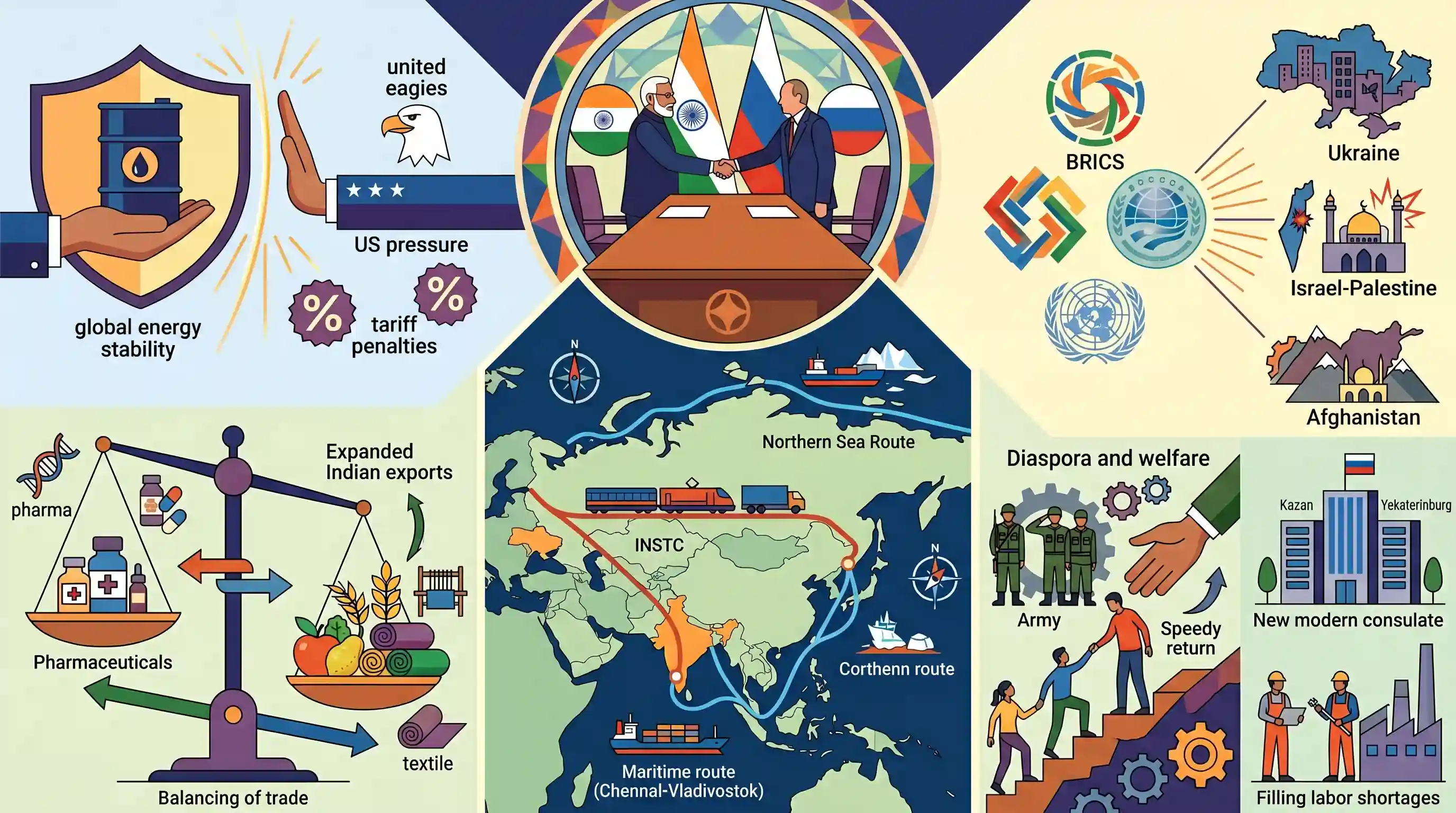
Why It Matters
This article highlights India's strategic autonomy in foreign policy, showcasing its ability to balance vital energy security needs with Russia amidst Western sanctions and pressure. It is crucial for understanding India's stance on multi-alignment, development of Eurasian connectivity (INSTC, maritime corridors), and the evolving challenges of the Indian diaspora (fraudulent recruitments).
Summary
External Affairs Minister S. Jaishankar met Russian President Vladimir Putin and Foreign Minister Sergey Lavrov in Moscow to comprehensively review bilateral relations. Amidst US pressure and tariff penalties by Donald Trump over expanding energy trade, Jaishankar firmly defended India's oil purchases from Russia as crucial for global energy stability. Talks focused on resolving trade imbalances by expanding Indian exports (pharma, agriculture, textiles) and advancing strategic connectivity corridors including the INSTC, Chennai-Vladivostok maritime route, and Northern Sea Route. Furthermore, they discussed multilateral coordination in BRICS, SCO, and the UNSC, addressing global crises in Ukraine, Israel-Palestine, and Afghanistan. Jaishankar also prioritized the speedy return of Indians fraudulently recruited into the Russian Army and announced new consulates in Kazan and Yekaterinburg to support Indian manpower filling Russian labor shortages.
Key Points
- EAM S. Jaishankar defended India\'s purchase of Russian oil as a necessary step to stabilize global energy markets, countering U.S. pressure and tariff threats from Donald Trump.
- Bilateral discussions emphasized correcting trade imbalances by increasing Indian exports to Russia in sectors like pharmaceuticals, agriculture, and textiles.
- India and Russia agreed to boost overland and maritime connectivity through the INSTC, Chennai-Vladivostok corridor, and the Northern Sea Route.
- Both nations coordinated their positions on multilateral platforms (BRICS, SCO, UNSC) and discussed geopolitical crises in Ukraine, Israel-Palestine, and Afghanistan.
- Jaishankar urgently raised the issue of Indians fraudulently recruited to fight for the Russian Army in Ukraine, seeking swift resolution.
- New Indian consulates will be opened in Kazan and Yekaterinburg to enhance people-to-people ties and support Indian manpower in Russian industries.
Important Terms
International North-South Transport Corridor (INSTC)

A 7,200 km multimodal (sea, rail, road) network connecting India, Iran, and Russia. It bypasses the Suez Canal, reducing transit time by 40% and transport costs by 30%.
UPSC context
GS Paper II/III: Strategic connectivity and "Connect Central Asia" policy; vital for bypassing Pakistan and enhancing trade with Eurasia.
Chennai-Vladivostok Eastern Maritime Corridor (CVEMC)
A 5,600 nautical mile sea route connecting Chennai to Russia’s Far East (Vladivostok). It cuts shipping time from 40 to 24 days, bypassing traditional European routes via the Suez Canal.
UPSC context
GS Paper II: International Relations. Links India's "Act East" with "Act Far East" policies; crucial for Indo-Pacific energy security.
Northern Sea Route (NSR)
A 5,600 km shipping lane in the Arctic Ocean connecting Europe and the Asia-Pacific. It is significantly shorter than the Suez route and increasingly navigable due to thawing Arctic ice.
UPSC context
GS Paper II: Geopolitics. Strategic for energy security (Arctic hydrocarbons) and diversifying global trade routes away from maritime chokepoints.
India-Russia Inter-Governmental Commission (IRIGC-TEC)
The primary institutional mechanism established in 1994 for bilateral cooperation. Co-chaired by India’s External Affairs Minister and Russia’s Deputy PM, it manages trade, energy, and scientific working groups.
UPSC context
GS Paper II: Bilateral Relations. Tests knowledge of formal frameworks driving the "Special and Privileged Strategic Partnership" and trade targets.
BRICS
A grouping of major emerging economies (Brazil, Russia, India, China, South Africa), expanded in 2024. It promotes multipolarity, global governance reform, and alternative financial systems like the New Development Bank.
UPSC context
GS Paper II: Global Groupings. Vital for Global South representation, de-dollarization debates, and reforming Western-centric international institutions.
Shanghai Cooperation Organisation (SCO)
A permanent Eurasian security and economic alliance (10 members including India). It focuses on regional stability, counter-terrorism (RATS), and combating the "Three Evils": terrorism, separatism, and extremism.
UPSC context
GS Paper II: Regional Groupings. Essential for India’s security engagement in Central Asia and balancing relations with China and Russia.
United Nations Security Council (UNSC)
One of six principal UN organs, responsible for international peace and security. It consists of five permanent members (P5) with veto power and ten rotating non-permanent members.
UPSC context
GS Paper II: International Institutions. Focuses on global governance reform and India’s longstanding bid for a permanent seat.
Prelims Trap
"The INSTC connects India to Russia via overland routes through Pakistan and Afghanistan."
INSTC is a multi-modal network linking India, Iran, Azerbaijan, and Russia. It specifically bypasses Pakistan and Afghanistan by utilizing sea routes to Iranian ports before heading north overland.
Static Concepts Connected
What are the geographical footprints of India-Russia maritime connectivity initiatives?
- Chennai-Vladivostok Route: Passes via the Malacca Strait, South China Sea, and Sea of Japan, drastically reducing cargo transit time from 40 days to 24 days.
- Northern Sea Route: An Arctic shipping lane along Russia's coast (Barents, Kara, Laptev seas to the Bering Strait), offering a shorter alternative to the Suez Canal.
How does the bilateral trade imbalance complicate Rupee-Ruble settlement?
- Special Vostro Accounts: Accounts held by an Indian bank for a Russian bank, enabling bilateral trade settlements in Rupees without relying on the SWIFT system or US Dollar.
- The Imbalance Dilemma: Because Indian imports (crude oil) massively outpace exports (pharma, agriculture), surplus Rupees accumulate in Russian Vostro accounts, making repatriation and reinvestment difficult.
Cross-Topic Patterns
Energy Security vs. Geopolitical Sanctions
India's purchase of discounted Russian crude tests its strategic autonomy, balancing US tariff threats against domestic inflation control and broader global energy market stability.
Diaspora Vulnerability in Conflict Zones
Fraudulent recruitment of Indians into the Russian army highlights gaps in emigration frameworks and the push factors of domestic unemployment driving high-risk overseas labor migration.

Expect a 2026 map-based prelims question sequencing the marginal seas crossed by the Chennai-Vladivostok corridor and Northern Sea Route.
Linked PYQs · 5
Linked PYQs · 5
- 2025MainsGS2
"Energy security constitutes the dominant kingpin of India's foreign policy, and is linked with India's overarching influence in Middle Eastern countries.” How would you integrate energy security with India's foreign policy trajectories in the coming years?
- 2017MainsGS2
The question of India's Energy Security constitutes the most important part of India's economic progress. Analyze India's energy policy cooperation with West Asian countries.
- 2023MainsGS2
‘Virus of Conflict is affecting the functioning of the SCO’ In the light of the above statement point out the role of India in mitigating the problems.
- 2024MainsGS2
Critically analyse India's evolving diplomatic, economic and strategic relations with the Central Asian Republics (CARs) highlighting their increasing significance in regional and global geopolitics.
- 2023MainsGS2
Indian diaspora has scaled new heights in the West. Describe its economic and political benefits for India.
