India raises concerns on US sanctions act during talks
Source:The Hindu ↗
কেন এটি গুরুত্বপূর্ণ
This high-level diplomatic interaction highlights the friction points in India-U.S. relations, specifically regarding unilateral U.S. sanctions laws, and tests India's pursuit of strategic autonomy in defense and foreign policy.
সারসংক্ষেপ
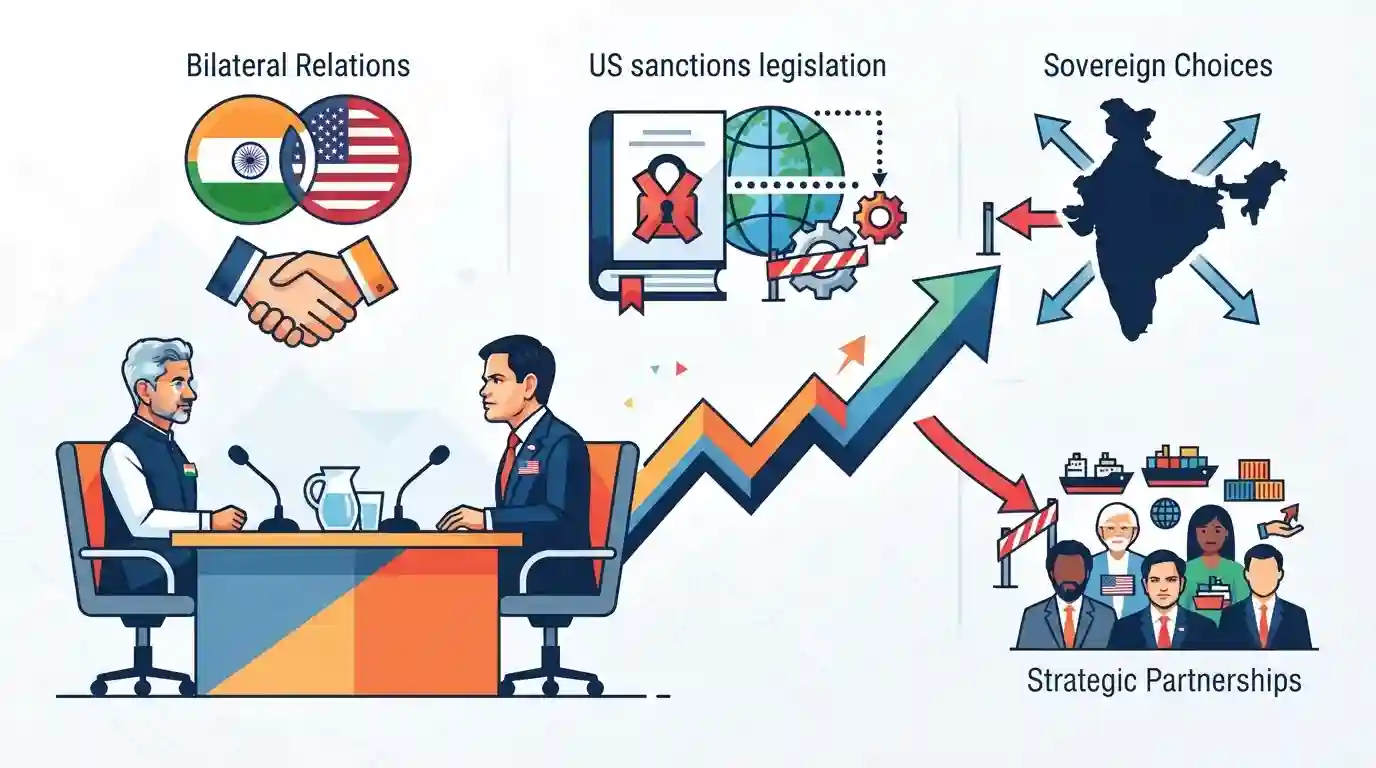
External Affairs Minister S. Jaishankar met U.S. counterpart Marco Rubio to discuss bilateral relations, during which India formally raised concerns over U.S. sanctions legislation impacting its sovereign choices and strategic partnerships.
মূল বিষয়
- External Affairs Minister S. Jaishankar met with U.S. official Marco Rubio in the United States.
- During the meeting, India raised its concerns regarding U.S. sanctions Acts that impact India's strategic autonomy and defense procurement.
- The talks underscored ongoing diplomatic engagements between India and the U.S. to navigate bilateral differences while strengthening the broader strategic partnership.
গুরুত্বপূর্ণ শব্দ
Countering America's Adversaries Through Sanctions Act (CAATSA)

A U.S. federal law allowing the imposition of secondary sanctions on countries engaging in significant transactions with Russia, Iran, or North Korea's defense and intelligence sectors.
UPSC context
UPSC GS Paper II (International Relations): Tests understanding of U.S. domestic legislation impacting India's strategic autonomy and defense purchases like the S-400 system.
sanctions Act
U.S. legislative measures, such as the Sanctioning Russia and Iran Act (SRIA), imposing economic penalties or tariffs that can affect third-party trade and energy security.
UPSC context
UPSC GS Paper II (International Relations): Important for studying the impact of developed countries' economic policies and unilateral sanctions on developing nations like India.
U.S. Congress
The bicameral legislature of the federal government of the United States, comprising the House of Representatives and the Senate, responsible for enacting foreign policy and sanctions legislation.
UPSC context
UPSC GS Paper II (International Relations): Essential for understanding how legislative actions in partner countries shape bilateral ties and affect Indian national interests.
Ministry of External Affairs India
The executive government department of India responsible for the country's foreign relations, diplomatic missions, and safeguarding Indian interests abroad.
UPSC context
UPSC GS Paper II (International Relations): Key institutional actor in formulating India's foreign policy responses to global sanctions and strategic challenges.
সংযুক্ত স্থির ধারণা
What are the key provisions and waiver mechanisms under the CAATSA framework?
- Legislative Intent: Passed in 2017 to counter aggression by Iran, Russia, and North Korea through secondary sanctions.
- Waiver Provision: The US President can issue a national security waiver for specific countries, though congressional pushback remains high.
- Target Scope: Targets significant transactions with Russian intelligence or defense sectors, creating compliance friction for nations like India.
আন্তঃবিষয় প্যাটার্ন
Strategic Autonomy vs. Unilateral Sanctions Regime
India's defense diversification (S-400 systems) tests the operational limits of US unilateral secondary sanctions like CAATSA against stated strategic autonomy goals.

CAATSA waivers, strategic autonomy, and US secondary sanctions are prime candidates for UPSC GS-2 analytical statements.
সংযুক্ত PYQ · 2
সংযুক্ত PYQ · 2
- 2012MainsGS2
How have the US sanctions against Iran affected India's bilateral relations with Iran?
- 2018MainsGS2
India and USA are two large democracies. Examine the basic tenets on which the two political systems are based.
