India BRICS Strategy and Management of US Trade Pressures
Source:Indian Express ↗
Why It Matters
Provides critical insights into how India balances its strategic autonomy and multi-alignment in an increasingly polarized world. It is highly relevant for GS Paper 2 (International Relations) and GS Paper 3 (Economy), particularly concerning trade protectionism, currency manipulation, and the evolving global order.
Summary
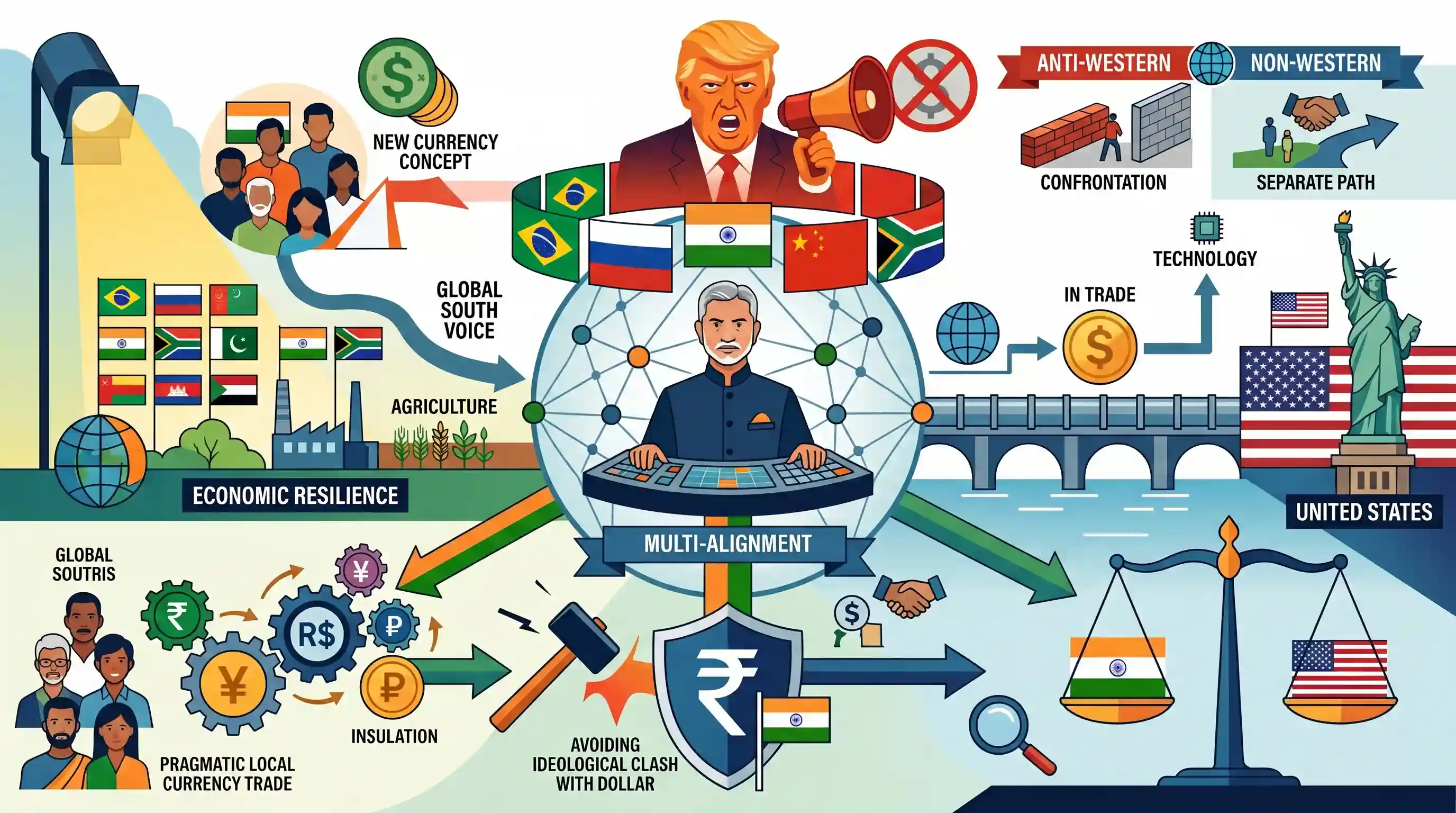
External Affairs Minister S. Jaishankar recently articulated India's strategy within the BRICS grouping amidst looming trade and geopolitical pressures. Against the backdrop of US President-elect Donald Trump threatening a 100% tariff on BRICS nations if they pursue de-dollarization or a new alternative currency, Jaishankar clarified India's stance. He stressed that India views BRICS as a "non-Western" platform focused on economic resilience and giving a voice to the Global South, rather than an "anti-Western" bloc. India's approach to global shocks involves pragmatic measures like trading in local currencies to insulate its economy, rather than leading an ideological campaign to dethrone the US dollar. This reflects India's broader strategy of multi-alignment, balancing its membership in organizations like BRICS with strong strategic and economic ties to the United States.
Key Points
- **India's Approach to BRICS**: EAM S. Jaishankar emphasized that India views BRICS as a "non-Western" grouping aimed at cooperation, not an "anti-Western" alliance.
- **Navigating US Pressure**: India is dealing with dual-tariff pressure from the US, including potential 100% tariffs threatened by Donald Trump on BRICS nations pursuing a common currency, as well as bilateral trade protectionism.
- **Pragmatic Currency Trade**: Instead of ideological 'de-dollarization', India's strategy focuses on promoting local currency settlements (like the rupee-trade mechanism) to weather global macroeconomic shocks and currency volatility.
- **Strategic Autonomy**: The situation highlights India's multi-aligned foreign policy, balancing its active role in multipolar platforms like BRICS with its deep strategic partnerships with the West.
Important Terms
BRICS

An intergovernmental organization of emerging economies originally comprising Brazil, Russia, India, China, and South Africa; expanded in 2024 to include Egypt, Ethiopia, Iran, and the UAE.
UPSC context
GS Paper II: Important for questions on multilateral groupings and India's role in a multipolar world order.
De-dollarization
The process of reducing global or national reliance on the US dollar for international trade, foreign exchange reserves, and financial transactions.
UPSC context
GS Paper III & II: Tests knowledge of global trade, currency internationalization, and geopolitical economic shocks.
Multi-alignment
A pragmatic foreign policy strategy where a country maintains independent, productive relationships with multiple competing global powers and blocs simultaneously.
UPSC context
GS Paper II: A core pillar of modern Indian diplomacy and its pursuit of national interest.
Global South
Nations in Asia, Africa, and Latin America characterized by developing economies and a shared history of colonialism, seeking equitable global governance reform.
UPSC context
GS Paper II: Relevant for India’s leadership role in international forums like the G20.
Strategic Autonomy
A state's ability to pursue its national interests and make independent foreign policy choices without being coerced by external powers or alliance obligations.
UPSC context
GS Paper II: Fundamental concept in Indian foreign policy since independence, evolved from non-alignment.
Tariffs
Taxes or duties imposed by a government on imported goods, often used to protect domestic industries or as leverage in geopolitical negotiations.
UPSC context
GS Paper III: Vital for understanding trade wars, protectionism, and their impact on India's economy.
Prelims Trap
India actively advocates for a common BRICS currency to rapidly de-dollarize and replace the US Dollar in international trade.
India explicitly opposes a common BRICS currency and an 'anti-Western' ideological stance. It pursues bilateral Local Currency Settlements (LCS) to pragmatically de-risk from dollar volatility.
Static Concepts Connected
How do Special Rupee Vostro Accounts (SRVAs) facilitate local currency trade?
- Mechanism: Domestic authorized dealer banks open these accounts on behalf of correspondent foreign banks.
- Settlement: Indian importers pay in INR into the SRVA, and Indian exporters are paid from the accumulated balances in that same account.
- Forex De-risking: It bypasses the need for hard currencies like the US Dollar, conserving forex reserves and protecting against exchange rate volatility.
What distinguishes India's Multi-alignment strategy from traditional Non-Alignment?
- Historical Distance: Non-alignment historically focused on passive distancing from Cold War geopolitical blocs to maintain independence.
- Active Engagement: Multi-alignment involves concurrent, active engagement with competing powers (e.g., Quad and BRICS) to maximize strategic autonomy.
- Issue-based: Partnerships are formed based on mutual, practical interests rather than rigid ideological boundaries.
Cross-Topic Patterns
Trade Protectionism & Forex Management
Tariff threats from developed nations directly link to India's push for SRVAs and bilateral FTAs to bypass dollar-dominated trade volatility and protect its macroeconomic stability.
Global South vs. Anti-West Positioning
India leverages BRICS and the G20 to amplify the Global South's voice, actively resisting Chinese and Russian attempts to pivot these expanded groupings into explicitly anti-US or anti-West blocs.

Expect a Prelims question contrasting India's Vostro-account local currency settlements with the proposed BRICS common currency.
Linked PYQs · 3
Linked PYQs · 3
- 2018MainsGS3
How would the recent phenomena of protectionism and currency manipulations in world trade affect macroeconomic stability of India?
- 2025MainsGS3
What are the challenges before the Indian economy when the world is moving away from free trade and multilateralism to protectionism and bilateralism? How can these challenges be met?
- 2019MainsGS2
‘What introduces friction into the ties between India and the United States is that Washington is still unable to find for India a position in its global strategy, which would satisfy India's national self-esteem and ambitions.’ Explain with suitable examples.
