India G7 Foreign Ministers Meeting and West Asia Diplomacy
Source:The Hindu ↗
Why It Matters
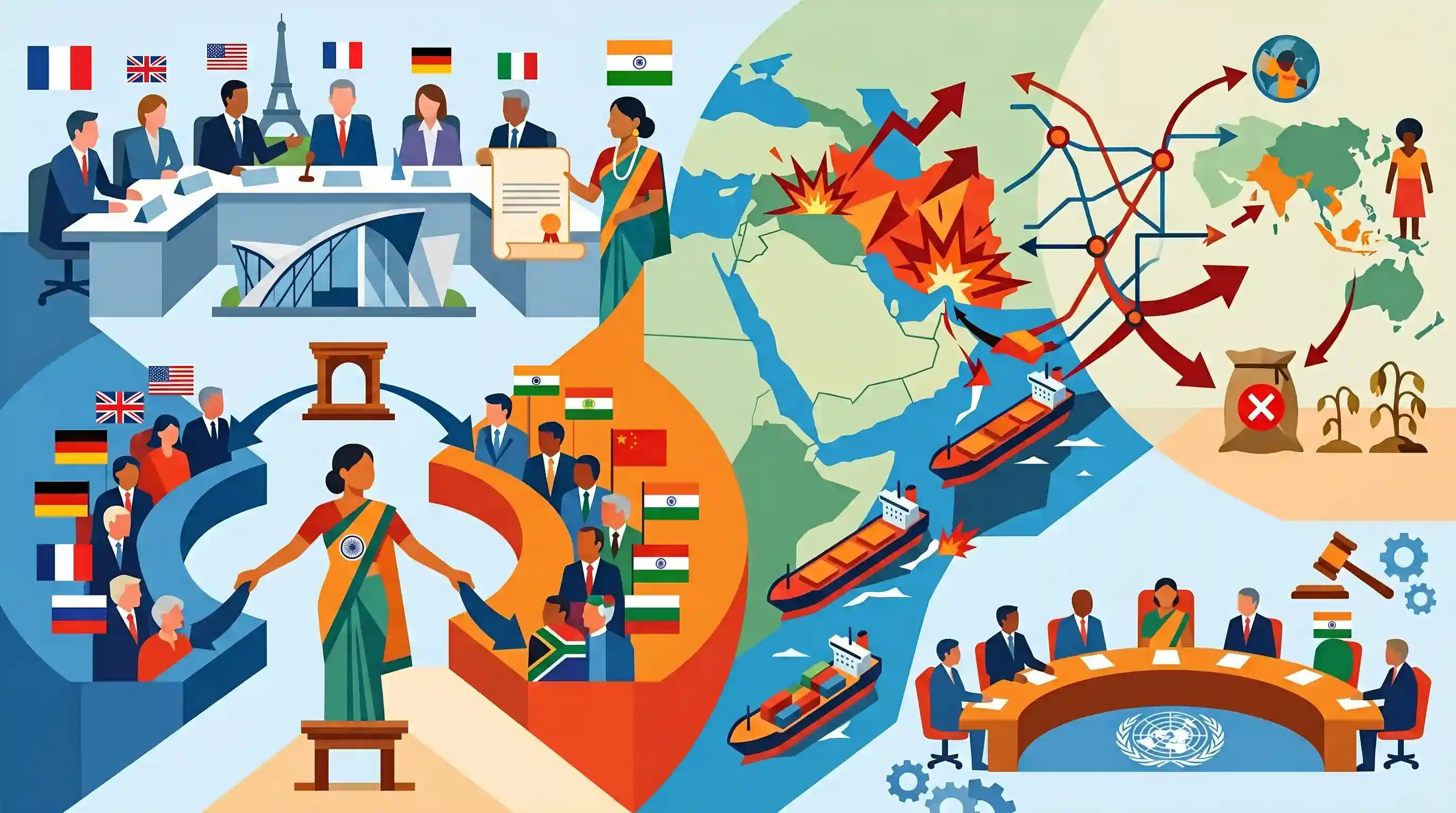
The meeting highlights India's strategic importance as a bridge between Western powers (G7) and the Global South/multilateral non-Western groupings (BRICS). It also underscores the direct impact of West Asian instability (particularly concerning the Strait of Hormuz) on India's energy security and the broader economic stability of developing nations, which are critical themes for UPSC GS Paper 2 (International Relations) and GS Paper 3 (Energy Security).
Summary
External Affairs Minister S. Jaishankar attended the G7 Foreign Ministers’ meeting in France with partner nations, where discussions were dominated by the escalating West Asia crisis. The conflict involving Iran has intensified concerns regarding energy supplies, the security of the Strait of Hormuz, and global supply chains, significantly affecting the Global South through potential fertilizer and food shortages. France's invitation highlights India's growing global footprint, notably attempting to bridge the G7 and BRICS (currently under India's presidency) to address global divides. The meeting also provided a platform to advocate for reforming global governance structures, reinforcing India's push for a permanent UN Security Council seat.
Key Points
- EAM S. Jaishankar attended the G7 Foreign Ministers' meeting in France, laying the groundwork for PM Modi's expected participation at the G7 Summit in Évian.
- The central focus of the meeting was the escalating crisis in West Asia, particularly the conflict involving Iran and Israel, and its ripple effects on global energy and stock markets.
- The security of the Strait of Hormuz emerged as a critical concern following the reported killing of an Iranian commander allegedly attempting to block the waterway.
- France sought to align the G7 agenda with India's current BRICS presidency, acknowledging India's strategic position in voicing the concerns of the Global South regarding food, fertilizer, and energy security.
- The discussions underscored the necessity of reforming global governance institutions, with India reiterating its pursuit of a permanent seat at the UN Security Council.
Important Terms
G7 (Group of Seven)

Informal bloc of seven advanced economies (USA, UK, France, Germany, Italy, Japan, Canada) and the EU. It coordinates on global security, finance, and climate. India is a frequent 'Outreach' partner.
UPSC context
GS-II: Important International groupings. Tests India's strategic engagement with the 'Collective West' and its role in global governance.
BRICS
Grouping of major emerging economies including Brazil, Russia, India, China, and South Africa, expanded in 2024. India holds the 2026 rotating presidency, focusing on multipolarity and inclusive development.
UPSC context
GS-II: Regional and global groupings. Tests India's leadership in non-Western forums and its push for 'Humanity First' global agendas.
United Nations Security Council (UNSC)
Principal UN organ for international peace and security. It has 5 permanent (P5) and 10 non-permanent members. India is a lead advocate for its reform and expansion.
UPSC context
GS-II: International Institutions. Focuses on India's bid for permanent membership and the need for updated global governance.
Global South
Collective term for developing and under-developed nations in Africa, Asia, and Latin America. India positions itself as their 'voice,' advocating for debt relief, energy access, and climate justice.
UPSC context
GS-II: India's foreign policy. Tests India’s role as a bridge-builder between developed nations and the developing world.
Strait of Hormuz
A narrow, strategic chokepoint between the Persian Gulf and Gulf of Oman. It handles roughly 20% of global oil trade and ~50% of India's crude imports.
UPSC context
GS-I/II: World Geography and Energy Security. Crucial for understanding macroeconomic vulnerabilities and regional geopolitical risks.
Prelims Trap
India is a formal member of the G7 forum.
India is not a member of the G7 (advanced economies). It participates as an 'Outreach Country' or 'Guest' to voice Global South concerns.
Static Concepts Connected
What is the Strait of Hormuz and its geographical location?
- Location: A critical maritime chokepoint situated between Iran to the north and Oman (Musandam Peninsula) to the south.
- Connecting Waters: It connects the Persian Gulf to the Gulf of Oman and the Arabian Sea.
- Strategic Value: Facilitates transit for roughly 20% of global petroleum liquids, making it indispensable for energy-importing nations like India.
What distinguishes the G7 from other multilateral forums like BRICS?
- Member States: Comprises seven advanced industrialized democracies (US, UK, France, Germany, Italy, Canada, Japan) plus the EU.
- Institutional Structure: It operates as an informal bloc lacking a permanent secretariat or a formal charter, relying on annual rotating presidencies.
Cross-Topic Patterns
Chokepoints & Energy Security
Disruptions in Hormuz directly inflate India's import bill and current account deficit, linking Middle Eastern geopolitics to domestic macroeconomic stability.
Multi-alignment: G7 to BRICS
India leverages its 2026 BRICS presidency while attending the G7 to act as a bridge, advocating for Global South concerns across polarized global blocs.

Map questions matching West Asian chokepoints (Hormuz, Bab-el-Mandeb) to their bordering nations will likely feature in Prelims 2026.
Linked PYQs · 4
Linked PYQs · 4
- 2012MainsGS2
Compare the significance of IBSA and BRICS in the context of India's multilateral diplomacy.
- 2015MainsGS2
Discuss the impediments India is facing in its pursuit of a permanent seat in UN Security Council.
- 2025MainsGS2
"Energy security constitutes the dominant kingpin of India's foreign policy, and is linked with India's overarching influence in Middle Eastern countries.” How would you integrate energy security with India's foreign policy trajectories in the coming years?
- 2017MainsGS2
The question of India's Energy Security constitutes the most important part of India's economic progress. Analyze India's energy policy cooperation with West Asian countries.
