Bilateral Engagement and Diplomatic Normalization with China
Source:Indian Express ↗
Why It Matters
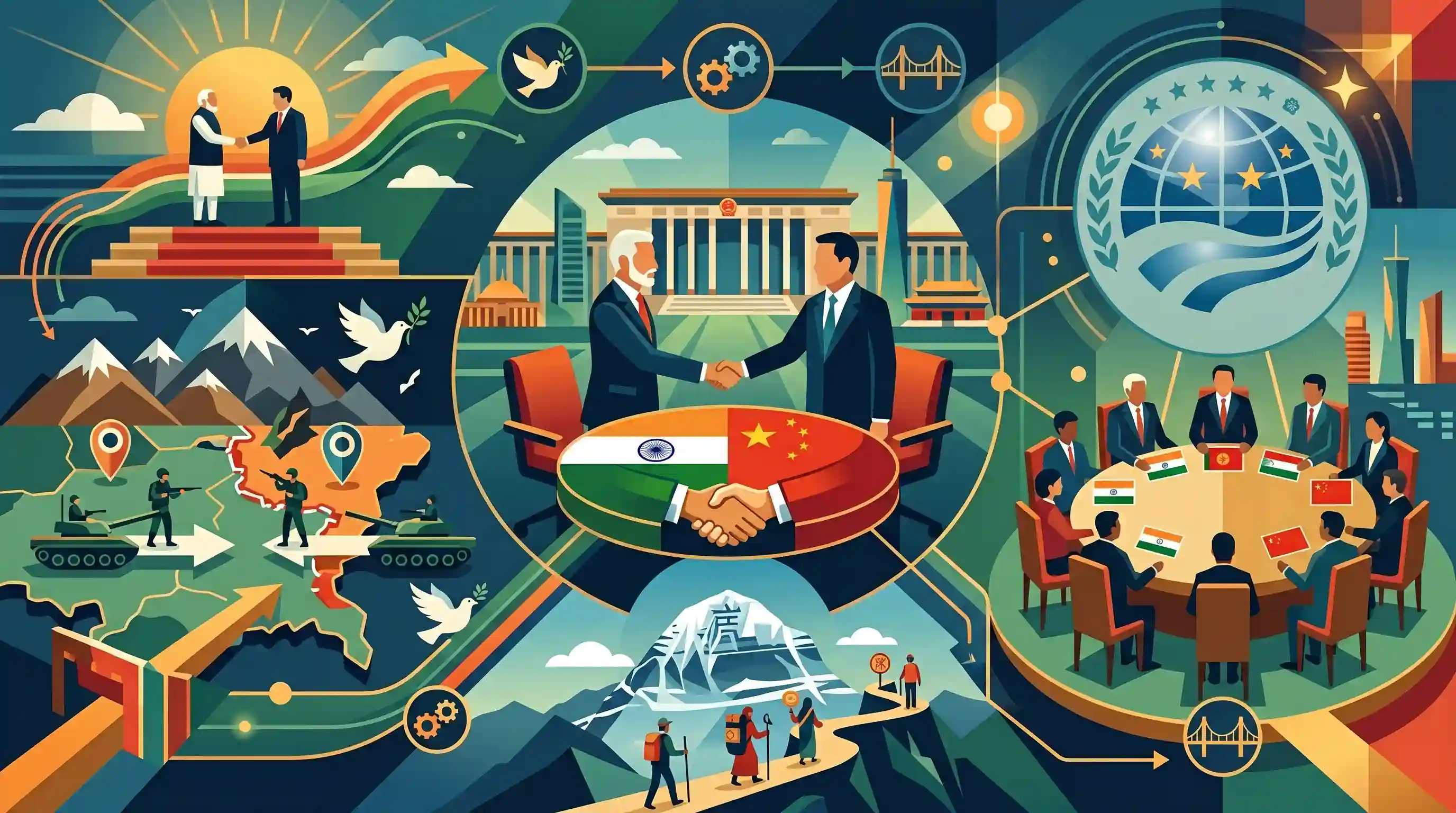
The visit is a critical milestone in India's foreign policy, indicating a transition from a tense military standoff to diplomatic normalization with China. It underscores the interplay between border security (Ladakh disengagement) and broader geopolitical engagements (SCO, Kazan summit), which is central to GS Paper 2 (International Relations).
Summary
External Affairs Minister S Jaishankar's visit to China, the first by an Indian EAM since the 2020 Ladakh military standoff, marks a significant step in the normalization of India-China ties. During his meeting with Chinese Vice President Han Zheng in Beijing, Jaishankar underscored the positive momentum generated by the October 2024 Modi-Xi summit in Kazan and the subsequent disengagement in Demchok and Depsang. Occurring alongside the SCO foreign ministers' meeting in Tianjin, the visit highlights India's strategy of balancing bilateral border resolution with multilateral engagement. The discussions also included the resumption of the Kailash Mansarovar Yatra, signaling a revival of cultural ties.
Key Points
- External Affairs Minister S Jaishankar made the first visit to China by an Indian EAM since the military standoff began in eastern Ladakh in May 2020.
- Jaishankar met Chinese Vice President Han Zheng, emphasizing the steady improvement in relations since the Modi-Xi summit in Kazan in October 2024.
- The diplomatic thaw follows the finalization of a disengagement agreement covering Demchok and Depsang, bringing stability to the border.
- The visit took place on the sidelines of the Shanghai Cooperation Organisation (SCO) foreign ministers\' meeting in Tianjin, reflecting ongoing multilateral engagement.
- The resumption of the Kailash Mansarovar Yatra was highlighted as a key step in restoring cultural and people-to-people ties.
Important Terms
Ladakh Disengagement Agreement (October 2024)

A pact on patrolling arrangements along the LAC in eastern Ladakh, restoring the pre-April 2020 status quo in the final friction points of Depsang and Demchok.
UPSC context
GS Paper II: Border management and bilateral agreements; tests the framework of 'disengagement, de-escalation, and de-induction' for regional stability.
Shanghai Cooperation Organisation (SCO)
A permanent intergovernmental Eurasian alliance focused on security, economy, and politics. India joined as a full member in 2017 to enhance regional connectivity and counter-terrorism.
UPSC context
GS Paper II: Regional groupings; crucial for India's 'Connect Central Asia' policy and managing its strategic presence in Eurasia.
Kazan Summit (2024)
The 16th BRICS Summit in Russia, hosting the first formal bilateral meeting between PM Modi and President Xi in five years to stabilize India-China ties.
UPSC context
GS Paper II: Multilateral diplomacy; tests how global forums provide windows for bilateral conflict resolution among member states.
Demchok and Depsang
Strategically vital friction points in eastern Ladakh. Depsang is a high-altitude plateau near the Karakoram Pass; Demchok is a sector in southeast Ladakh.
UPSC context
GS Paper I & III: Geography/Mapping and Internal Security; focuses on the strategic significance of the LAC and northern border defense.
Kailash Mansarovar Yatra
A significant pilgrimage to Tibet Autonomous Region (China). Its resumption marks a revival of cultural ties after being suspended during the 2020 standoff.
UPSC context
GS Paper I & II: Culture and International Relations; examines the role of religious and cultural diplomacy in normalizing bilateral relations.
Regional Anti-Terrorist Structure (RATS)
A permanent SCO body based in Tashkent that coordinates member states' efforts against the 'three evils' of terrorism, separatism, and extremism.
UPSC context
GS Paper III: Internal Security; tests India's engagement in international counter-terrorism frameworks and intelligence sharing.
Prelims Trap
The Kailash Mansarovar Yatra is undertaken exclusively through the Lipulekh pass in Uttarakhand.
The Yatra is officially conducted via two primary routes by the Indian government: the Lipulekh Pass in Uttarakhand and the Nathu La Pass in Sikkim.
Static Concepts Connected
Where are the key strategic flashpoints located in Eastern Ladakh?
- Depsang Plains: Located in the north; controls access to the critical Daulat Beg Oldie (DBO) airstrip and the Karakoram Pass.
- Demchok: Located in southern Ladakh near the point where the Indus River enters Indian territory.
- Galwan Valley: Situated centrally between Depsang and Pangong Tso, along the crucial Shyok River valley.
Which major trans-boundary rivers originate near the Kailash Mansarovar region?
- Brahmaputra: Originates from the Chemayungdung glacier, located east of Lake Mansarovar.
- Indus: Originates from the Bokhar Chu glacier, located north of Lake Mansarovar.
- Sutlej: Originates from Rakshastal, a lake situated immediately adjacent to Lake Mansarovar.
Cross-Topic Patterns
SCO Multilateralism vs Bilateral Tensions
India's strategy to engage China at the SCO despite border disputes mirrors its approach to the Indus Water Treaty—insulating regional or treaty-based frameworks from direct bilateral geopolitical friction.
Kazan Summit and Global South Geopolitics
The border thaw occurred at the BRICS Kazan summit, tying bilateral normalization to India and China's broader contest for leadership within the newly expanded BRICS+ framework.

A map-based question ordering Ladakh's flashpoints (Depsang, Galwan, Pangong, Demchok) north-to-south is highly likely in 2026 Prelims.
Linked PYQs · 5
Linked PYQs · 5
- 2012MainsGS2
Do you think that China's emergence as one of the largest trading partners of India has adversely affected the settlement of the outstanding border problem?
- 2014MainsGS2
With respect to the South China sea, maritime territorial disputes and rising tension affirm the need for safeguarding maritime security to ensure freedom of navigation and over flight throughout the region. In this context, discuss the bilateral issues between India and China.
- 2021MainsGS2
Critically examine the aims and objectives of SCO. What importance does it hold for India?
- 2023MainsGS2
‘Virus of Conflict is affecting the functioning of the SCO’ In the light of the above statement point out the role of India in mitigating the problems.
- 2024PrelimsGS1
The longest border between any two countries in the world is between :
