India Foreign Policy Principles and Strategic Autonomy
Source:Indian Express ↗
Why It Matters
The article highlights the fundamental principles of India's foreign policy—prioritizing national interest, strictly resisting third-party mediation in bilateral disputes, and proactively addressing cross-border terrorism. These aspects are highly relevant to India's international relations and internal security paradigms.
Summary
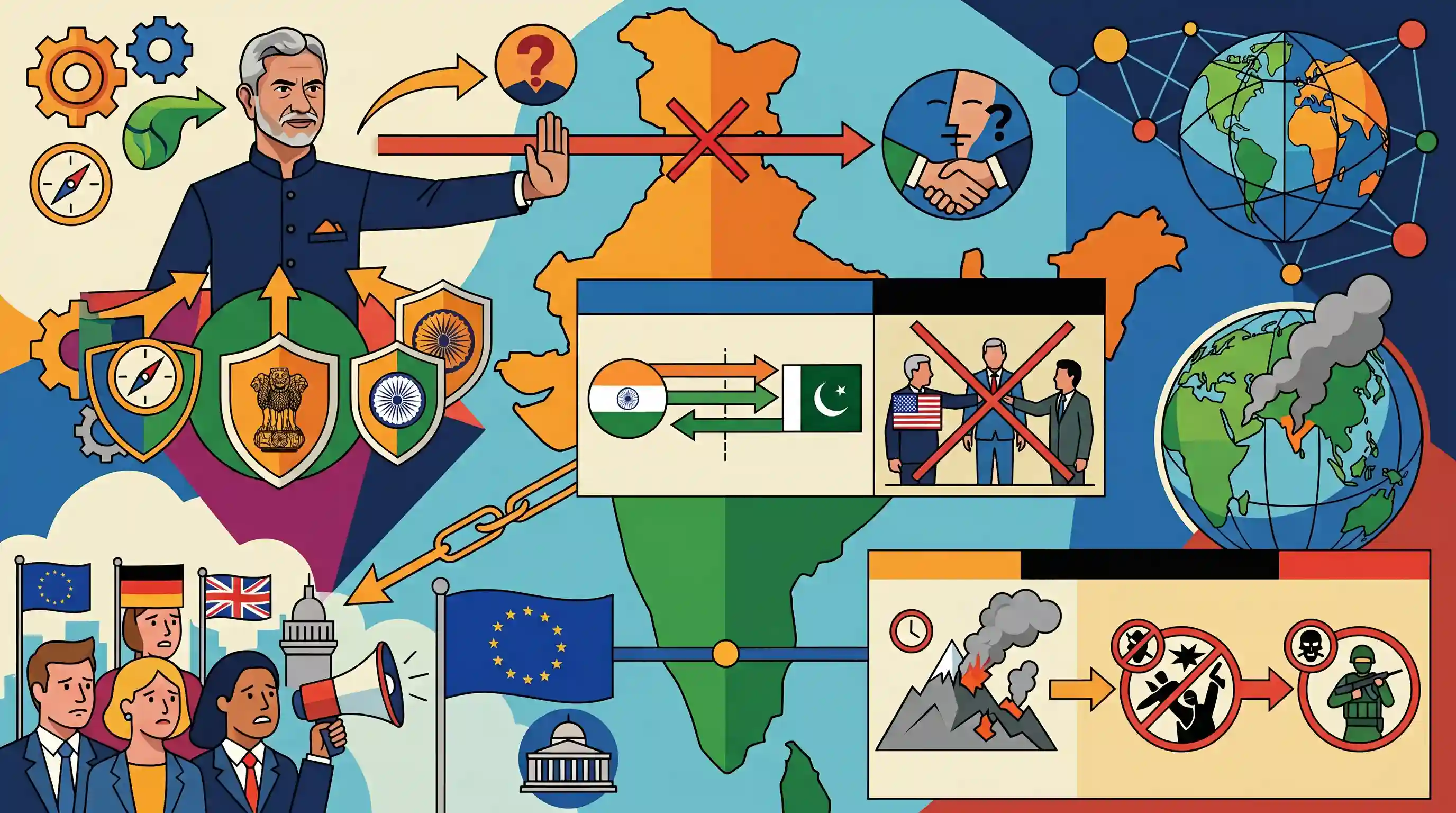
External Affairs Minister S Jaishankar addressed queries regarding India's trust in US President Donald Trump by emphasizing that Indian foreign policy is driven by national interest, not personalities. Amidst differing narratives, New Delhi categorically rejected US claims of mediating the ceasefire following "Operation Sindoor," reiterating that the de-escalation with Pakistan was achieved strictly through bilateral engagement without any third-party involvement. Jaishankar also contextualized Operation Sindoor as a necessary anti-terror response to the Pahalgam attack, urging the West to recognize the global threat of terrorism, while simultaneously advocating for deeper ties with the EU in a multipolar world.
Key Points
- External Affairs Minister S Jaishankar, when asked about trusting US President Donald Trump, stated that India's foreign policy prioritizes national interests over individual personalities.
- India firmly pushed back on Trump's claims of brokering the ceasefire following "Operation Sindoor", asserting that the resolution was achieved strictly via direct bilateral engagement between India and Pakistan.
- Highlighting the Pahalgam terror attack, Jaishankar urged Western nations to recognize India's response (Operation Sindoor) as an anti-terrorism measure rather than a mere border conflict, warning of the global threat of state-sponsored terrorism.
- Jaishankar underscored the EU's importance as a "major pole" in the global order, acknowledging Europe's pursuit of "strategic autonomy" in an increasingly multipolar world.
Important Terms
Operation Sindoor

A 2025 Indian precision military operation targeting terror infrastructure in Pakistan and PoK, launched in response to the Pahalgam terror attack to enforce a policy of zero tolerance for cross-border terrorism.
UPSC context
GS-II: India-Pakistan relations and security; tests understanding of India's 'proactive' defense posture and counter-terrorism diplomacy.
Strategic Autonomy
A core tenet of Indian foreign policy emphasizing independent decision-making and the pursuit of national interests without alignment to any specific power bloc or external pressure.
UPSC context
GS-II: Foreign policy principles; relevant for questions on India's 'balancing act' in a multipolar world and India-US-Russia ties.
Multipolar World Order
A global power structure characterized by multiple centers of influence (poles) such as the US, China, India, and the EU, rather than unipolar or bipolar dominance.
UPSC context
GS-II: Global groupings and agreements; focuses on changing world order and India's role as an emerging global power pole.
Bilateralism
The conduct of political, economic, or cultural relations between two sovereign states directly, specifically excluding third-party mediation or intervention in disputes.
UPSC context
GS-II: India and its neighborhood; tests knowledge of India's long-standing Simla Agreement (1972) stance against external mediation in Kashmir.
European Union (EU)
A 27-member political and economic union in Europe. For India, it is a key strategic partner for trade, technology, and climate cooperation through negotiations like the FTA.
UPSC context
GS-II: Bilateral and regional groupings; critical for questions on trade diversification (China-plus-one) and strategic partnerships in Europe.
Euractiv
A Brussels-based media network specializing in European Union policy and politics, frequently serving as a platform for high-level diplomatic discourse between the EU and its partners.
UPSC context
General: Useful as a source for understanding the European perspective on Indian foreign policy and the framing of international narratives.
Prelims Trap
The recent de-escalation between India and Pakistan was brokered by the United States.
India strictly adheres to the 1972 Shimla Agreement, categorically rejecting any third-party mediation (including the US) in its disputes with Pakistan.
Static Concepts Connected
What is the core mandate of the 1972 Shimla Agreement?
- Strict Bilateralism: Resolved that all disputes between India and Pakistan must be settled peacefully through direct bilateral talks.
- Third-Party Exclusion: Effectively rejected and bypassed the role of the UN or any third-party foreign mediators in the Kashmir dispute.
- Line of Control: Converted the 1949 UN Ceasefire Line into the Line of Control (LoC), legally binding both sides to respect it.
How does 'Strategic Autonomy' differ from traditional 'Non-Alignment'?
- Proactive Engagement: Emphasizes issue-based, multi-directional partnerships (like Quad and SCO simultaneously) rather than maintaining an equidistant aloofness.
- Pragmatic Realism: Driven purely by realpolitik and national interest rather than the ideological Third World solidarity that characterized the NAM era.
Cross-Topic Patterns
Strategic autonomy and EU multi-alignment
India's push for a multipolar world aligns with the EU's own quest for 'strategic autonomy', making the EU a natural geopolitical partner to balance US-China bipolarity.
Pre-emptive strikes under international law
By framing operations like "Sindoor" or Balakot strictly as non-military, anti-terror actions, India invokes the right of self-defense to legitimize its actions internationally.

Expect 2026 questions linking the strict bilateralism of the Shimla Agreement with India's right to pre-emptive anti-terror strikes.
Linked PYQs · 4
Linked PYQs · 4
- 2015MainsGS2
Terrorist activities and mutual distrust have clouded India-Pakistan relations. To what extent the use of soft power like sports and cultural exchanges could help generate goodwill between the two countries? Discuss with suitable examples.
- 2023MainsGS2
‘The expansion and strengthening of NATO and a stronger US-Europe strategic partnership works well for India.’ What is your opinion about this statement ? Give reasons and examples to support your answer.
- 2025MainsGS3
Terrorism is a global scourge. How has it manifested in India? Elaborate with contemporary examples. What are the counter measures adopted by the State? Explain.
- 2020MainsGS3
Analyze internal security threats and transborder crimes along Myanmar, Bangladesh and Pakistan borders including Line of Control (LoC). Also discuss the role played by various security forces in this regard.
