Jaishankar and Rubio discuss critical minerals and bilateral trade
Source:Indian Express ↗
Why It Matters
The reciprocal lowering of tariffs demonstrates a mature trade relationship capable of resolving persistent bilateral friction points. Additionally, the focus on critical minerals processing signals a strategic alignment to secure supply chains independent of China, which is crucial for green transitions and emerging technologies. Understanding this geopolitical realignment is vital for answering questions on IR dynamics in GS2.
Summary
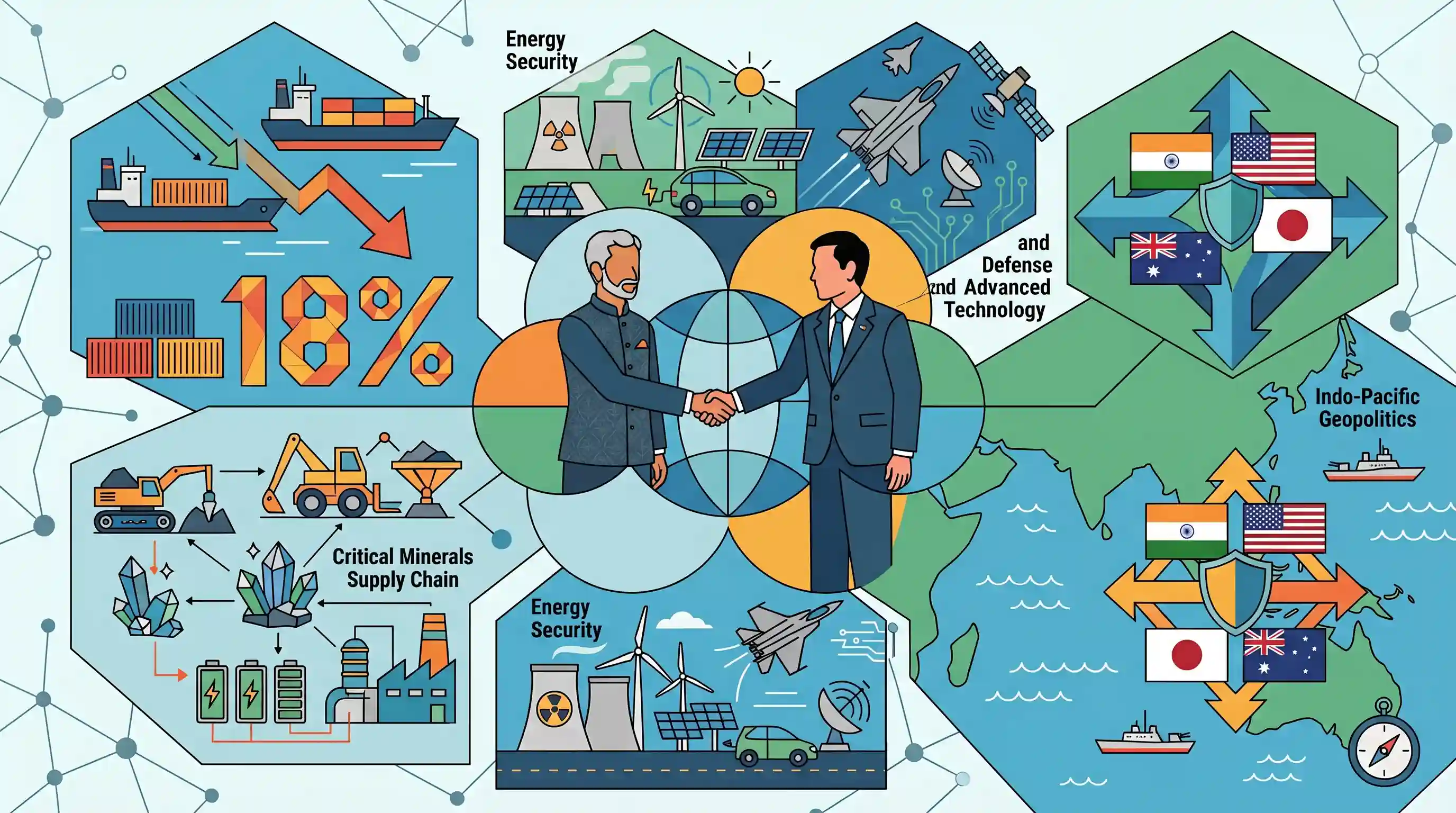
India's External Affairs Minister S. Jaishankar and US Secretary of State Marco Rubio met to discuss the strengthening of the India-US strategic partnership. A key highlight was their mutual welcome of an agreement to lower reciprocal trade tariffs to 18%. The diplomats also resolved to formalize cooperation in critical minerals—from exploration and mining to processing—while reinforcing joint efforts in nuclear energy, defense, and advanced technology. Additionally, both sides underscored the importance of the Quad in maintaining stability and prosperity in the Indo-Pacific region.
Key Points
- India and the US welcomed a trade agreement that mutually lowers reciprocal tariffs on certain products to 18%, down from 25%.
- Both nations agreed to formalise bilateral cooperation across the critical minerals supply chain, including exploration, mining, processing, and trade.
- Energy security and the advancement of nuclear energy as a clean energy source were highlighted as critical areas for mutual growth.
- EAM S. Jaishankar and Secretary of State Marco Rubio reaffirmed their commitment to expanding cooperation via multilateral frameworks like the Quad to ensure a prosperous Indo-Pacific.
Important Terms
India-US Trade Deal (2026)

A 2026 interim agreement between New Delhi and Washington lowering reciprocal trade tariffs to 18%, aimed at boosting bilateral commerce and reducing non-tariff barriers for various goods.
UPSC context
GS Paper II: Bilateral Agreements. Crucial for understanding evolving trade dynamics and tariff diplomacy under different US administrations.
Quad (Quadrilateral Security Dialogue)
A strategic security dialogue between Australia, India, Japan, and the USA focused on ensuring a free, open, and prosperous Indo-Pacific through maritime and technological cooperation.
UPSC context
GS Paper II: Regional Groupings. Tests knowledge of maritime security, ASEAN centrality, and counterbalance strategies in the Indo-Pacific.
Critical Minerals
Metallic/non-metallic elements (e.g., lithium, cobalt, rare earths) essential for high-tech manufacturing, defense, and green energy transitions, often subject to supply chain vulnerabilities.
UPSC context
GS Paper III: Resources & Economy. Focuses on supply chain resilience and India's quest for resource security in the energy transition.
iCET (Initiative on Critical and Emerging Technology)
A 2023 bilateral framework to expand strategic technology partnership and defense industrial cooperation in areas like AI, space, semiconductors, and telecommunications.
UPSC context
GS Paper II & III: International Relations and S&T. Key for questions on high-tech diplomacy and defense co-production.
Minerals Security Partnership (MSP)
A US-led initiative to accelerate the development of diverse and sustainable critical energy minerals supply chains globally, which India joined in 2023.
UPSC context
GS Paper II: Global Groupings. Tests India's participation in Western-led resource alliances to counter single-source dependencies.
Energy Security
The reliable availability of energy sources at an affordable price, involving diversification of imports (e.g., US LNG) and development of civil nuclear and renewable infrastructure.
UPSC context
GS Paper III: Infrastructure & Energy. Vital for understanding India's strategic autonomy and sustainable development goals.
Indo-Pacific
A biogeographic region comprising the Indian Ocean and the western/central Pacific, serving as the primary theater for global geopolitical and maritime competition.
UPSC context
GS Paper II: International Relations. The central geographic focus for Indian foreign policy and maritime domain awareness.
Prelims Trap
The Minerals Security Partnership (MSP) is a bilateral India-US initiative to secure critical minerals.
The MSP is a US-led plurilateral alliance of 14 countries and the EU. The bilateral India-US collaboration is formalized under the TRUST initiative, not the MSP.
Static Concepts Connected
What are the key features of India's Civil Liability for Nuclear Damage Act (2010)?
- Operator Liability: Establishes absolute, no-fault liability channeled directly to the nuclear power plant operator in the event of an accident.
- Supplier Recourse: Section 17(b) uniquely allows operators to claim compensation from equipment suppliers if patent defects caused the nuclear incident.
- Import Barrier: This strict supplier liability has historically deterred foreign companies, like US and French firms, from executing reactor projects in India.
What distinguishes Rare Earth Elements (REEs) from other critical minerals?
- Specific Elements: Consists of 15 lanthanides plus scandium and yttrium, crucial for permanent magnets, EVs, wind turbines, and defense technology.
- Abundance vs Concentration: They are not geologically rare but are highly dispersed, making economically viable extraction and concentration exceptionally difficult.
- Processing Monopoly: While reserves are globally distributed, China dominates the complex, environmentally toxic refinement and processing stage, controlling over 70% of the market.
Cross-Topic Patterns
SMRs and India's Nuclear Liability Law
The shift towards Small Modular Reactors (SMRs) revives debates over India’s 2010 Civil Liability Act, which historically hindered US reactor imports due to strict supplier liability clauses.
IPMDA: Quad's Functional Security Shift
The Indo-Pacific Partnership for Maritime Domain Awareness (IPMDA) transitions the Quad from abstract dialogue to real-time regional security, tracking dark shipping and illegal fishing across the Indo-Pacific.

Expect a Prelims question comparing the plurilateral Minerals Security Partnership (MSP) with bilateral critical mineral supply initiatives.
Linked PYQs · 4
Linked PYQs · 4
- 2020MainsGS2
What is the significance of Indo-US defence deals over Indo-Russian defence deals? Discuss with reference to stability in the Indo-Pacific region.
- 2021MainsGS2
The newly tri-nation partnership AUKUS is aimed at countering China's ambitions in the Indo-Pacific region. Is it going to supersede the existing partnerships in the region? Discuss the strength and impact of AUKUS in the present scenario.
- 2025PrelimsGS1
Consider the following statements : Statement I: Some rare earth elements are used in the manufacture of flat television screens and computer monitors. Statement II : Some rare earth elements have phosphorescent properties. Which one of the following is correct in respect of the above statements?
- 2021MainsGS1
Discuss the multi-dimensional implications of uneven distribution of mineral oil in the world.
