Bus Fire in Jaisalmer Highlights Transport Safety Regulatory Lapses
Source:The Hindu ↗
Why It Matters
Road traffic accidents and vehicle fires are recurring hazards in India. This incident draws attention to the critical gaps in enforcing transport safety regulations, the vulnerabilities of commercial passenger vehicles, and the reactive nature of disaster response mechanisms.
Summary
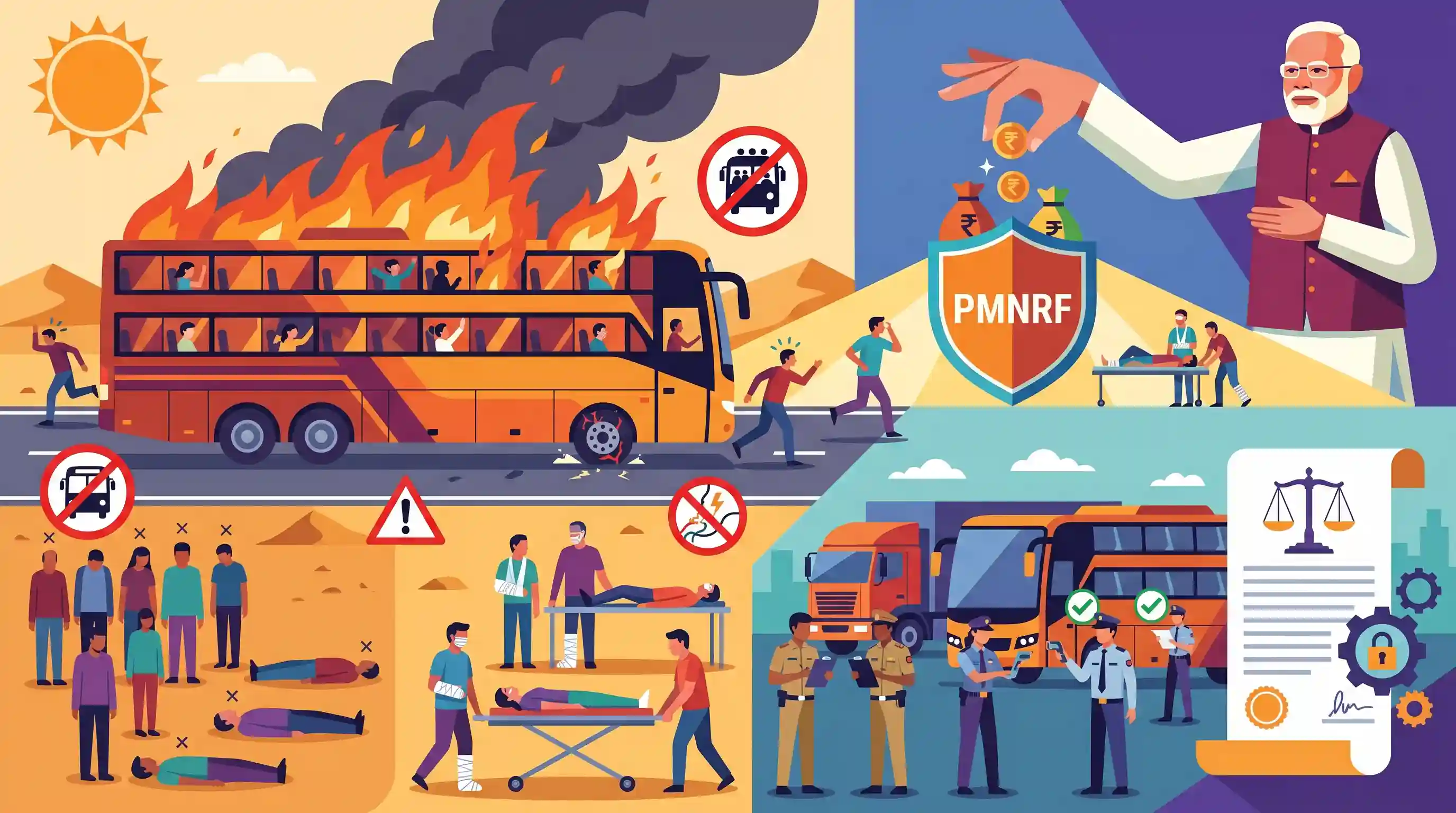
A tragic accident occurred in Jaisalmer, Rajasthan, when an overloaded private AC sleeper bus traveling to Jodhpur caught fire, claiming the lives of 20 passengers and injuring 16 others. The Prime Minister announced financial assistance for the victims from the PMNRF. The incident underscores significant lapses in road safety enforcement, specifically regarding passenger overloading and fire safety standards in private commercial vehicles, necessitating stronger regulatory oversight to prevent such transport hazards.
Key Points
- A private AC sleeper bus caught fire near Thaiyat village in Jaisalmer, Rajasthan, resulting in 20 fatalities and leaving 16 injured.
- The bus, en route to Jodhpur, was reportedly overloaded with 57 passengers, raising serious questions about compliance with passenger limits.
- Prime Minister Narendra Modi announced an ex-gratia payment of ₹2 lakh for the next of kin of the deceased and ₹50,000 for the injured from the Prime Minister's National Relief Fund (PMNRF).
- The exact cause of the fire remains under investigation, highlighting the critical need for strict enforcement of fire safety protocols and road transport regulations for private operators.
Important Terms
Prime Minister's National Relief Fund (PMNRF)

A 1948-established fund consisting of public contributions (no budgetary support) used to provide immediate relief for victims of natural calamities and major man-made disasters like accidents.
UPSC context
GS Paper 2/3: Tests knowledge of non-constitutional funds, disaster relief mechanisms, and executive-led social security schemes.
Ex-gratia payment
A discretionary, goodwill-based financial assistance provided by the government to victims of tragedies without any legal admission of liability or obligation to pay.
UPSC context
GS Paper 2: Relevant for governance and administrative discretion in providing immediate social relief during crises.
Motor Vehicles Act, 1988
The primary legislation governing road transport in India, regulating vehicle registration, licensing, and safety standards; significantly amended in 2019 to increase penalties for violations.
UPSC context
GS Paper 3: Crucial for topics on infrastructure, internal security, and regulatory enforcement in road safety.
Disaster Management Act, 2005
Legislative framework that shifted India's disaster response from reactive relief to proactive preparedness, establishing the National (NDMA) and State (SDMA) Disaster Management Authorities.
UPSC context
GS Paper 3: Core topic for Disaster Management; tests understanding of institutional hierarchies and legal mandates during emergencies.
Golden Hour
The critical one-hour period following a traumatic injury during which there is the highest likelihood that prompt medical treatment will prevent death.
UPSC context
GS Paper 3: Specifically mentioned in the Motor Vehicles (Amendment) Act 2019 regarding road safety and emergency medical response.
Prelims Trap
"The Prime Minister's National Relief Fund (PMNRF) receives annual budgetary allocations from the Consolidated Fund of India."
PMNRF operates entirely on voluntary public contributions and receives zero budgetary support from the government, distinguishing it from statutory disaster funds like the NDRF.
Static Concepts Connected
What are the financial and administrative features of the PMNRF?
- Funding Source: The fund operates entirely on voluntary public contributions and receives no budgetary support.
- Tax Status: Donations are 100% exempt from Income Tax under Section 80G.
- Administration: The Prime Minister is the Chairman of PMNRF, assisted by Joint Secretaries; disbursements are made at the PM's discretion.
What are India's institutional frameworks for road safety?
- MV Act 2019: Mandated the creation of the National Road Safety Board (NRSB) to advise on traffic management.
- Good Samaritan Law: Provides statutory protection to bystanders assisting accident victims from civil and criminal liability or police harassment.
- S. Sundar Committee: Recommended an apex National Road Safety Policy and a dedicated Directorate, highlighting severe institutional gaps.
Cross-Topic Patterns
Brasilia Declaration & SDG 3.6
UPSC frequently links domestic transport legislation to international pledges. India's struggle with road accidents directly threatens its Brasilia Declaration commitment to halve traffic deaths by 2030 (SDG 3.6).
Concurrent List & Transport Enforcement
Motor vehicles fall under the Concurrent List. While the Centre amends the Motor Vehicles Act, enforcement remains with State transport departments, leading to fragmented compliance and safety gaps like overloading.

Expect a multi-statement prelims question comparing PMNRF funding to statutory funds like NDRF, or testing Brasilia Declaration targets.
Linked PYQs · 2
Linked PYQs · 2
- 2020MainsGS3
Discuss the recent measures initiated in disaster management by the Government of India departing from the earlier reactive approach.
- 2013MainsGS3
How important are vulnerability and risk assessment for pre-disaster management ? As an administrator, what are key areas that you would focus on in a Disaster Management System.
