Jaipur faces water crisis due to leakage in ageing Bisalpur pipeline
Source:patrika ↗
Why It Matters
The Bisalpur Project is the lifeline of Jaipur's urban drinking water supply. Understanding the project's geographic details (Banas River, Tonk) along with urban infrastructure bottlenecks, administrative delays, and municipal drinking water bodies (like PHED and RUDSICO) is extremely important for RPSC RAS Prelims questions covering water resource management, state geography, and public utility governance.
Summary
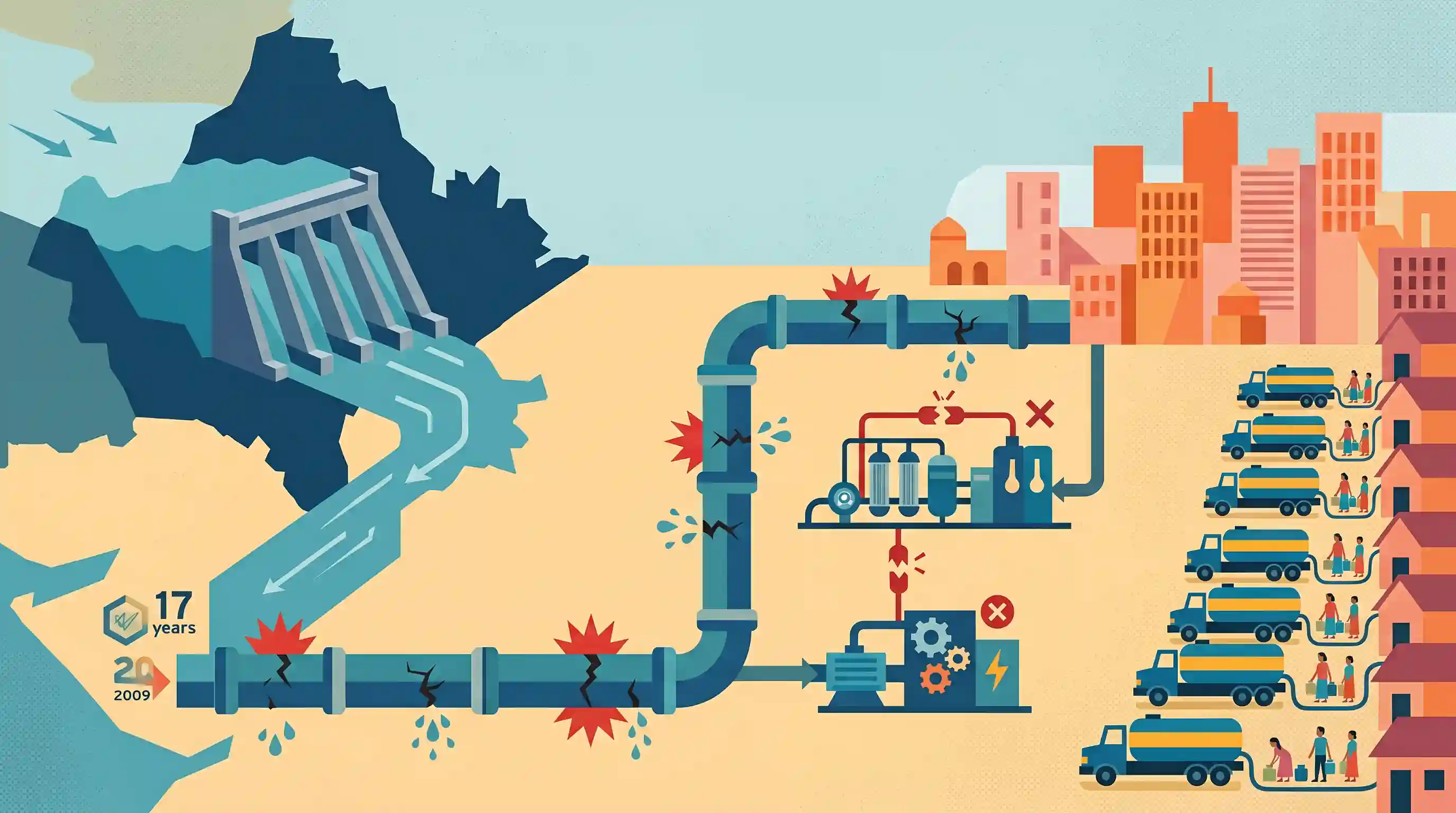
The article highlights a severe urban water crisis in Jaipur in 2026, caused by critical vulnerabilities in the ageing Bisalpur pipeline. Although the Bisalpur Dam (the primary source of drinking water for Jaipur, Ajmer, and Tonk) has sufficient water, 33 major leaks in the 17-year-old pipeline (built in 2009 and designed to last until 2021) lead to frequent operational shutdowns of 24 to 72 hours when pressure is increased. Furthermore, a ₹205-crore project including a 216 MLD treatment plant at Surajpura and a pumping station at Renwal has failed to resolve the distribution crisis, sustaining the city's high dependence on water tankers.
Key Points
- Jaipur is suffering from a major drinking water crisis despite the Bisalpur Dam being fully filled, primarily due to 33 critical leaks in its ageing supply pipeline.
- The Bisalpur pipeline, operational since 2009, was designed to cater to Jaipur's urban population demand only up to the year 2021. Delays in constructing a secondary pipeline since 2015 have caused severe capacity deficits by 2026.
- Increasing water pressure to meet current urban demand triggers ruptures at weak spots, requiring emergency shutdowns of 24 to 72 hours for repairs.
- A ₹205-crore infrastructure project—comprising a 216 MLD (Million Litres per Day) water treatment plant in Surajpura and an intermediate pumping station in Renwal—was built to resolve the bottleneck but has failed to yield the promised results.
- Despite original project assurances to eliminate dependence on municipal water tankers, the tanker system remains an essential primary water source in several Jaipur neighborhoods.
Important Terms
Bisalpur Drinking Water Project

A multi-phase water supply initiative in Rajasthan that transfers treated drinking water from the Bisalpur Dam on the Banas River to Jaipur, Ajmer, and Tonk, mitigating groundwater depletion.
UPSC context
GS Paper I & III: Rajasthan geography, public utilities, and regional urban water resource management.
Public Health Engineering Department (PHED)
The nodal state government department in Rajasthan responsible for formulating water policies, executing potable water supply schemes, and managing rural and urban sanitation grids.
UPSC context
GS Paper II: Government policies, state administration, and institutional water governance mechanisms.
Rajasthan Urban Drinking Water, Sewage and Infrastructure Corporation Limited (RUDSICO)
A state-owned undertaking in Rajasthan formed to plan, fund, and implement urban infrastructure, including drinking water systems, sewage management, housing, and central schemes like AMRUT.
UPSC context
GS Paper II & III: Urban planning, local body governance, and infrastructure development.
Banas River
A major tributary of the Chambal River that flows entirely within Rajasthan; it originates in the Aravalli Range and feeds the critical Bisalpur reservoir.
UPSC context
GS Paper I: Geography of India, physical drainage systems, and major river basins.
AMRUT 2.0 (Atal Mission for Rejuvenation and Urban Transformation)
A flagship central government mission aiming to make Indian cities water-secure by ensuring universal tap water coverage, sewerage management, and recycling of treated wastewater.
UPSC context
GS Paper II & III: Welfare schemes, sustainable urban development, and water-security planning.
Prelims Trap
The Brahmani-Banas river-linking scheme transfers water from Odisha's major Brahmani River to Rajasthan's Banas River.
The Brahmani involved here is a minor tributary of the Chambal River flowing in Rajasthan, not the famous peninsular Brahmani River of Odisha.
Static Concepts Connected
What are the key geographical features of the Banas River system?
- Origin and Course: Rises in Khamnor Hills (Aravallis) and flows entirely within Rajasthan, joining Chambal River at Rameshwar in Sawai Madhopur.
- Key Tributaries: Fed by Berach, Kothari, Khari, Dai, and Morel rivers, draining the eastern slopes of the Aravallis.
- Economic Lifeline: Hosts the Bisalpur gravity dam, acting as the primary source of drinking water for Jaipur and Ajmer.
What are the structural challenges in urban water distribution networks?
- Non-Revenue Water: Refers to water lost before reaching customers through physical leaks, pipe bursts, and unauthorized consumption.
- Design Capacity Gap: Urban pipelines suffer rapid obsolescence when physical expansion lags behind rapid decadal population growth.
- Intermittent Stress: Alternate drying and high-pressure pumping in pipelines accelerates structural fatigue, leading to chronic maintenance shutdowns.
Cross-Topic Patterns
River interlinking vs ecological balance
The proposed Brahmani-Banas diversion project highlights the ecological trade-offs of artificial river-linking to satisfy urban consumer demand at the cost of downstream flows.
Urbanization and municipal water governance
The persistent reliance on private water tankers despite major infrastructure spending highlights the structural governance gaps of parastatals like RUDSICO.

2026 GS-3/GS-1 may link urban utility failures (non-revenue water, aging pipelines) with geography of western India's seasonal river basins.
Linked PYQs · 2
Linked PYQs · 2
- 2023RPSC_PRELIMSGS1
Which of the following is not a part of the Rajasthan Urban Drinking Water, Sewage and Infrastructure Corporation Limited?
- 2021RPSC_PRELIMSGS1
The 'Parwan' multipurpose irrigation project of Rajasthan will provide irrigation facilities to which districts?
