MoSPI Survey Ranks Jaipur and Jodhpur Highest in Rajasthan Salaries
Source:the-times-of-india ↗
Why It Matters
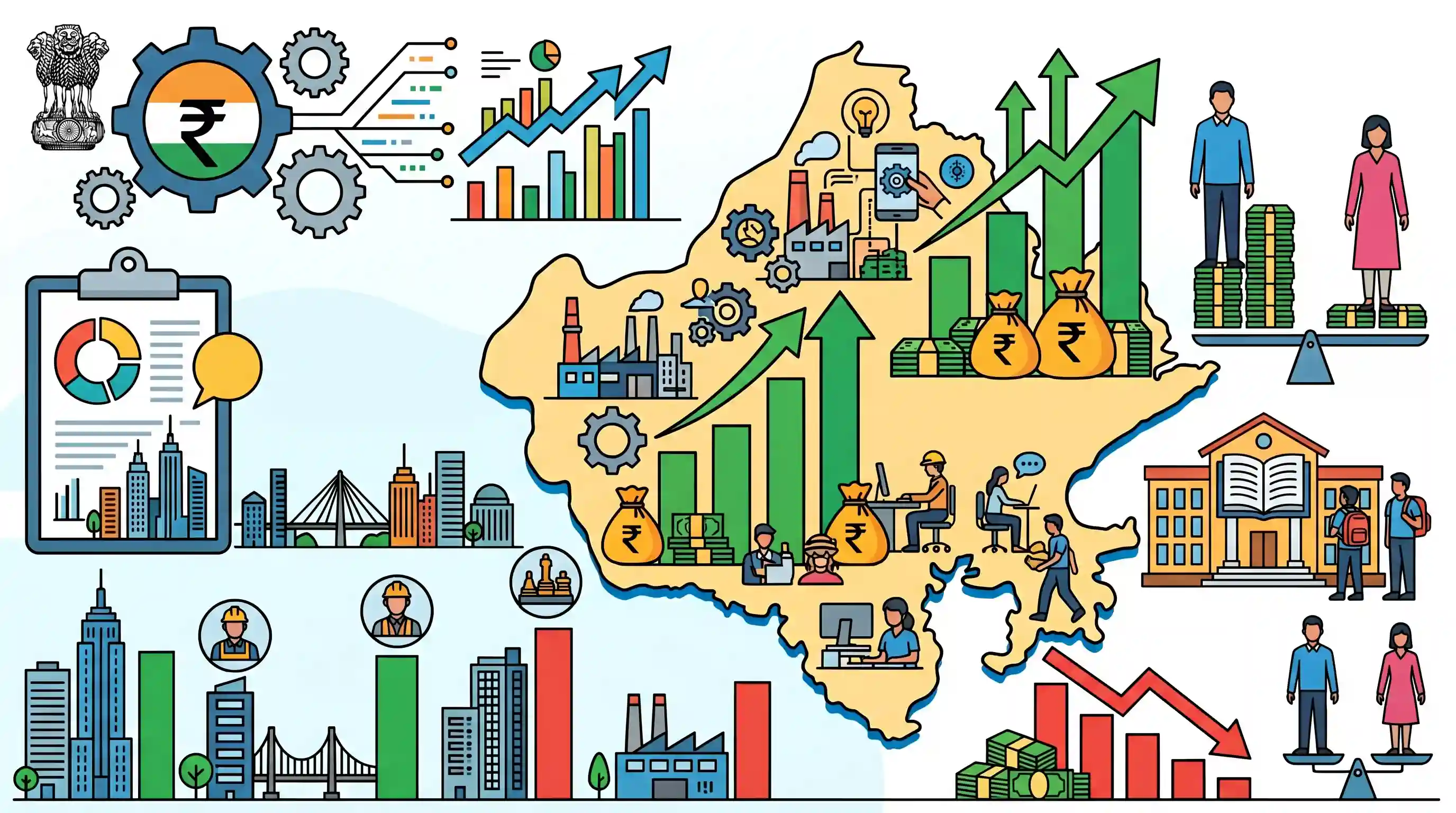
This survey provides official, state-specific, and city-level empirical data on employment quality, average wages, and gender pay disparities in Rajasthan. These metrics are crucial for RPSC RAS GS paper analysis on demographic dividend, industrial planning, and regional disparities.
Summary
The Ministry of Statistics and Programme Implementation (MoSPI) has released its first-ever 'Labour Market Dynamics' survey based on the Current Weekly Status (CWS) approach. The survey compares labour market outcomes and monthly salaries across India's million-plus cities. Within Rajasthan, Jaipur and Jodhpur emerged as high-performing hubs, both surpassing national salary averages due to diversified and manufacturing economies. Conversely, Kota registered some of the lowest salaries among India's major urban centers due to its dependence on the coaching sector, though it showcased the narrowest gender pay gap in the state.
Key Points
- According to MoSPI's first 'Labour Market Dynamics' survey using the Current Weekly Status (CWS) approach, Jaipur and Jodhpur are Rajasthan's highest-paying cities for regular salaried employees.
- Jaipur leads the state with an average monthly salary of ₹31,332, followed closely by Jodhpur at ₹31,081. Both cities exceed the national urban average (₹26,258) and the average for Indian million-plus cities (₹28,808).
- Kota ranks among the lowest-paying million-plus cities in India with an average salary of ₹17,984. Only Ludhiana, Raipur, and Agra recorded lower averages.
- Kota possesses the narrowest gender pay gap among Rajasthan's major cities, with men earning ₹18,062 and women earning ₹17,695 monthly.
- In Jaipur, men earn an average of ₹32,269 and women earn ₹28,453. In Jodhpur, men earn ₹31,564 and women earn ₹29,341.
- Jaipur's strong salaries are driven by a diversified economy (IT, services, tourism, trade, government jobs). Jodhpur's earnings are backed by manufacturing and exports, while Kota's low salaries reflect its coaching-centric, retail, and hostel-led service economy.
- Nationally, Navi Mumbai topped the list of million-plus cities with an average monthly salary of ₹51,515.
Important Terms
Labour Market Dynamics in Million-Plus Cities Report

A report by India’s National Statistics Office (NSO) under MoSPI, mapping employment, wages, and workforce trends across 46 major Indian cities with populations over one million.
UPSC context
GS Paper III (Employment & Economy); tests urban formalization trends and metropolitan workforce data.
Ministry of Statistics and Programme Implementation (MoSPI)
The nodal Indian ministry responsible for official statistical operations, including national income accounting, industrial production tracking (IIP), and the Periodic Labour Force Survey.
UPSC context
GS Paper II (Governance) & Paper III (Economy); tests institutional roles in socio-economic data collection.
Current Weekly Status (CWS)
A labor measurement methodology that classifies a person as employed if they worked for at least one hour during the seven-day reference period preceding the survey.
UPSC context
GS Paper III (Employment); tests understanding of short-term labor market dynamics and high-frequency employment indicators.
Periodic Labour Force Survey (PLFS)
India's primary official household survey, launched in 2017 by the NSO, designed to estimate key employment and unemployment indicators at regular quarterly and annual intervals.
UPSC context
GS Paper III (Indian Economy); tests knowledge of national employment measurement metrics and economic planning databases.
Gender Pay Gap
The average disparity in earnings between working men and women, reflecting systematic inequalities, occupational segregation, and domestic care burdens that hinder women’s financial parity.
UPSC context
GS Paper I (Social Issues) & GS Paper III (Inclusive Growth); tests structural labor inequalities and gender justice policies.
Worker Population Ratio (WPR)
An economic indicator defined as the percentage of employed persons within the total population, used to assess the labor force's actual contribution to economic production.
UPSC context
GS Paper III (Economic Growth); tests the ability to evaluate labor absorption capacity and sectoral employment trends.
Prelims Trap
A person is classified as employed under Current Weekly Status (CWS) only if they worked for a majority of days in the reference week.
Under CWS, a person is considered employed if they worked for even one hour on any single day during the seven-day reference period, making the 'majority of days' threshold false.
Static Concepts Connected
What is the difference between Usual Status (US) and Current Weekly Status (CWS) in Indian labor surveys?
- Reference Period: US uses a 365-day recall period, whereas CWS uses a short 7-day recall period preceding the survey.
- CWS Employment Threshold: Under CWS, a person is employed if they worked for at least 1 hour on any day in the reference week.
- Usual Status Threshold: Determined based on the activity pursued for a relatively longer time (major time criterion) during the 365-day reference year.
- Fluctuation Capture: CWS captures short-term, seasonal shifts in employment patterns, whereas Usual Status highlights structural and chronic trends.
Cross-Topic Patterns
Urbanization and Labour Formalization
Higher regular salary rates in million-plus cities show how planned urban growth directly facilitates structural economic transitions from casual to formal employment.
Care Economy and Gender Pay
Low female LFPR driven by domestic duties highlights how lack of state-supported childcare infrastructure hinders the closing of urban wage gaps.

First-ever MoSPI city labor survey will likely trigger comparative questions on CWS vs Usual Status methodologies and urban-rural LFPR trends.
Linked PYQs · 2
Linked PYQs · 2
- 2024RPSC_PRELIMSGS1
Worker to Population Ratio (WPR) is –
- 2016RPSC_PRELIMSGS1
India's unemployment and poverty estimates are based on
