Jaipur Electric Buses Deployment Under PM eBus Sewa Scheme
Source:elets ↗
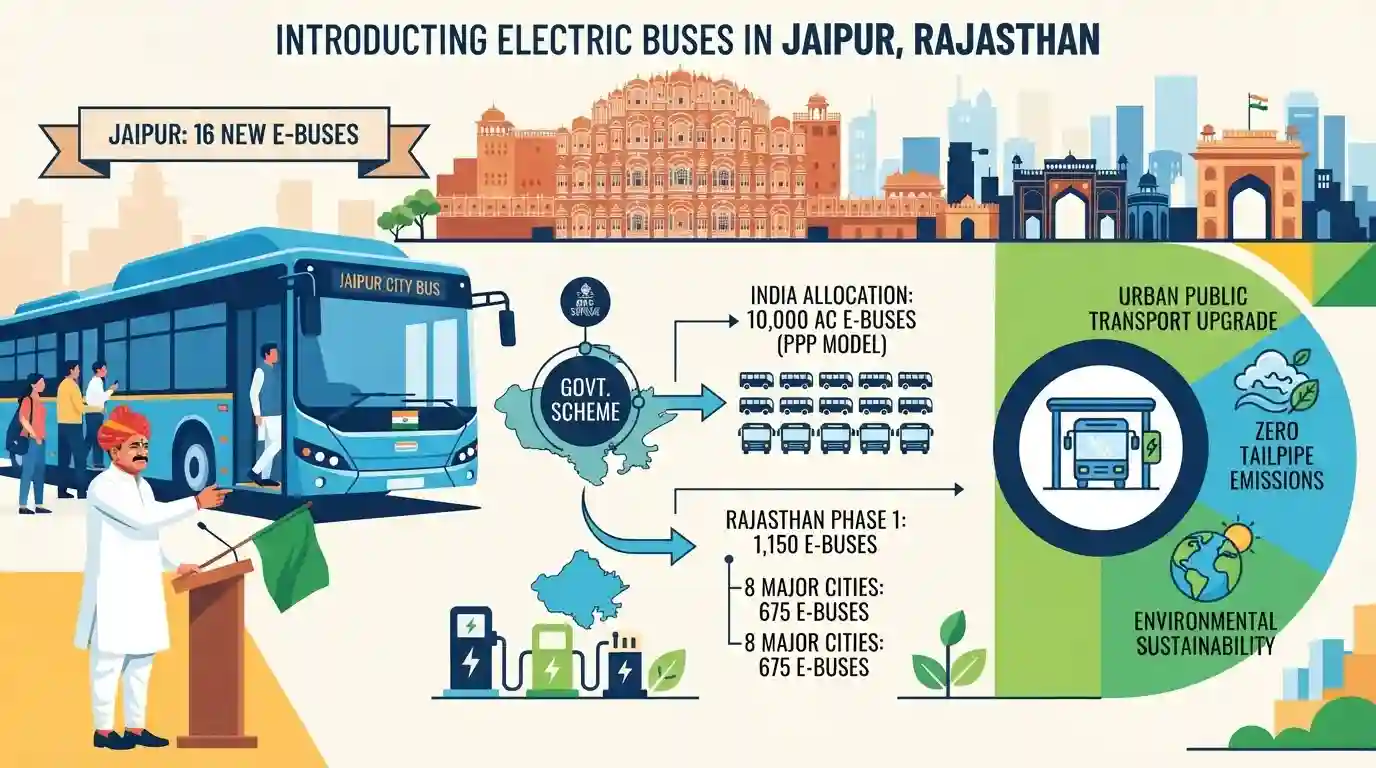
Why It Matters
RPSC Prelims frequently tests candidates on both central and state-specific government schemes, infrastructure developments, and initiatives promoting environmental sustainability. Knowledge of the PM-eBus Sewa scheme and its specific allocations to Rajasthan cities is highly relevant for state-level general awareness.
Summary
Jaipur has received 16 new electric buses, flagged off by Rajasthan Chief Minister Bhajan Lal Sharma, marking a step forward in the state's clean mobility drive. The deployment is part of the central government's PM-eBus Sewa Scheme, designed to introduce 10,000 AC electric buses across India under a PPP model. Rajasthan has secured an allocation of 1,150 e-buses, with 675 slated for eight major cities in the initial phase. This move aims to enhance urban public transport while ensuring zero tailpipe emissions and fostering environmental sustainability.
Key Points
- Rajasthan CM Bhajan Lal Sharma flagged off 16 new electric buses in Jaipur to promote clean urban transit.
- The buses are part of the central government's PM-eBus Sewa Scheme, which aims to deploy 10,000 AC electric buses nationwide via a Public-Private Partnership (PPP) model.
- Rajasthan has been sanctioned a total of 1,150 e-buses under the scheme, with 675 buses allocated to 8 specific cities (including Jaipur, Jodhpur, and Udaipur) in the first phase.
- The initiative highlights a transition toward sustainable urban mobility by minimizing tailpipe emissions and reducing dependence on conventional fuels.
Important Terms
PM-eBus Sewa Scheme

A central government initiative deploying 10,000 electric buses across Indian cities using a Public-Private Partnership model to enhance public transport and green urban mobility.
UPSC context
GS Papers 2 & 3 (Government Policies, Infrastructure). Tests knowledge of urban mobility interventions and EV infrastructure schemes.
Public-Private Partnership (PPP)
A collaborative model between government and private sectors, utilized in the PM-eBus scheme for procuring, operating, and maintaining public assets with state support.
UPSC context
GS Paper 3 (Investment Models). Evaluates understanding of how the state leverages private efficiency and capital for infrastructure.
Zero Tailpipe Emissions
The total absence of harmful exhaust gases, such as carbon dioxide and nitrogen oxides, emitted directly from a vehicle's tailpipe during its operation.
UPSC context
GS Paper 3 (Environment). Tests awareness of clean energy technologies, urban pollution control, and climate change mitigation.
Sustainable Urban Mobility
A city planning approach prioritizing eco-friendly, efficient mass transit, non-motorized transport, and integrated systems to reduce private vehicle reliance and urban congestion.
UPSC context
GS Paper 1 (Urbanization) & GS 3 (Infrastructure). Covers Transit-Oriented Development and the National Urban Transport Policy.
Prelims Trap
"The PM-eBus Sewa Scheme exclusively covers metropolitan and million-plus cities."
The scheme targets cities with a 3 lakh+ population (Census 2011), specifically prioritizing tier-2/3 cities that currently lack organized public bus services, not just metros.
Static Concepts Connected
What is the Gross Cost Contract (GCC) model used in e-bus PPPs?
- The Mechanism: The private operator owns, maintains, and drives the buses, while the public transport authority pays a fixed per-kilometer rate.
- Risk Allocation: Revenue (ridership) risk stays with the government authority, while operations, maintenance, and asset risks are transferred to the private partner.
How does PM-eBus Sewa functionally differ from the FAME scheme?
- FAME Mechanism: Provides upfront capital subsidies to buyers to drive the overall adoption of EVs across multiple segments (2W, 3W, 4W, buses).
- PM-eBus Mechanism: Focuses purely on public transit, offering long-term (10-year) per-kilometer operational financial support to bridge the cost gap for city authorities.
Cross-Topic Patterns
Urban E-Mobility & DISCOM viability
Scaling heavy-duty e-bus depots requires massive 'behind-the-meter' power upgrades. This links urban transport directly to the financial health and grid load capacity of state DISCOMs.
E-Buses & NCAP targets
Zero-tailpipe urban transit directly intersects with the National Clean Air Programme (NCAP) and 15th Finance Commission performance grants for million-plus cities tasked with reducing PM10/PM2.5.

Expect a Prelims question contrasting PM-eBus Sewa's PPP/operational support model with FAME's upfront subsidy mechanism.
Linked PYQs · 2
Linked PYQs · 2
- 2025RPSC_PRELIMSGS1
Which of the following statements are correct with respect to the PM Surya Ghar Free Electricity Scheme? (i) Under this scheme, solar plants will be installed on one crore houses to provide free electricity up to 300 units per month. (ii) Provision of 30% subsidy for installing rooftop solar plants (iii) 100% online system for registration, application, approval and grant (iv) Provision of lending to each applicant at a bank interest rate of 4%
- 2023RPSC_PRELIMSGS1
Which of the following schemes aims to make rural areas socially, economically, and physically sustainable?
