Amer Fort Elephant Safari Ridership Decline and Tourism Shift
Source:the-print ↗
Why It Matters
This development illustrates the shifting landscape of Rajasthan's traditional tourism sector. It highlights how global ethical standards, such as animal welfare, can directly impact local economies and heritage practices at major cultural sites like Amer Fort.
Summary
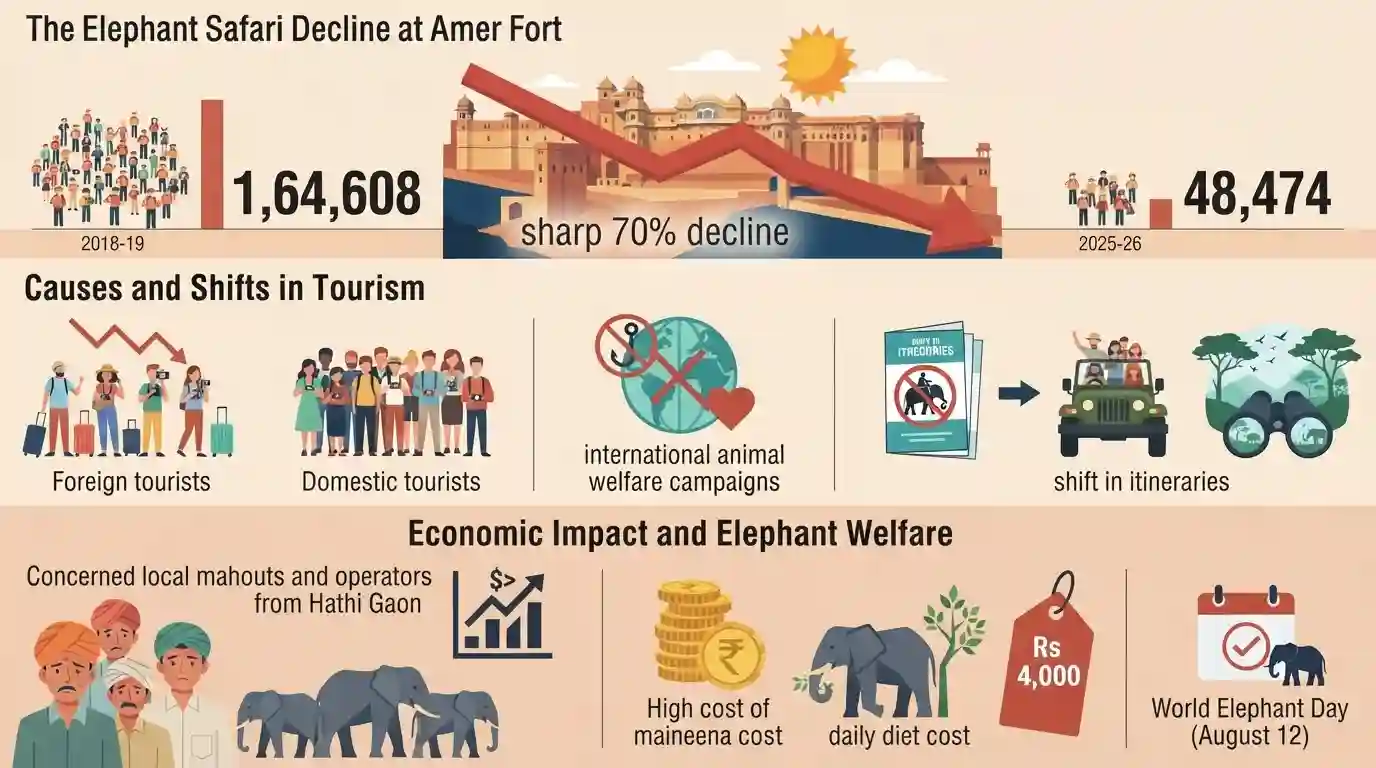
Elephant safari ridership at the historic Amer Fort in Jaipur has experienced a sharp 70% decline over the past seven years. Official records show numbers fell from 1,64,608 tourists in 2018-19 to 48,474 in 2025-26. Tourism stakeholders and experts attribute this significant drop to a decrease in foreign tourist arrivals and shifting visitor preferences driven by international animal welfare campaigns. Consequently, many travel companies have excluded elephant rides from their itineraries, favoring alternative experiences like jeep safaris and visits to wildlife sanctuaries. Ahead of World Elephant Day (August 12), local operators, including the Hathi Gaon Development Committee, have expressed concern over the financial strain of maintaining the elephants, which require around Rs 4,000 daily for their diet alone.
Key Points
- Elephant safari ridership at Jaipur's Amer Fort has plummeted by 70% over seven years, dropping from 1,64,608 tourists in 2018-19 to 48,474 in 2025-26.
- Tourism experts attribute the sharp decline to changing visitor preferences and international campaigns advocating for animal welfare.
- Many foreign tour operators have removed animal-based experiences like elephant rides from their travel packages, shifting tourist interest toward jeep safaris and national parks.
- The Hathi Gaon Development Committee raised alarms regarding the elephants' upkeep, noting that a single elephant's daily diet costs approximately Rs 4,000.
Important Terms
Hathi Gaon (Elephant Village)

Established in 2010 near Jaipur to house working elephants and mahouts, this sanctuary is managed by local committees. It currently faces severe economic strain and increased scrutiny over the ethics of using captive elephants for tourism.
UPSC context
Relevant to GS-3 (Environment), linking the economic viability of captive wildlife management with evolving animal welfare standards in tourism.
Amer Fort
A monumental 16th-century palace-fort in Jaipur built by Raja Man Singh I. Known for blending Rajput and Mughal architectural styles, it is part of the UNESCO World Heritage "Hill Forts of Rajasthan" network.
UPSC context
Crucial for GS-1 (Art & Culture), frequently tested on its unique architectural synthesis, UNESCO status, and Rajput history.
Heritage Tourism
Travel focused on experiencing places of historical and cultural significance. It is a major economic driver for states like Rajasthan, but requires sustainable practices to prevent degradation of monuments and ensure ethical animal welfare.
UPSC context
Connects GS-1 (Heritage) and GS-3 (Economy), focusing on the balance between tourism-led employment and sustainable conservation policies.
World Elephant Day
Observed annually on August 12 to promote the global conservation of elephants. It highlights critical threats like habitat fragmentation and poaching, while advocating for improved welfare standards for both wild and captive populations.
UPSC context
Key for GS-3 (Environment) Prelims, focusing on species conservation status, human-wildlife conflict, and protections for India's National Heritage Animal.
Prelims Trap
Commercial use and ownership of captive elephants is strictly banned under the Wildlife Protection Act, 1972.
Captive elephants can be legally owned and used for tourism or religious purposes provided owners hold valid ownership certificates under the WPA 1972, serving as a unique historical exception.
Static Concepts Connected
Which forts comprise the 'Hill Forts of Rajasthan' UNESCO World Heritage property?
- Six Forts: The serial property includes six majestic forts: Chittorgarh, Kumbhalgarh, Ranthambore, Gagron, Amer, and Jaisalmer.
- Rajput Architecture: They reflect Rajput military hill architecture, characterized by their strategic defensive placements utilizing natural barriers like hills, deserts, and forests.
- Amer Fort Details: Amer Fort specifically is renowned for its synthesis of Rajput and Mughal architectural styles, featuring extensive water harvesting structures.
What is the legal framework governing captive elephants in India?
- WPA 1972 Status: Asian Elephants are listed under Schedule I of WPA 1972. However, captive ownership is legally permitted subject to strict certification by the Chief Wildlife Warden.
- PCA Act 1960: The Animal Welfare Board of India (AWBI) monitors the treatment of captive elephants used in tourism to prevent maltreatment under this act.
- Project Elephant Guidelines: The MoEFCC issues specific guidelines for the care, housing, and veterinary support of captive elephants to ensure their welfare.
Cross-Topic Patterns
Animal Ethics vs. Traditional Livelihoods
Connects GS-4 (Environmental Ethics) with GS-3 (Tourism economy). The shift away from animal-based tourism highlights the challenge of rehabilitating traditional mahout communities dependent on captive elephants.
Global Eco-Norms Shaping Local Economies
International animal welfare campaigns altering local heritage tourism demonstrates the growing economic impact of global environmental sensitization on domestic policies and MSMEs.

Captive elephant ownership rules under WPA 1972 alongside AWBI's role is highly likely to feature as a Prelims multi-statement question.
Linked PYQs · 1
Linked PYQs · 1
- 2018RPSC_PRELIMSGS1
Which of the following is NOT a unique selling proposition (USP) in Rajasthan's tourism sector?
