Rajasthan CM Reviews Cybercrime Control Measures in Jaipur
Source:social-news ↗
Why It Matters
With the rapid digitization of services, cybercrime has emerged as a significant internal security challenge. Awareness of state-level institutional mechanisms like the Rajasthan Cyber Crime Control Centre (R4C) and the 1930 helpline is crucial for RPSC RAS aspirants under topics of state governance, internal security, and science & technology applications in administration.
Summary
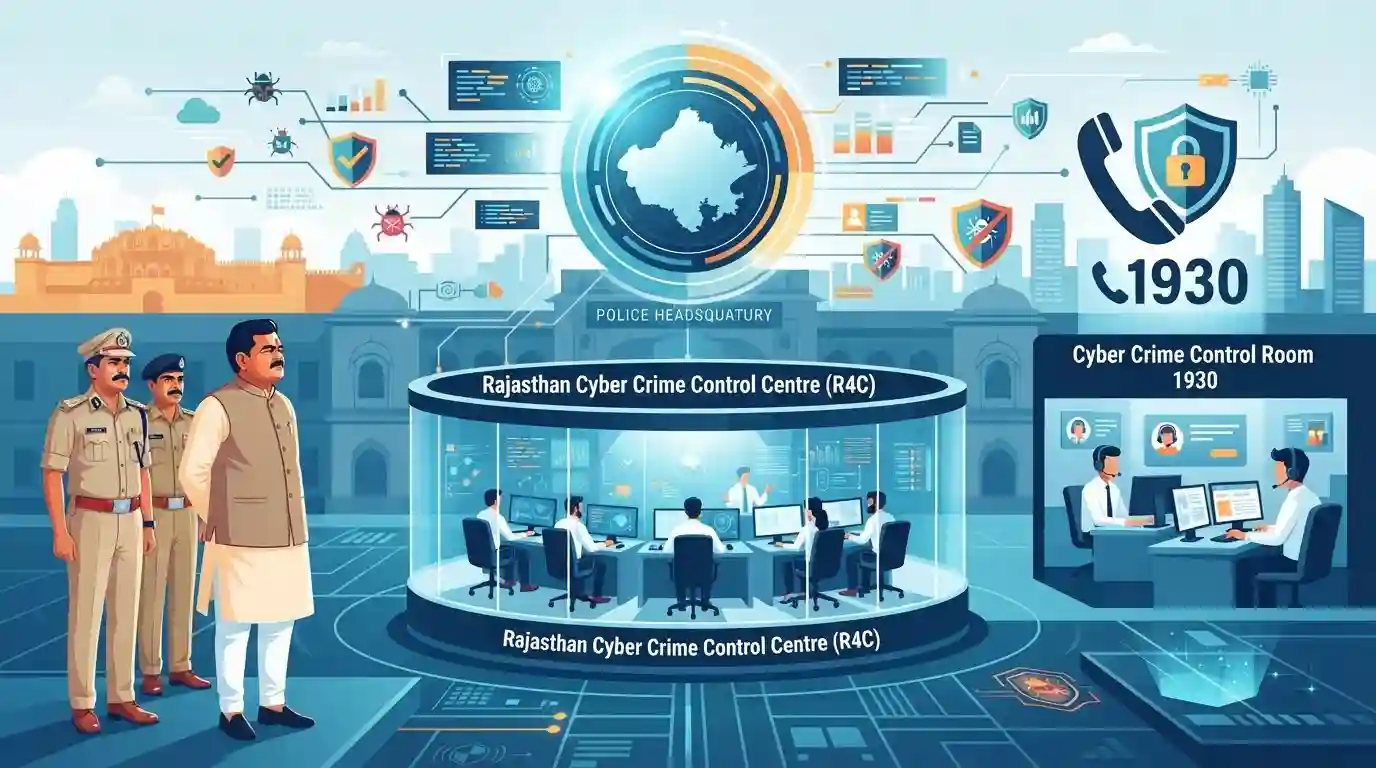
Rajasthan Chief Minister Bhajanlal Sharma visited the Police Headquarters in Jaipur to review the state's cybercrime control measures. During the visit, he inspected the functioning of the Rajasthan Cyber Crime Control Centre (R4C) and the dedicated Cyber Crime Control Room 1930. This review highlights the state administration's focus on modernizing law enforcement to combat the growing threat of cybercrime and ensuring digital security for citizens.
Key Points
- Rajasthan Chief Minister Bhajanlal Sharma reviewed cybercrime control measures at the State Police Headquarters in Jaipur.
- The review included assessing the functioning of the Rajasthan Cyber Crime Control Centre (R4C).
- He also inspected the operations of the Cyber Crime Control Room 1930, a dedicated helpline for reporting cyber offenses.
- The visit underscores the state government's priority on enhancing digital security and modernizing police infrastructure to tackle emerging tech-driven crimes.
Important Terms
Rajasthan Cyber Crime Control Centre (R4C)

A state-level cyber command hub in Rajasthan, modeled on the central I4C, providing a unified platform for real-time cybercrime monitoring, technical investigation support, and inter-district coordination.
UPSC context
GS-3 (Cyber Security). Highlights state-level institutional capacity building and law enforcement modernization against digital crimes.
National Cyber Crime Helpline 1930
A toll-free national helpline established for citizens to quickly report financial cyber frauds, enabling immediate coordination with banking institutions to freeze stolen funds.
UPSC context
GS-3 (Internal Security). Crucial for evaluating citizen-centric e-governance tools and financial cyber incident response mechanisms.
Indian Cyber Crime Coordination Centre (I4C)
A Ministry of Home Affairs initiative acting as the apex national nodal point to combat cybercrime comprehensively, serving as the architectural model for state centers like R4C.
UPSC context
GS-3 (Cyber Security). Tests knowledge of India's central institutional frameworks addressing complex and organized digital offenses.
Golden Hour (Cyber Fraud)
The critical early timeframe immediately following a financial cyber scam. Rapid reporting during this window maximizes the probability of tracking and freezing defrauded money.
UPSC context
GS-3 (Cyber Security). A vital concept in digital literacy, highlighting the importance of immediate incident response in law enforcement.
Zero FIR
A legal provision allowing victims to register a police complaint at any station regardless of territorial jurisdiction, now extended to online cyber frauds in states like Rajasthan.
UPSC context
GS-2 (Governance). Demonstrates structural reforms in the criminal justice system to improve citizens' access to timely legal remedies.
Prelims Trap
Cybercrime investigations and the National Cyber Crime Helpline (1930) are exclusively administered by Union agencies.
While the MHA created the 1930 framework and I4C, 'Police' remains a State subject under the 7th Schedule. States retain primary investigative jurisdiction.
Static Concepts Connected
What is the mandate of the Indian Cyber Crime Coordination Centre (I4C)?
- Apex Nodal Body: A nodal body under the MHA established to coordinate comprehensive action against cybercrime across various state jurisdictions.
- PMLA Integration: Recently integrated into PMLA (Section 66), enabling direct information sharing on illicit money trails with the Enforcement Directorate.
- Citizen Reporting: Manages the National Cybercrime Reporting Portal and operationalizes the emergency financial fraud freezing helpline (1930).
Who holds constitutional jurisdiction over cybercrime investigation in India?
- State Subject: Under the Seventh Schedule of the Indian Constitution, 'Police' and 'Public Order' are State subjects.
- Primary Responsibility: State police forces are constitutionally responsible for registering, investigating, and prosecuting cyber offenses.
- Union Support: The Centre assists via policy frameworks, national coordination (I4C), capacity building, and digital forensics infrastructure.
Cross-Topic Patterns
Cybercrime & Cooperative Federalism
State-level centers like R4C mirroring the central I4C exemplify cooperative federalism in internal security, addressing borderless tech crimes despite 'Police' remaining a state subject.
PMLA and Digital Frauds
Integrating cyber coordination frameworks (I4C) into the PMLA allows digital fraud intelligence to flow directly to the ED, linking GS3 cybersecurity with GS2 statutory bodies.

Expect a GS3 question analyzing the friction between borderless cybercrimes and state-list police jurisdiction, highlighting I4C's role.
Linked PYQs · 2
Linked PYQs · 2
- 2025RPSC_PRELIMSGS1
What has been formed in place of the Chief Minister Rajasthan Economic Reforms Advisory Council (CMRETAC)?
- 2024RPSC_PRELIMSGS1
According to the Rajasthan Lokayukta and Deputy Lokayukta Act, 1973, the Lokayukta in Rajasthan can investigate allegations against ministers and public servants in certain cases. Which of the following subject is included in such cases? (i) Involves grievance/any suffering caused by public servant. (ii) Used his position as a public servant to obtain, for himself or for any other person, any valuable thing or financial benefit. (iii) Sexual harassment of woman, cause injury to any person. (iv) Can be related to being guilty of corruption of the trust reposed in him as a public servant.
