Jaipur Clean Drive At Jal Mahal On Environment Day
Source:kindnesswelfare ↗
Why It Matters
This event highlights key aspects of environmental conservation, sustainable urban waste management, and the role of municipal bodies in Rajasthan. For RPSC RAS aspirants, studying the geographical context of Man Sagar Lake, the policy and administrative aspects of municipal waste management, and global environmental frameworks (such as desertification treaties and themes) is highly relevant for both Prelims and Mains.
Summary
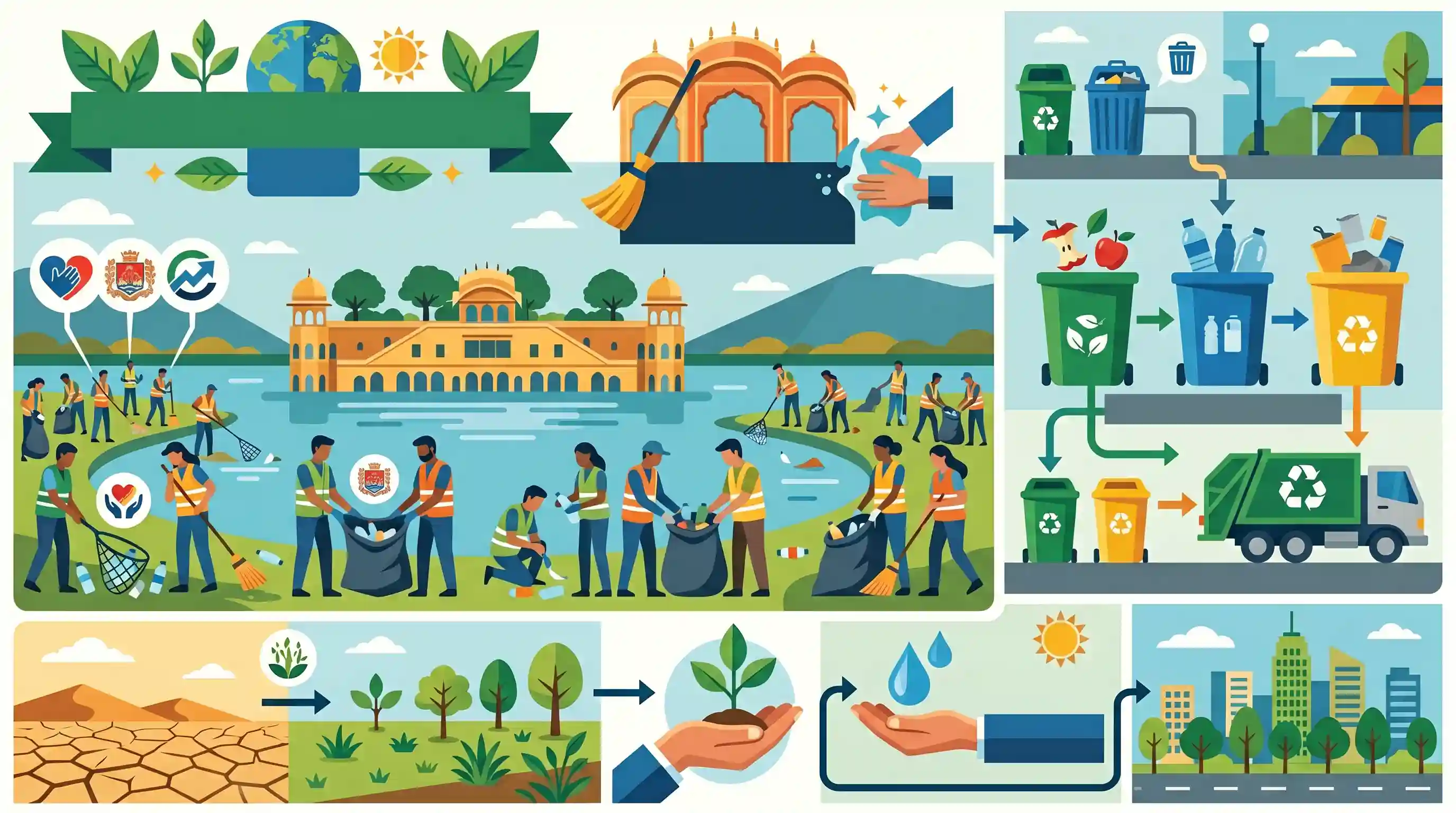
On World Environment Day (June 5, 2026), the 'Jaipur Clean Drive 2026' was successfully conducted at the iconic Jal Mahal on Man Sagar Lake, Jaipur. Led by the Kindness Welfare Association in collaboration with Nagar Nigam Jaipur and SK Finance Ltd., the citizen-driven cleanup mobilized hundreds of volunteers to collect and segregate municipal and plastic waste, promoting civic environmental consciousness. The drive aligned with the global 2026 theme of land restoration, desertification, and drought resilience, drawing attention to Rajasthan's pressing waste management and desertification challenges.
Key Points
- The 'Jaipur Clean Drive 2026' was organized at Jal Mahal (situated in Man Sagar Lake, Jaipur) on World Environment Day (June 5, 2026) by the Kindness Welfare Association.
- The initiative showcased a successful Public-Private-Civic Partnership (PPCP) model, receiving active support from Nagar Nigam Jaipur (logistics and professional waste handlers) and SK Finance Ltd. (Corporate Social Responsibility partnership and employee mobilization).
- The global theme for World Environment Day 2026 is 'land restoration, desertification, and drought resilience'—issues of immense geographical relevance to Rajasthan, which is India's largest state and highly prone to desertification.
- India generates 62 million tonnes of waste annually, but only 43 million tonnes is collected, and a mere 12 million tonnes is treated or recycled. Rajasthan is noted as having one of the lowest urban waste management efficiency rates despite its vast geographical size.
- The clean-up prioritized segregation of waste into recyclable, organic, and non-recyclable categories to divert waste away from landfills and protect the fragile wetland ecosystem of Man Sagar Lake from plastic pollution.
Important Terms
Swachh Bharat Mission

A nationwide campaign launched in 2014 by the Government of India to eliminate open defecation, improve municipal solid waste management, and foster public behavioral change toward hygiene and clean sanitation.
UPSC context
GS Paper II (Governance) & Paper III (Environment); tests public policy, waste management, and sustainable sanitation models.
Smart Cities Mission
A Centrally Sponsored Scheme launched in 2015 by the Ministry of Housing and Urban Affairs to promote citizen-centric, sustainable cities by leveraging technological solutions and core infrastructure.
UPSC context
GS Paper I (Urbanization) & Paper III (Infrastructure); tests modern urban development paradigms and smart municipal planning.
Nagar Nigam
A local self-government body (Urban Local Body) in India that administers urban areas with a population exceeding one million, constitutionalized under the 74th Constitutional Amendment Act, 1992.
UPSC context
GS Paper II (Polity & Governance); tests grassroots democratic decentralization, fiscal devolution, and urban local body functioning.
World Environment Day
An annual global campaign celebrated on June 5, led by the United Nations Environment Programme, to raise awareness and mobilize international action for pressing environmental and climate challenges.
UPSC context
GS Paper III (Environment); tests multilateral environmental cooperation, global green policies, and sustainable development initiatives.
United Nations General Assembly
The main deliberative, policymaking, and representative organ of the United Nations, established in 1945, where all 193 member nations hold equal voting rights.
UPSC context
GS Paper II (International Relations); tests international organizations, multilateral diplomacy, and structural reforms in global governance.
Prelims Trap
Water erosion and over-grazing are the primary physical drivers of desertification in Western Rajasthan.
While anthropogenic activities like over-grazing and over-cultivation heavily accelerate land degradation, the dominant *physical* process driving desertification in the Thar region of Rajasthan is wind (aeolian) erosion, accounting for over 75% of the desertified area.
Static Concepts Connected
What are the historical and geographical origins of Jaipur's Man Sagar Lake and Jal Mahal?
- Origin & Damming: Man Sagar Lake was created circa 1610 AD by Raja Man Singh I of Amer by damming the Dravyavati (Garbhavati) River for water harvesting.
- Submerged Architecture: Features a unique 5-story Rajput-style palace (Jal Mahal) designed so that four of its stories remain submerged under high water levels.
- Famine Relief Links: Historically, several Rajasthani artificial lakes (like Lake Foy Sagar in Ajmer) were engineered specifically as famine relief and drought mitigation projects.
What are the primary drivers and physical processes of desertification in the Thar Desert?
- Aeolian Dominance: Wind erosion (aeolian process) is the primary physical driver, impacting roughly 76% of the degraded land in Western Rajasthan.
- Anthropogenic Forcing: Over-grazing, over-ploughing, and rapid demographic expansion act as the chief anthropogenic accelerants of land degradation.
- Mitigation Protocols: Biological measures such as windbreaks, shelterbelts, sand dune stabilization, and circular waste systems (5R policy) mitigate soil degradation.
Cross-Topic Patterns
Historical water engineering vs. modern urban degradation
Connects medieval Rajput water harvesting (damming rivers for drought resilience) to modern municipal solid waste challenges and wetland conservation under urban local body mandates.
Section 135 CSR meets 74th Amendment mandates
Integrates Section 135 Corporate Social Responsibility (Companies Act, 2013) with 74th Amendment obligations to manage municipal waste in ecologically fragile urban commons.

UPSC may couple Rajasthan's historical drought-relief lakes with the physical mechanisms of aeolian desertification in Western India.
Linked PYQs · 2
Linked PYQs · 2
- 2012RPSC_PRELIMSGS1
Which of the following is NOT a cause of desertification in Rajasthan?
- 2023RPSC_PRELIMSGS1
Which of the following is not a part of the Rajasthan Urban Drinking Water, Sewage and Infrastructure Corporation Limited?
