Jaipur summit brings 52 commonwealth nations for legal dialogue
Source:Punjab Kesari ↗
Why It Matters
The hosting of a 52-nation Commonwealth summit in Jaipur is a major state-level current affairs event for RPSC. It highlights the growing focus on Alternative Dispute Resolution (ADR) mechanisms and underscores India's judicial soft power on the global stage, directly relevant to the Polity and Current Affairs sections of the RAS Prelims.
Summary
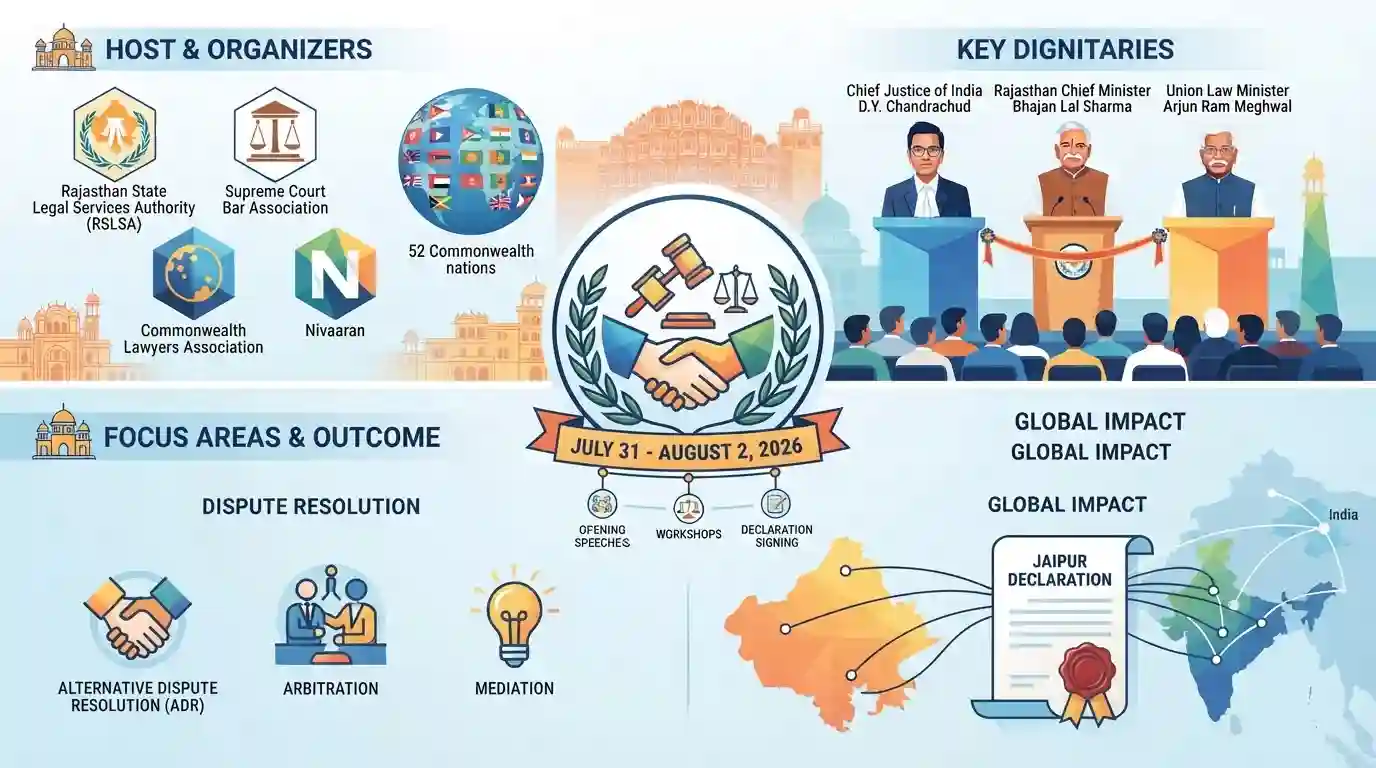
Jaipur is set to emerge as a global hub for judicial dialogue by hosting the Commonwealth Peace Mediation and Rule of Law Conference (CPMC-2026) from July 31 to August 2, 2026. Organized by the Rajasthan State Legal Services Authority (RSLSA) in collaboration with the Supreme Court Bar Association, Commonwealth Lawyers Association, and Nivaaran, the summit will see participation from 52 Commonwealth nations. Chief Justice of India D.Y. Chandrachud will inaugurate the event, accompanied by dignitaries including Rajasthan Chief Minister Bhajan Lal Sharma and Union Law Minister Arjun Ram Meghwal. The summit will focus on alternative dispute resolution and culminate in the 'Jaipur Peace Mediation Declaration 2026', bolstering India's and Rajasthan's profile in international judicial circles.
Key Points
- Jaipur is hosting the Commonwealth Peace Mediation and Rule of Law Conference (CPMC-2026) from July 31 to August 2, 2026.
- The conference focuses on alternative dispute resolution (ADR), global peace mediation, and the rule of law.
- The event will bring together legal luminaries and delegates from 52 Commonwealth nations.
- Organizers include RSLSA, SCBA, CLA, and Nivaaran.
- The summit will culminate in the adoption of the 'Jaipur Peace Mediation Declaration 2026', emphasizing India's growing role in global judicial diplomacy.
Important Terms
Jaipur Peace Mediation Declaration 2026

A landmark framework adopted by 52 Commonwealth nations outlining common principles for peace mediation, conflict resolution, and the rule of law to promote faster, sustainable, and peaceful justice globally.
UPSC context
Highly relevant for GS Paper 2 (IR & Judiciary), highlighting India's growing role in global "judicial diplomacy" and Alternative Dispute Resolution.
Commonwealth Peace Mediation and Rule of Law Conference (CPMC-2026)
An international summit hosted in Jaipur bringing together legal experts from 52 Commonwealth nations to strengthen alternative dispute resolution. It marks India's leadership in organizing international dialogues on accessible justice.
UPSC context
Important for GS Paper 2 (International Forums, Dispute Redressal Mechanisms), highlighting India's diplomatic and judicial leadership in the Commonwealth context.
Rajasthan State Legal Services Authority (RSLSA)
A statutory body constituted under the Legal Services Authorities Act, 1987. It organizes Lok Adalats, provides free legal aid to vulnerable groups, and promotes mediation as a faster alternative to traditional litigation.
UPSC context
Significant for GS Paper 2 (Statutory Bodies, Vulnerable Sections), testing knowledge on decentralized legal empowerment and access to justice.
Nivaaran
A specialized organization of mediators from the Supreme Court of India. It focuses on advancing amicable dispute settlements, promoting peace mediation practices, and training professionals to reduce case pendency.
UPSC context
Relevant for GS Paper 2 (Judiciary, Dispute Redressal), demonstrating the institutional push for Alternative Dispute Resolution (ADR) to reduce court backlog.
Prelims Trap
"The Commonwealth of Nations consists of exactly 52 member states."
While 52 nations participated in CPMC-2026, the Commonwealth has 56 member states (Gabon and Togo joined in 2022). Furthermore, not all members are former British colonies.
Static Concepts Connected
What are the key statutory ADR mechanisms in India?
- Arbitration: An out-of-court binding settlement by a neutral third party, governed by the Arbitration and Conciliation Act, 1996.
- Mediation: A non-binding process where a neutral mediator assists parties to reach a negotiated settlement, institutionalized under the Mediation Act, 2023.
- Lok Adalats: Statutory forums governed by the Legal Services Authorities Act, 1987, used to amicably settle pending or pre-litigation disputes with the status of a civil court decree.
What defines the modern Commonwealth of Nations?
- Evolution: The 1949 London Declaration modernized the bloc, allowing republics to remain members without owing allegiance to the British Crown.
- Membership criteria: It currently comprises 56 nations. Though primarily former British territories, nations like Mozambique, Rwanda, Gabon, and Togo joined with no historic British administrative ties.
Cross-Topic Patterns
ADR and Ease of Doing Business
The push for institutional mediation (via the Mediation Act 2023) aligns with India's goal to improve contract enforcement and attract FDI by offering faster dispute resolution outside clogged traditional courts.
Judicial Diplomacy as Soft Power
The 'Jaipur Declaration' showcases India projecting its legal jurisprudence and alternative dispute resolution frameworks as a governance model for the Global South and Commonwealth peers.

Expect a 2026 prelims question pairing the Mediation Act 2023's mandatory pre-litigation clauses with Article 39A and NALSA's mandate.
Linked PYQs · 3
Linked PYQs · 3
- 2023RPSC_PRELIMSGS1
The 9th Commonwealth Parliamentary Association (CPA) India Region Conference was held in which city?
- 2025RPSC_PRELIMSGS1
Recently, Jaipur Municipal Corporation, Heritage, has launched which app to report civic issues and for the government to analyze, track, manage and resolve them?
- 2023RPSC_PRELIMSGS1
According to Article 217 (1) of the Constitution, the President shall make the appointment of a judge of the Rajasthan High Court (other than the Chief Justice) after consultation with whom?
