Global alliances unreliability and India strategic autonomy
Source:Indian Express ↗
Why It Matters
The CDS's remarks provide an official strategic perspective on how the Indian military assesses current global realignments, directly informing India's ongoing emphasis on multi-alignment in international relations and self-reliance in defense production.
Summary
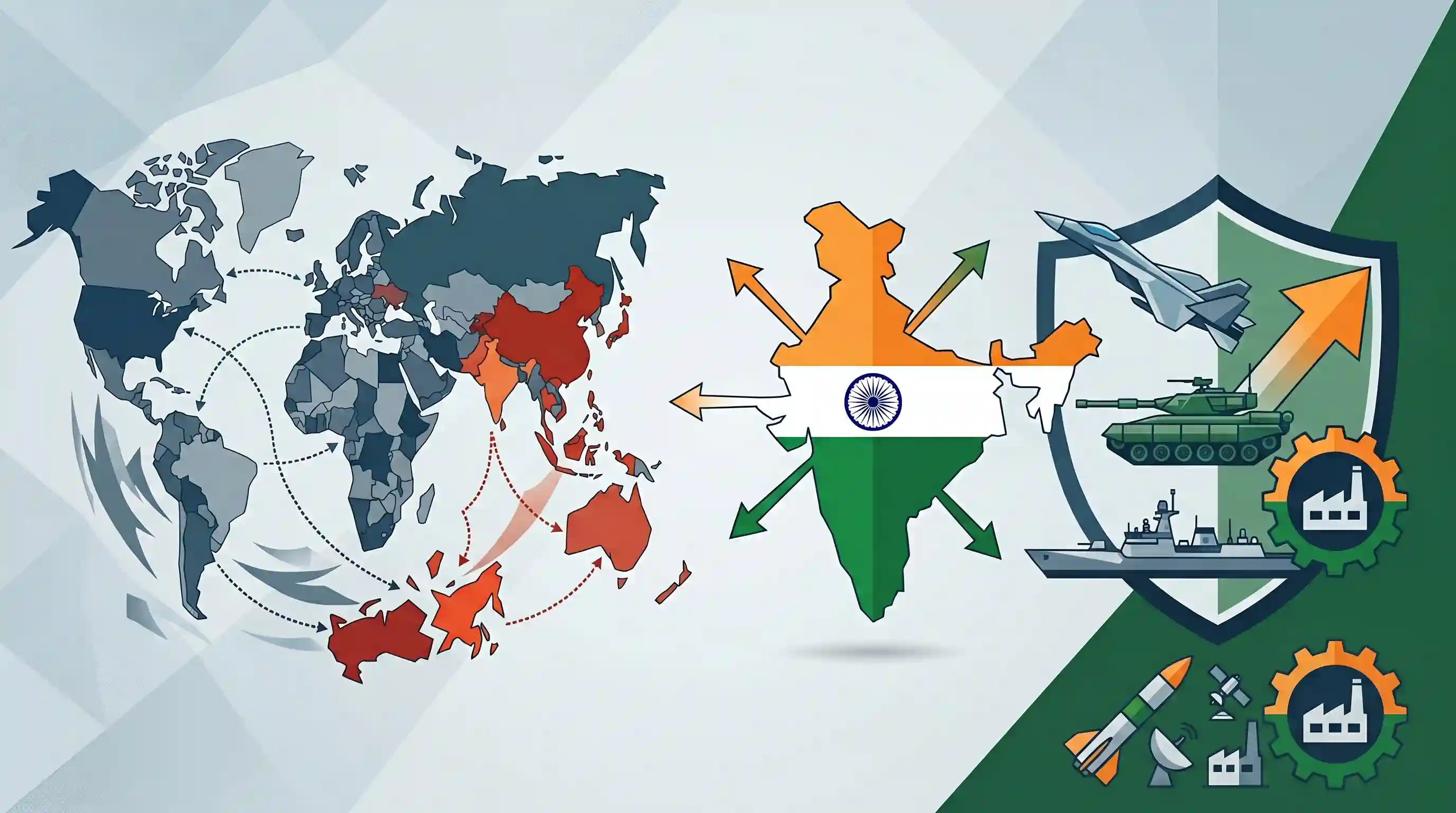
Speaking at the 'JAI Se Vijay' seminar in Pune, the Chief of Defence Staff (CDS) stated that traditional geopolitical assumptions about permanent friends or adversaries are becoming increasingly unreliable. This observation highlights a rapidly shifting global order, reinforcing the necessity for India to maintain strategic autonomy in its foreign policy and accelerate its drive toward self-reliance (Atmanirbharta) in the defence sector to navigate future uncertainties.
Key Points
- The Chief of Defence Staff (CDS) highlighted the rapidly shifting nature of global alliances at the 'JAI Se Vijay' seminar in Pune.
- He noted that traditional assumptions regarding permanent friends or adversaries in geopolitics are becoming increasingly unreliable.
- The assessment underscores the necessity for India to maintain strategic autonomy in its foreign policy.
- These global uncertainties reinforce the strategic need for self-reliance (Atmanirbharta) in defence and security capabilities.
Important Terms
Chief of Defence Staff (CDS)

The highest-ranking military officer in India, serving as the Principal Military Advisor to the Defence Minister and heading the Department of Military Affairs (DMA).
UPSC context
GS Paper II & III: High-level military leadership, defense reforms, and civil-military relations.
JAI Framework
A strategic mantra (Jointness, Atmanirbharta, and Innovation) coined to drive India's military transformation toward a future-ready, self-reliant, and integrated force.
UPSC context
GS Paper III: Security challenges, defense indigenization, and modern warfare strategies.
Strategic Autonomy
The ability of a nation to make sovereign decisions in foreign and defense policy without being constrained by external alliances, pressures, or dependencies.
UPSC context
GS Paper II: International Relations; core pillar of India’s multipolar foreign policy.
Jointness (Military)
The integration of the Army, Navy, and Air Force in planning and execution to achieve synergy and operational effectiveness across all domains.
UPSC context
GS Paper III: Military modernization and structural reforms like Theatre Commands.
Atmanirbharta in Defence
The policy of achieving self-reliance in defense by indigenizing production, reducing import reliance, and fostering a domestic defense industrial base.
UPSC context
GS Paper III: Indian Economy and Security; crucial for supply chain resilience.
Global Order
The set of norms and power balances governing international relations, currently transitioning from a unipolar to a more fragmented, multipolar landscape.
UPSC context
GS Paper II: International Relations; tests analysis of shifting geopolitical dynamics.
Multi-domain Warfare
A modern combat approach that integrates operations across land, sea, air, cyber, and cognitive domains to achieve decisive advantages.
UPSC context
GS Paper III: Emerging security threats and technological disruption in defense.
Prelims Trap
The Chief of Defence Staff (CDS) exercises direct operational and military command over the three Service Chiefs.
The CDS acts as the Principal Military Advisor on tri-services matters but does NOT exercise military command authority over the individual Army, Navy, or Air Force Chiefs.
Static Concepts Connected
What are the primary functions of the Chief of Defence Staff (CDS)?
- Principal Advisor: Acts as the Principal Military Advisor to the Defence Minister specifically on tri-services matters.
- DMA Head: Heads the Department of Military Affairs (DMA) to promote jointness in procurement, training, and staffing.
- No Military Command: Administers tri-service organizations but does not command the individual Service Chiefs.
How does the Defence Acquisition Procedure (DAP) 2020 promote self-reliance?
- Positive Indigenisation Lists: Introduced embargoes on importing specified military platforms and components, mandating their domestic procurement.
- FDI Liberalisation: Raised the automatic route limit to 74% to encourage foreign Original Equipment Manufacturers to manufacture in India.
Cross-Topic Patterns
Non-Alignment to Multi-Alignment
The CDS's observation reflects India's shift toward multi-alignment—engaging simultaneously with competing blocs like the Quad and SCO—to maximize strategic autonomy in a fragmented world.
Defence Indigenisation & Macroeconomy
Record defence production (₹1.27 lakh crore) and the push for Positive Indigenisation Lists directly curb massive military import bills, structurally improving India's Current Account Deficit.

Expect a 2026 prelims statement mixing the exact administrative role of the CDS (DMA head) with DAP 2020's Indigenisation Lists.
Linked PYQs · 2
Linked PYQs · 2
- 2025MainsGS2
"The reform process in the United Nations remains unresolved, because of the delicate imbalance of East and West and entanglement of the USA vs. Russo-Chinese alliance.” Examine and critically evaluate the East-West policy confrontations in this regard.
- 2024MainsGS2
Critically analyse India's evolving diplomatic, economic and strategic relations with the Central Asian Republics (CARs) highlighting their increasing significance in regional and global geopolitics.
