Jai Prakash Narayan Bird Sanctuary Declared India 100th Ramsar Site
Source:jagranjosh ↗
Why It Matters
The declaration of India's 100th Ramsar site is a major environmental milestone. For UPPSC, protected areas, wetlands, and bird sanctuaries in Uttar Pradesh (and their specific district locations like Ballia, Etah, and Aligarh) are highly high-yielding topics frequently tested in matches and objective questions.
Summary
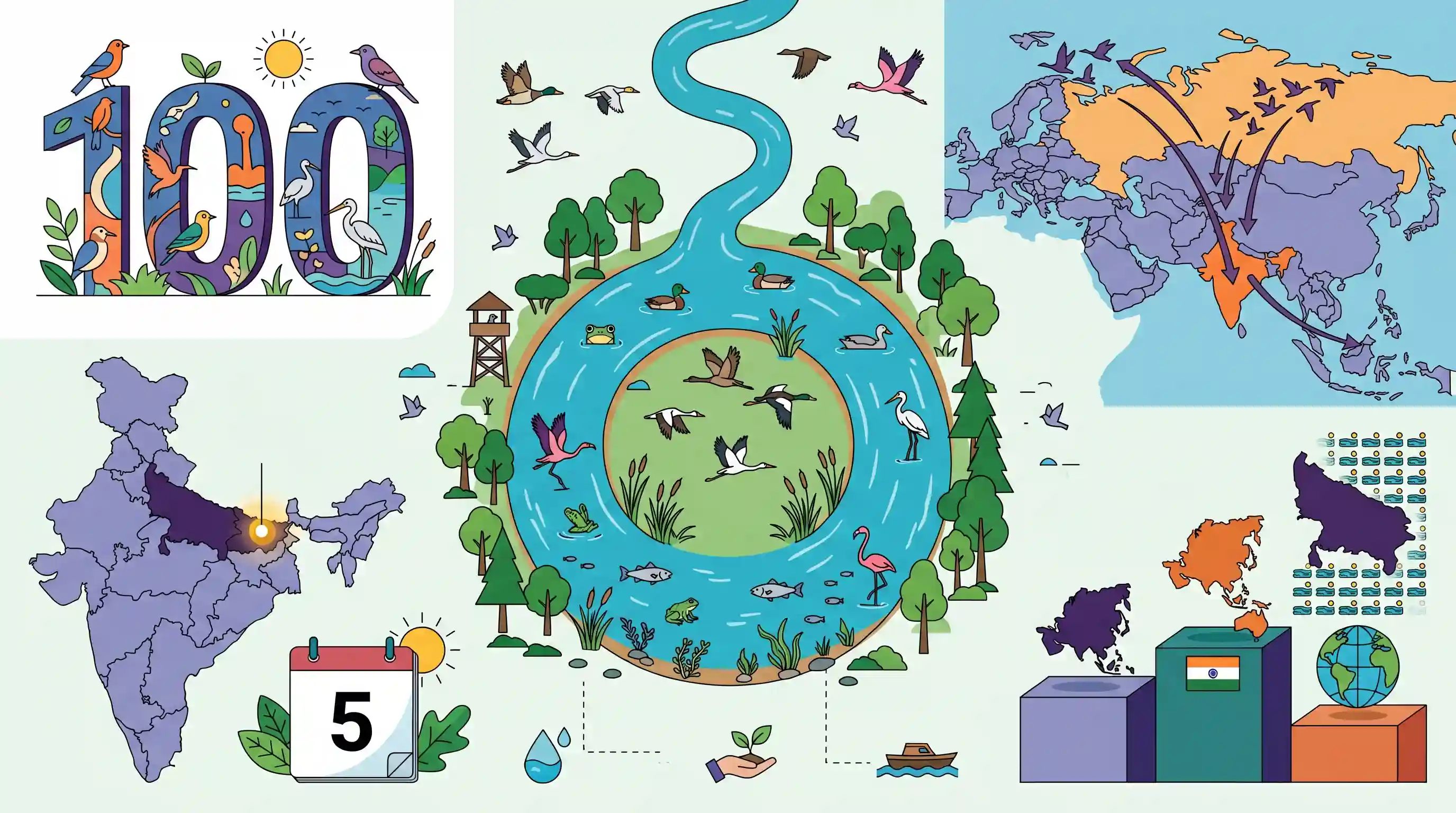
On June 5, 2026, the Jai Prakash Narayan Bird Sanctuary (Surha Tal) in Ballia, Uttar Pradesh, was officially declared India's 100th Ramsar site. The natural oxbow lake in the Ganga River basin is the 13th Ramsar site in Uttar Pradesh and a major biodiversity hotspot along the Central Asian Flyway. This addition puts India at the 1st position in Asia and 3rd globally in terms of designated Ramsar sites.
Key Points
- On World Environment Day (June 5, 2026), the Jai Prakash Narayan Bird Sanctuary (popularly known as Surha Tal) in Ballia district, Uttar Pradesh, was designated as India's 100th Ramsar Site.
- This milestone places India 3rd globally and 1st in Asia in terms of the total number of Ramsar sites, preceded only by the United Kingdom (176) and Mexico (144).
- Surha Tal is the 13th Ramsar site designated in Uttar Pradesh. Earlier in 2026, two other wetlands from UP were designated: Shekha Jheel Bird Sanctuary (Aligarh) and Patna Bird Sanctuary (Etah).
- Geographically, the sanctuary is a completely natural oxbow lake located within the Ganga River Basin, covering a core area of approximately 3,432 hectares. It was established as a bird sanctuary in 1991 and renamed in 2002 in honour of activist Jai Prakash Narayan.
- The sanctuary lies on the Central Asian Flyway and serves as a major wintering ground for migratory birds from Siberia and Central Asia, hosting species like the common pochard, Indian river tern, sarus crane, and bar-headed geese.
- The wetland is extremely rich in biodiversity, supporting 221 plant species, 66 fish species (including vulnerable Wallago attu and Bagarius), and providing a feeding and breeding ground for the vulnerable fishing cat (Prionailurus viverrinus).
Important Terms
Jai Prakash Narayan Bird Sanctuary (Surha Tal)

A natural oxbow lake wetland in Ballia, Uttar Pradesh, designated as India's 100th Ramsar site in June 2026. It serves as a major biodiversity hotspot along the Central Asian Flyway.
UPSC context
GS Paper III (Environment & Biodiversity); tests knowledge of India's major protected areas, Ramsar sites, and geographic distribution of wetlands.
Ramsar Convention on Wetlands of International Importance
An international treaty signed in 1971 in Ramsar, Iran, focused on the conservation, sustainable management, and wise use of globally significant wetlands.
UPSC context
GS Paper III (Environment/Ecology); tested under international conventions, environmental governance, and national measures for biodiversity conservation.
Wise Use of Wetlands
A core Ramsar Convention principle defining the maintenance of a wetland's ecological character through ecosystem-based approaches that align with sustainable development.
UPSC context
GS Paper III (Conservation); tests understanding of sustainable resource management, international environmental standards, and balancing livelihood with ecology.
Central Asian Flyway (CAF)
One of the world's major migratory bird flight paths, spanning 30 countries from the Arctic/Siberia to the Indian Ocean, with India situated at its heart.
UPSC context
GS Paper III (Ecology and Wildlife); tests international migratory routes, species conservation under CMS, and transboundary environmental cooperation.
Oxbow Lake
A crescent-shaped body of water formed in a river's lower course when continuous erosion and deposition cut off a meandering loop from the main river.
UPSC context
GS Paper I (Physical Geography); tests geomorphic processes, fluvial landforms, and the ecological role of plains-basin hydrology.
Prelims Trap
With its 13th designated site (Surha Tal), Uttar Pradesh now hosts the highest number of Ramsar wetlands among all Indian states.
Tamil Nadu retains the highest number of Ramsar sites in India with 20 designated wetlands, whereas Uttar Pradesh ranks second with 13.
Static Concepts Connected
How do oxbow lakes form and behave hydrologically?
- Lateral Erosion: Meandering rivers migrate laterally as water erodes the outer bend (cut bank) and deposits sediment on the inner bend (point bar).
- Neck Cutoff: During high-discharge flood events, the river breaches the narrow meander neck to establish a straighter, energy-efficient path.
- Chute Isolation: Silt and clay deposition gradually seals off the old channel loop, isolating it into a standalone, crescent-shaped oxbow lake.
Cross-Topic Patterns
Oxbow Hydrology & Flood Mitigation
Surha Tal's Kathar Nala shows reverse flow during floods, demonstrating how oxbow plains act as critical natural sponge buffers that absorb excess monsoon discharge.
Central Asian Flyway Diplomacy
With India reaching 100 Ramsar sites, its leadership in the 30-nation Central Asian Flyway (CAF) framework becomes central to transboundary ecological diplomacy.

India's 100th Ramsar milestone will likely trigger a 2026 question mapping oxbow hydrology, flyway paths, and state-wise site counts.
Linked PYQs · 2
Linked PYQs · 2
- 2021UPPSC_PRELIMSGS1
Which of the following Ramsar site is NOT situated in Uttar Pradesh ?
- 2025UPPSC_PRELIMSGS1
Which of the following Ramsar wetland site is/are NOT situated in Uttar Pradesh? 1. Sarsai Nawar Jheel 2. Samaspur Bird Sanctuary 3. Rudrasagar Lake 4. Sultanpur National Park Select the correct answer from the code given below:
