Former Chief Minister Criticizes Ramayapatnam Port Disinvestment Plan
Source:The Hindu ↗
ఇది ఎందుకు ముఖ్యం
The development and privatization of maritime infrastructure are key economic topics for Andhra Pradesh. Understanding the financial implications of port disinvestment, asset monetization, and the ensuing debt burden provides critical context for questions on state infrastructure, investment models, and public finance.
సారాంశం
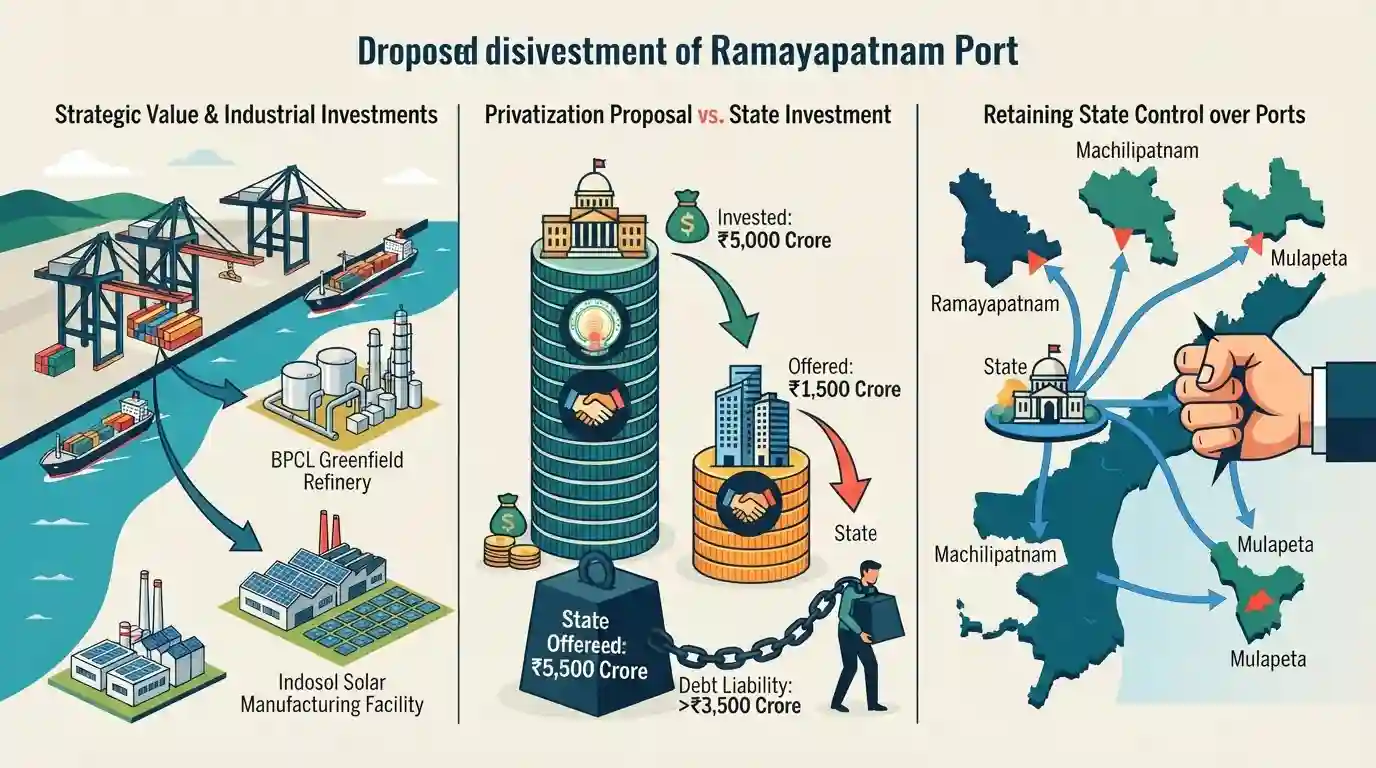
Former Andhra Pradesh Chief Minister Y.S. Jagan Mohan Reddy has criticized the state government's proposed plan to disinvest its 100% equity in the newly developed Ramayapatnam Port. He argued that the privatization is financially detrimental to the state, as the government has already invested nearly ₹5,000 crore, while private investors are only offering an upfront payment of ₹1,500 crore. Furthermore, the state would be burdened with debt-servicing liabilities exceeding ₹3,500 crore. Highlighting the port's strategic value, Jagan noted that it had already attracted massive industrial investments, including a BPCL greenfield refinery and an Indosol Solar manufacturing facility. He emphasized the importance of retaining state control over maritime assets like the Ramayapatnam, Machilipatnam, and Mulapeta ports.
ముఖ్య అంశాలు
- Former AP Chief Minister Y.S. Jagan Mohan Reddy strongly opposed the state government's proposed move to disinvest its 100% equity in the Ramayapatnam Port.
- He alleged that the state government spent ₹4,929 crore on the port, while private entities would only make an upfront payment of ₹1,500 crore.
- The disinvestment would allegedly leave Andhra Pradesh with debt servicing obligations of over ₹3,500 crore, creating a financial burden on the exchequer.
- Jagan highlighted that the port had secured major strategic investments during his tenure, including a BPCL greenfield refinery, an Indosol Solar manufacturing unit, and JSW Steel berths.
- The controversy emphasizes the broader political and economic debate regarding the privatization of critical maritime infrastructure (Ramayapatnam, Machilipatnam, and Mulapeta ports) in Andhra Pradesh.
ముఖ్యమైన పదాలు
Ramayapatnam Port

A greenfield seaport located in Nellore district, Andhra Pradesh, currently undergoing phased construction by the AP government. Under the new NDA government, there is a proposal to disinvest 100% of state equity to private investors.
UPSC context
Relevant to GS Paper 3 (Infrastructure - Ports, Investment Models) to analyze state-led vs private operation models for major logistics assets.
BPCL Greenfield Refinery
A proposed ₹95,000 to ₹1 lakh crore greenfield petroleum refinery and petrochemical complex by Bharat Petroleum Corporation Ltd near Ramayapatnam Port, expected to refine 9-12 million metric tonnes per annum.
UPSC context
Important for GS Paper 3 (Energy infrastructure) as a massive downstream energy project enhancing India's refining capacity.
Indosol Solar Manufacturing Facility
A massive vertically integrated solar PV manufacturing project being set up near Ramayapatnam Port, Andhra Pradesh, aiming to scale from quartz to module manufacturing with a total capacity of 10 GW.
UPSC context
Connects to GS Paper 3 (Renewable Energy, Industrial Policy, PLI Scheme) regarding building domestic supply chains for solar infrastructure.
YSRCP (Yuvajana Sramika Rythu Congress Party)
A regional political party in India, particularly active in Andhra Pradesh. Founded by Y. S. Jagan Mohan Reddy, who led the state government until recent elections before the current NDA government took over.
UPSC context
Contextual background for political economy and policy continuity/reversal topics in State-level politics.
ప్రిలిమ్స్ ఉచ్చు
Under the Landlord Port model, the public port authority sells port land and core infrastructure to private developers.
Under the Landlord Port model, the port authority retains permanent ownership of the land and basic infrastructure. Private entities only lease terminals for operations.
అనుసంధానమైన స్థిర భావనలు
What is the Landlord Port Model?
- Core Ownership: The public port authority acts as a regulatory body and landlord, retaining ownership of the port land and basic infrastructure (breakwaters, channels).
- Private Role: Private operators lease the terminal assets, install their own superstructure, and manage cargo-handling operations.
- Objective: It optimizes operational efficiency, leverages private capital, and reduces the financial risk borne by the state.
Disinvestment vs. Asset Monetization
- Disinvestment: Refers to the sale or liquidation of government-owned equity/assets in public sector enterprises, often reducing state shareholding.
- Asset Monetization: Involves leasing out the operations and maintenance of public assets to private players for a fixed tenure without transferring ownership.
- Privatization: The ultimate transfer of both ownership and management control of a public asset to private hands.
అంతర-అంశ నమూనాలు
Blue Economy and Port-Led Development
State-led port creation underpins the Sagarmala initiative, directly linking maritime infrastructure to coastal economic zones (CEZs) and regional manufacturing clusters.
Fiscal Federalism and State Debt
Off-budget infrastructure funding through state maritime boards raises crucial questions about state-level debt sustainability and fiscal transparency under Article 293.

UPSC may contrast Landlord Port models with service ports alongside debt-servicing implications of state-level asset monetization in 2026.
అనుసంధాన PYQలు · 3
అనుసంధాన PYQలు · 3
- 2024APPSC_PRELIMSGS1
The strategic objective of Asset Monetization Programme may be explained as :
- 2008APPSC_PRELIMSGS1
Which of the following is a natural harbour in Andhra Pradesh?
- 2024APPSC_PRELIMSGS1
In connection with transport and infrastructure in Andhra Pradesh, which of the following statement/statements is/are valid? I. Andhra Pradesh's first riverine project has been proposed between Muktayala and Madipadu on Krishna river. II. The Bhogapuram Greenfield International Airport had been started with a corpus fund that is sourced from National Investment and Infrastructure Fund (NIIF). III. Infrastructure investments in Andhra Pradesh are strictly implemented only with reference to strategic investments like ports and industrial corridors, but not with reference to community assets. IV. Rail Over Bridges (ROBs) are being developed in Andhra Pradesh under the Setu Bandhan Scheme. Select the correct answer using the codes given below :
