Administrative Overreach And Civil Disabilities In Indian Democracy
Source:Indian Express ↗
Why It Matters
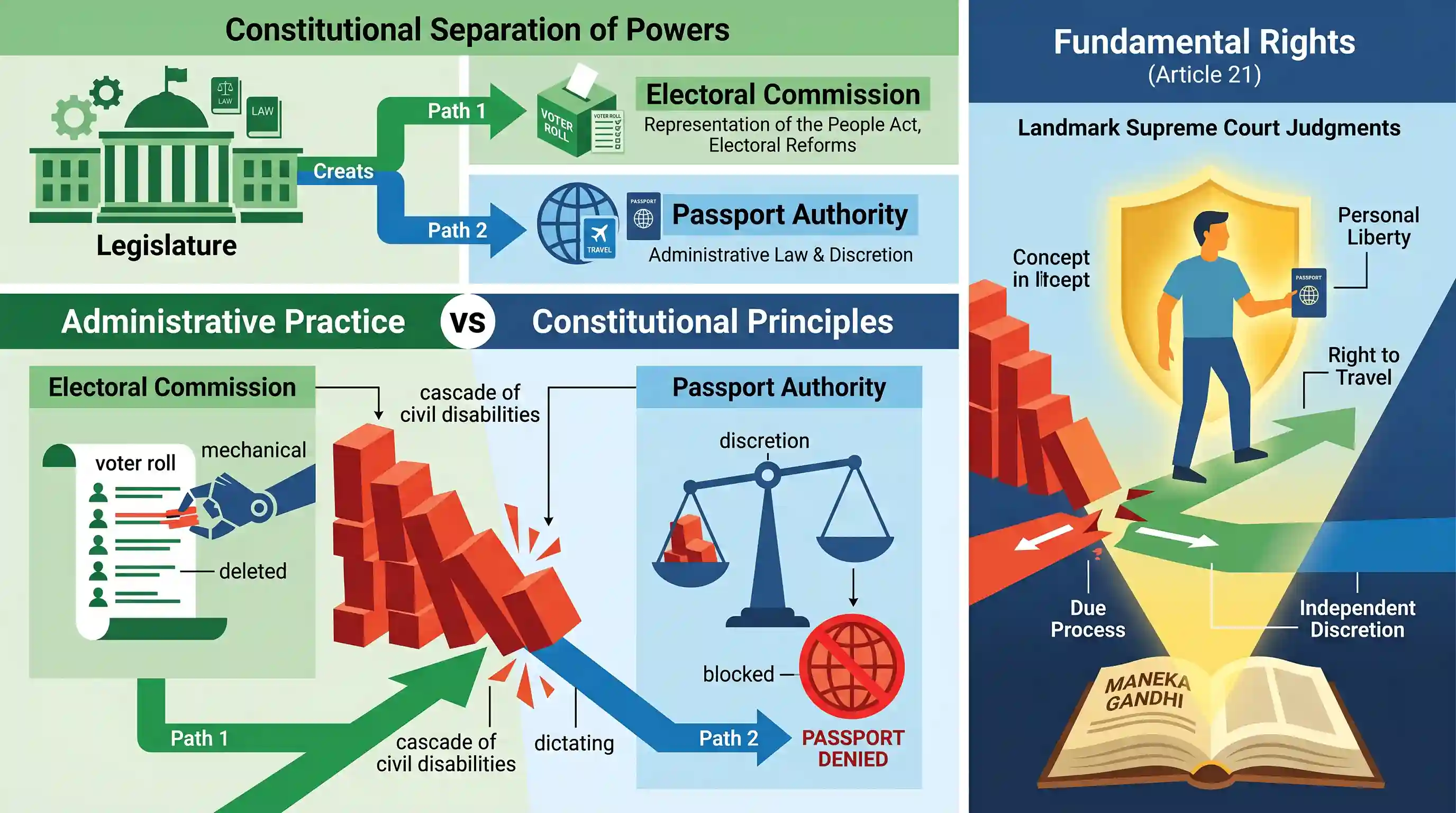
This article highlights a highly nuanced, contemporary constitutional challenge: the 'cascade of civil disabilities' arising from the unauthorized integration of administrative database outcomes across different ministries/authorities. For GS2, it serves as an excellent case study of how bureaucratic convenience can bypass parliamentary intent, undermine the rule of law, and erode fundamental freedoms (Article 21 and the legacy of the Maneka Gandhi ruling) without proper legislative or judicial oversight.
Summary
The article critiques the administrative practice where actions taken under one legislative framework (such as voter roll deletions under the Representation of the People Act) are mechanically used to dictate outcomes in unrelated domains (such as passport issuance under the Passports Act). This creates a 'cascade of civil disabilities' that undermines the constitutional separation of powers and the core principles of administrative law, which mandate that statutory bodies must exercise independent discretion. The authors argue that this administrative overreach violates fundamental rights—particularly personal liberty (Article 21)—and ignores the due process standards established by the Supreme Court in the landmark Maneka Gandhi case.
Key Points
- The concept of the 'cascade of civil disabilities' refers to when administrative decisions from one statutory domain (e.g., voter registration) migrate to dictate outcomes in another (e.g., passport issuance), leading to a progressive loss of civil rights without Parliamentary sanction.
- Under the Special Intensive Revision (SIR), more than 5.8 crore names have been deleted from voter lists across 12 states/UTs (with 91 lakh in West Bengal alone); utilizing these administrative deletions mechanically to deny or stall passports represents a major threat to fundamental freedoms.
- In administrative law, the fragmentation of public power is a safeguard of liberty; statutory authorities must exercise independent statutory judgment under their respective acts and cannot mechanically delegate or surrender their discretion to another authority's findings.
- The landmark Maneka Gandhi (1978) judgment established that the right to travel abroad is an integral part of personal liberty under Article 21, and any restriction on this right must satisfy the benchmarks of fairness, reasonableness, and due process.
- Administrative collation of statutory outcomes without legislative mandate bypasses parliamentary intent, as the legislature deliberately created separate legal frameworks for citizenship, elections, and travel documents.
Important Terms
Passports Act (1967)

A statutory framework regulating the issuance of passports and travel documents, governing the departure of citizens, and defining grounds for refusal, impounding, or revocation.
UPSC context
GS Paper II: Fundamental Rights. Tests understanding of personal liberty, administrative discretion, and due process under Article 21.
Representation of the People Act (1951)
A key statute enacted under Article 327 governing the actual conduct of Indian elections, candidate qualifications/disqualifications, electoral offenses, and resolution of disputes.
UPSC context
GS Paper II: Salient features of the Representation of People's Act. Tests electoral integrity, candidate disqualification, and democratic processes.
Citizenship Act (1955)
The primary legislation governing the acquisition, determination, and termination of Indian citizenship post-Constitution, detailing methods like birth, descent, registration, and naturalization.
UPSC context
GS Paper II: Indian Constitution (Part II). Tests legal frameworks of citizenship, migration, and constitutional identity.
Election Commission of India
A permanent constitutional body established under Article 324 to direct, superintend, and control elections to Parliament, State Legislatures, and the offices of President and Vice-President.
UPSC context
GS Paper II: Constitutional Bodies. Tests appointment, powers, and responsibilities of the commission in preserving electoral democracy.
Passport Authority
The statutory officer or authority designated under the Passports Act, 1967, and Rules, responsible for processing, issuing, impounding, or revoking passports independently.
UPSC context
GS Paper II: Statutory bodies and administrative law. Tests independent exercise of statutory discretion and the rule of law.
Supreme Court of India
The apex judicial body in India under Part V, Chapter IV, serving as the ultimate court of appeal, final interpreter of the Constitution, and guardian of fundamental rights.
UPSC context
GS Paper II: Structure, organization, and functioning of the Judiciary. Tests judicial review, basic structure, and landmark judgments.
Prelims Trap
Deletion of an individual's name from electoral rolls under the RPA automatically strips citizenship or permits automatic passport cancellation.
Electoral rolls and passports are governed by separate, independent statutes. Authorities must exercise independent discretion; findings under one act cannot automatically dictate outcomes in another.
Static Concepts Connected
What is the 'Golden Triangle' doctrine established by the Supreme Court?
- Core Components: Comprises Articles 14, 19, and 21, which are mutually inclusive and cannot be read in isolation.
- Maneka Gandhi Shift: Transitioned Indian jurisprudence from 'procedure established by law' to substantive 'due process of law' requiring fairness.
- Administrative Check: Ensures state actions restricting personal liberty, like travel abroad, are not arbitrary or unreasonable.
What is the administrative rule against 'acting under dictation'?
- Independent Discretion: Statutory authorities must exercise their own judgment using criteria defined solely in their governing Act.
- No Automatic Surrender: An authority cannot mechanically apply decisions made by another body under a different statutory framework.
- Judicial Consequence: Decisions made under dictation or without independent application of mind are treated as ultra vires.
Cross-Topic Patterns
Database integration vs Privacy rights
Linking separate statutory databases like voter rolls and passports creates a single-point identity matrix that risks mass surveillance and violates informational privacy under Article 21.
Delegated legislation vs separation of powers
When executive agencies use administrative circulars to link distinct statutes, they bypass legislative oversight, disrupting the balance between parliamentary intent and executive execution.

Mains 2026 may analyze how 'cascade of civil disabilities' via database integration violates independent statutory discretion under Art 21.
Linked PYQs · 2
Linked PYQs · 2
- 2023MainsGS2
“The Constitution of India is a living instrument with capabilities of enormous dynamism. It is a constitution made for a progressive society.” Illustrate with special reference to the expanding horizons of the right to life and personal liberty.
- 2017PrelimsGS1
Right to vote and to be elected in India is a
