Aryabhata satellite golden jubilee and ISRO space milestones
Source:The Hindu ↗
Why It Matters
The 50th anniversary of Aryabhata is a significant milestone for India's space program, highlighting the historical evolution of ISRO from relying on foreign launch vehicles to becoming a self-reliant, commercial space powerhouse. This forms a natural anchor for GS3 questions tracing the trajectory and socio-economic impact of Indian space technology.
Summary
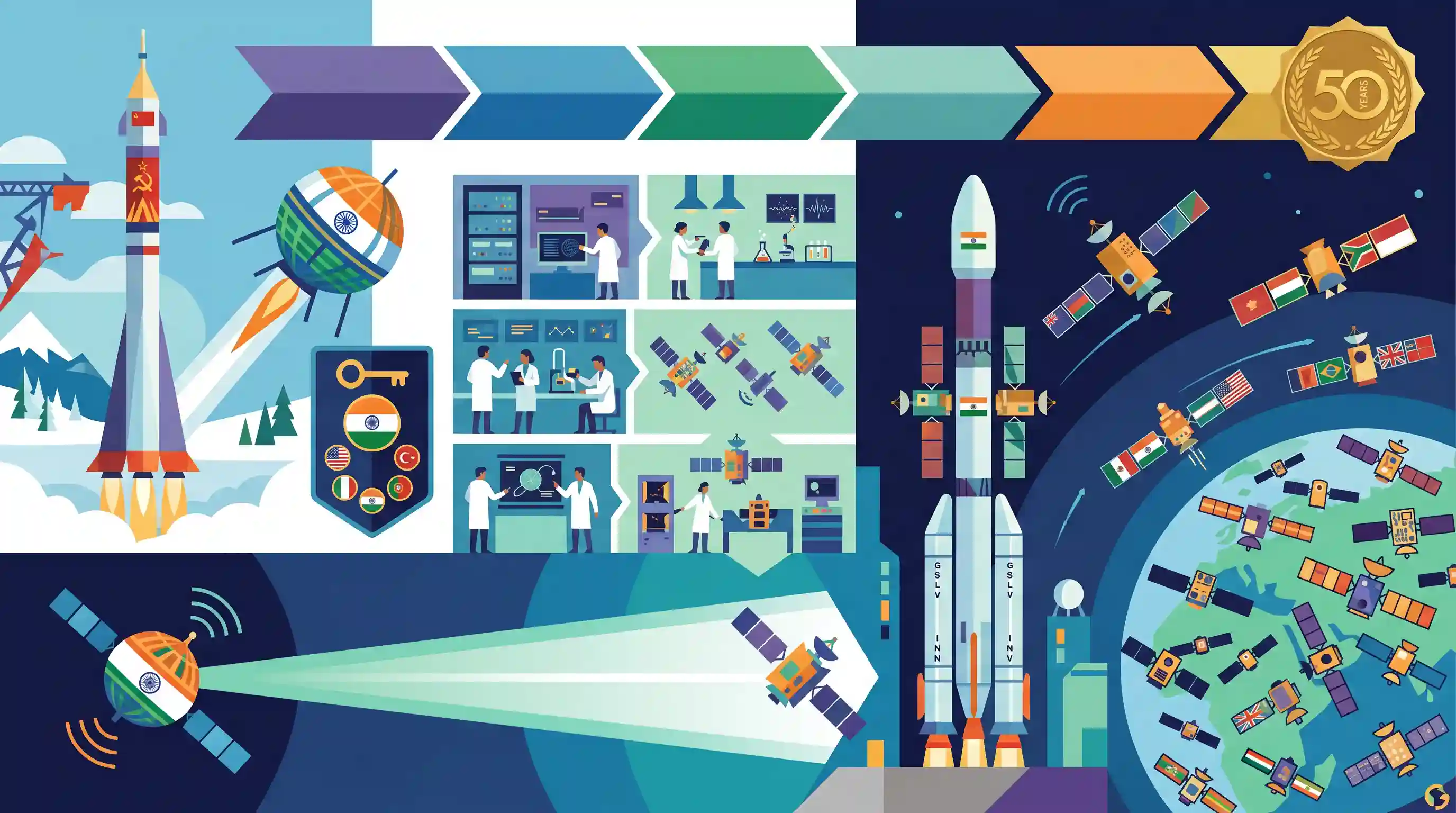
India is celebrating the golden jubilee of the launch of its first satellite, Aryabhata, on April 19, 1975. Launched from the USSR using a Kosmos-3M rocket, the 360-kg quasi-spherical satellite marked ISRO's entry into the exclusive club of satellite-building nations. Although it operated briefly due to a power anomaly, Aryabhata laid the foundation for India's indigenous satellite expertise. Over the past 50 years, ISRO has vastly expanded its capabilities, successfully building 131 satellites and executing commercial launches for 34 foreign nations.
Key Points
- April 19 marks the golden jubilee (50 years) of the launch of India's first satellite, Aryabhata, which was sent to space in 1975.
- The 360-kg satellite was launched using a Soviet Kosmos-3M rocket from Kapustin Yar in Russia's Astrakhan Oblast.
- Aryabhata carried payloads for X-ray astronomy, aeronomy, and solar physics; despite a power failure stopping its primary functions early, it proved ISRO's capability in satellite design and tracking.
- The project was led by space pioneer U.R. Rao under a management board headed by Satish Dhawan, with the name chosen by then-Prime Minister Indira Gandhi.
- Since Aryabhata, ISRO has achieved tremendous growth, building 131 Indian satellites (with 55 currently active) and launching 433 satellites for 34 foreign countries.
Important Terms
Aryabhata Satellite

India’s first experimental satellite, launched in 1975 to conduct X-ray astronomy and solar physics. It established the foundation for indigenous satellite design and orbital mechanics.
UPSC context
GS Paper III (S&T); essential for historical milestones and evolution of India’s space program.
ISRO (Indian Space Research Organisation)
India's premier space agency under the Department of Space. Formed in 1969, it leads national space programs, planetary exploration, and the development of launch vehicles.
UPSC context
GS Paper III (S&T); core institutional framework for scientific achievements.
Kosmos-3M
A Soviet-era liquid-fueled launch vehicle used to place Aryabhata into orbit. Its use highlights the critical historical strategic-scientific cooperation between India and the USSR.
UPSC context
GS Paper II (International Relations); relevant for Indo-Russia historical ties and early technology transfers.
PSLV (Polar Satellite Launch Vehicle)
ISRO's "workhorse" rocket, capable of launching multiple satellites into Sun-synchronous Polar Orbits. It has been pivotal in India’s commercial success in the global space market.
UPSC context
GS Paper III (S&T); tests knowledge of launch infrastructure and commercial capability.
NewSpace India Limited (NSIL)
A Central Public Sector Enterprise and the commercial arm of ISRO. It facilitates private sector participation in the Indian space program and handles foreign satellite launches.
UPSC context
GS Paper III (Economy/S&T); focuses on space privatization and global market share.
Kapustin Yar
A Soviet/Russian rocket launch station in Astrakhan Oblast. It served as the launch site for Aryabhata, marking the beginning of India’s satellite launches from foreign soil.
UPSC context
GS Paper III (S&T); tests awareness of geography and historical space collaboration sites.
Prelims Trap
Aryabhata was India's first satellite successfully launched from Sriharikota using an indigenous launch vehicle.
While Aryabhata was built indigenously by ISRO, it was launched from the Soviet Union using a Russian Kosmos-3M rocket. India's first indigenous satellite launch was Rohini (via SLV-3) in 1980.
Static Concepts Connected
What is the chronological evolution of India's indigenous launch vehicles?
- SLV & ASLV: Experimental flights in the early 1980s; SLV-3 successfully placed the Rohini satellite in orbit in 1980, marking India's entry into the spacefaring club.
- PSLV: ISRO's workhorse. Introduced in the 1990s, it has successfully launched numerous Earth observation, navigation, and interplanetary missions like Chandrayaan-1 and Mangalyaan.
- GSLV & LVM3: Heavy-lift vehicles utilizing cryogenic technology to place heavier communication satellites into geostationary orbits and execute deep space missions like Chandrayaan-3.
- SSLV: A recently developed three-stage solid vehicle designed for low-cost, on-demand commercial launches of small satellites into Low Earth Orbit (LEO).
What were the major scientific contributions of the ancient scholar Aryabhata?
- Mathematical treatises: Authored the Aryabhatiya, a seminal text covering arithmetic, algebra, plane trigonometry, and spherical trigonometry.
- Heliocentric concepts: Proposed that the Earth rotates on its axis causing day and night, and provided a scientific explanation for solar and lunar eclipses, moving away from mythological beliefs.
- Pi and Zero: Provided a highly accurate approximation of pi (3.1416) and used a place-value system that heavily implied the concept of zero.
Cross-Topic Patterns
From foreign aid recipient to commercial space provider
India's shift from utilizing free Soviet rockets (1975) to launching satellites for 34 foreign nations reflects the commercial success of ISRO's commercial arms like NSIL and Antrix in the global space economy.
Evolution of India's space science payloads
Aryabhata carried payloads for X-ray astronomy and solar physics. This experimental DNA directly maps to modern indigenous scientific missions like AstroSat (X-ray astronomy) and Aditya-L1 (solar physics).

A 50-year jubilee makes Aryabhata highly relevant; expect a chronological mapping question linking early ISRO milestones with modern missions.
Linked PYQs · 2
Linked PYQs · 2
- 2016MainsGS3
Discuss India's achievements in the field of Space Science and Technology. How the application of this technology has helped India in its socio-economic development?
- 2015PrelimsGS1
In which of the following activities are Indian Remote Sensing (IRS) satellites used? 1. Assessment of crop productivity 2. Locating groundwater resources 3. Mineral exploration 4. Telecommunications 5. Traffic studies Select the correct answer using the code given below.
