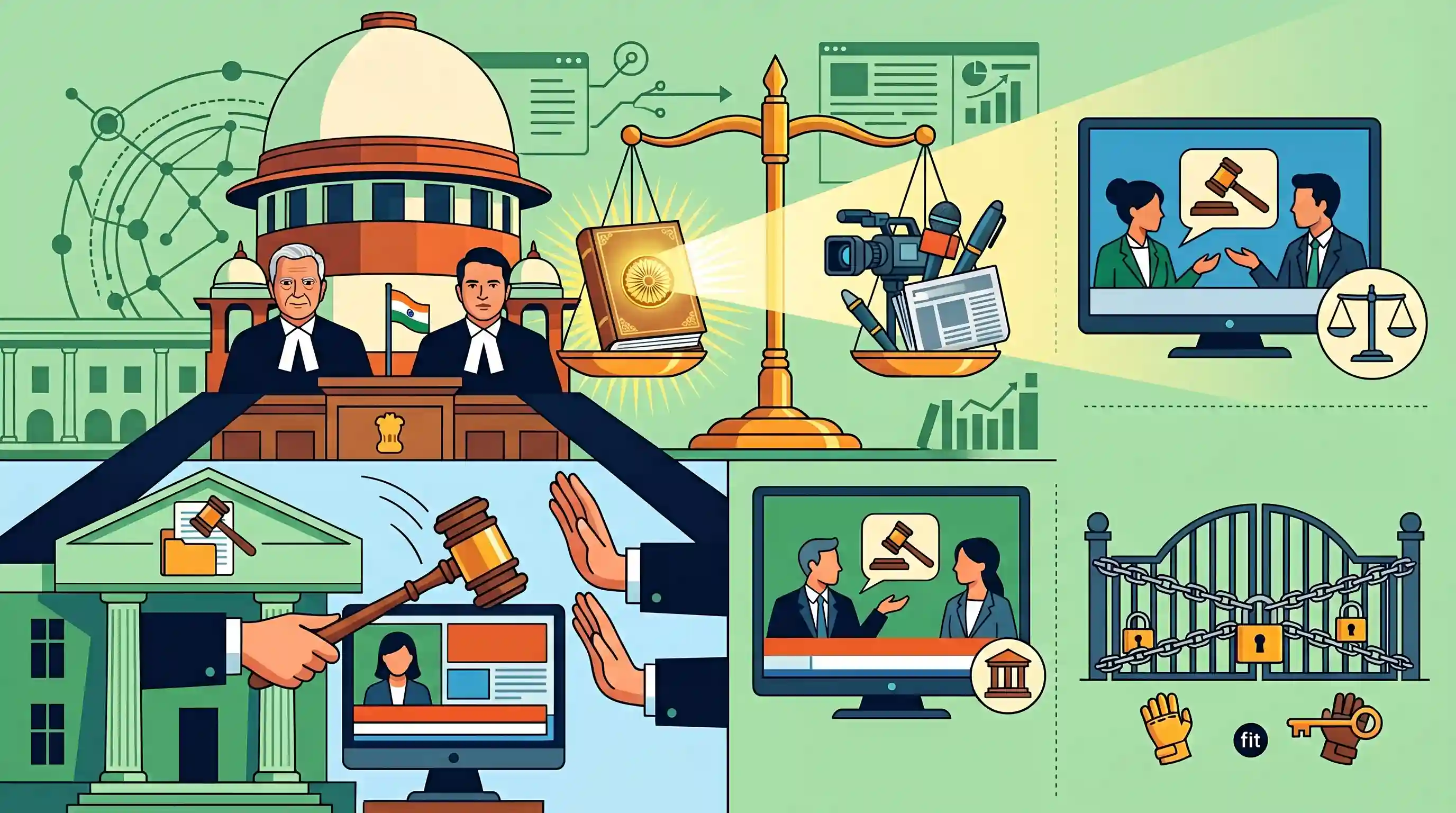
Supreme Court ruling on media content removal and free speech
Source:The Hindu ↗
Why It Matters
The Supreme Court's stance strikes a delicate balance between freedom of speech (Article 19) and the right to a fair trial. It is a critical judgment defining the contours of media trials, sub judice discussions, and the proportionality test for judicial censorship, all of which are salient for GS Paper 2 (Polity and Governance).
Summary
The Supreme Court of India, led by Justices A.S. Oka and Ujjal Bhuyan, ruled that courts are not obligated to instruct the media to delete or take down content, asserting that doing so jeopardizes the constitutionally guaranteed freedom of speech and expression. The ruling emerged during a challenge to a Delhi High Court order concerning the removal of online content related to a defamation dispute between Asian News International (ANI) and the Wikimedia Foundation. The Supreme Court emphasized that media can debate sub judice matters as long as it does so fairly. It further clarified that prior restraint or "postponement orders" against press publications should be rare, passing stringent tests of necessity and proportionality, and permitted only when publication threatens the administration of justice or the right to a fair trial.
Key Points
- The Supreme Court ruled that it is not the role of courts to order media to delete or take down content, terming such actions a threat to freedom of speech.
- The apex court criticized a Delhi High Court order directing the takedown of content in a defamation case between ANI and Wikimedia Foundation as disproportionate.
- The Court highlighted that media can vigorously and objectively debate sub judice matters, provided the discourse remains constructive.
- Postponement orders (preventive injunctions against the press) should only be issued if publication is highly likely to impair the administration of justice or a fair trial.
- Such preventive injunctions must strictly adhere to the twin tests of necessity and proportionality.
Important Terms
Article 19(1)(a)

Article 19(1)(a) of the Indian Constitution guarantees all citizens the right to freedom of speech and expression, which includes the freedom of the press and the right to information.
UPSC context
GS Paper II (Polity); foundational for media freedom and fundamental rights topics.
Postponement Orders
Judicial directives that temporarily restrict media reporting on pending cases to prevent a "real and substantial risk" of prejudice to a fair trial or the administration of justice.
UPSC context
GS Paper II (Judiciary); tests the balance between freedom of expression and the right to a fair trial.
Open Justice
A legal principle stating that court proceedings should be conducted in public and be accessible to media and citizens to ensure transparency and prevent judicial overreach.
UPSC context
GS Paper II (Judiciary); relevant for questions on judicial transparency and accountability.
Sub Judice
A Latin term meaning "under judgment," describing matters currently being considered by a court. Public discussion is often restricted to avoid influencing the outcome of the case.
UPSC context
GS Paper II (Polity); concerns the limits of free speech regarding ongoing legal proceedings.
Prior Restraint
Legal action that prohibits speech or other expression before it occurs. In India, such censorship is rare and must pass strict tests of necessity and proportionality.
UPSC context
GS Paper II (Constitutional Law); critical for understanding the high threshold for media censorship.
Contempt of Court
Acts that defy the court's authority or interfere with the administration of justice. It is a "reasonable restriction" on free speech under Article 19(2).
UPSC context
GS Paper II (Polity/Judiciary); tests understanding of the constitutional limits on fundamental rights.
Prelims Trap
"The media is constitutionally prohibited from debating any matter that is sub judice (under trial) to prevent contempt of court."
False. The SC explicitly stated media can vigorously debate sub judice matters, provided it is fair. It only constitutes contempt if it creates a "real and substantial risk" of prejudice.
Static Concepts Connected
How is Freedom of Press protected and restricted under the Indian Constitution?
- Implicit Right: Freedom of press is not explicitly mentioned but is an implicit part of the Freedom of Speech and Expression under Article 19(1)(a).
- Prior Restraint: Restricting expression before publication. The Supreme Court holds that prior restraint is broadly unconstitutional, allowed only in exceptional circumstances passing stringent proportionality tests.
- Reasonable Restrictions: Subject to limits under Article 19(2): sovereignty, security of the State, public order, decency, defamation, and contempt of court.
What constitutes Contempt of Court in India?
- Civil Contempt: Willful disobedience to any judgment, decree, direction, order, or writ of a court.
- Criminal Contempt: Publication of matter that scandalises the court, prejudices judicial proceedings, or materially interferes with the administration of justice.
- Truth as Defense: Under the 2006 amendment to the Contempt of Courts Act, 1971, truth is a valid defense if made in the public interest and invoked bona fide.
Cross-Topic Patterns
Defamation vs. IT Act Safe Harbour Protection
The Wikimedia Foundation case indirectly invokes Section 79 of the IT Act, questioning when a platform loses its "safe harbour" intermediary status and becomes a publisher liable for defamation.
Balancing Fair Trial (Art 21) & Press Freedom
The "necessity and proportionality" test for postponement orders underscores the classic constitutional friction between a citizen's Right to Life (Article 21 - fair trial) and Freedom of Press (Article 19).

Expect a Prelims question testing 'Prior Restraint' vs 'Contempt of Court', specifically checking if media can debate sub judice matters.
Linked PYQs · 2
Linked PYQs · 2
- 2014MainsGS2
What do you understand by the concept "freedom of speech and expression"? Does it cover hate speech also ? Why do the films in India stand on a slightly different plane from other forms of expression ? Discuss.
- 2017MainsGS2
Examine the scope of Fundamental Rights in the light of the latest judgement of the Supreme Court on Right to Privacy.
