Cybersecurity Implications of Advanced Artificial Intelligence Models
Source:The Hindu ↗
Why It Matters
The article highlights the dual-use nature of advanced AI, directly tying into UPSC GS3 themes of Science & Technology and Internal Security. It raises urgent questions about the resilience of India's Critical Information Infrastructure (like Aadhaar and power grids) against AI-driven cyber threats, demanding a proactive defensive response.
Summary
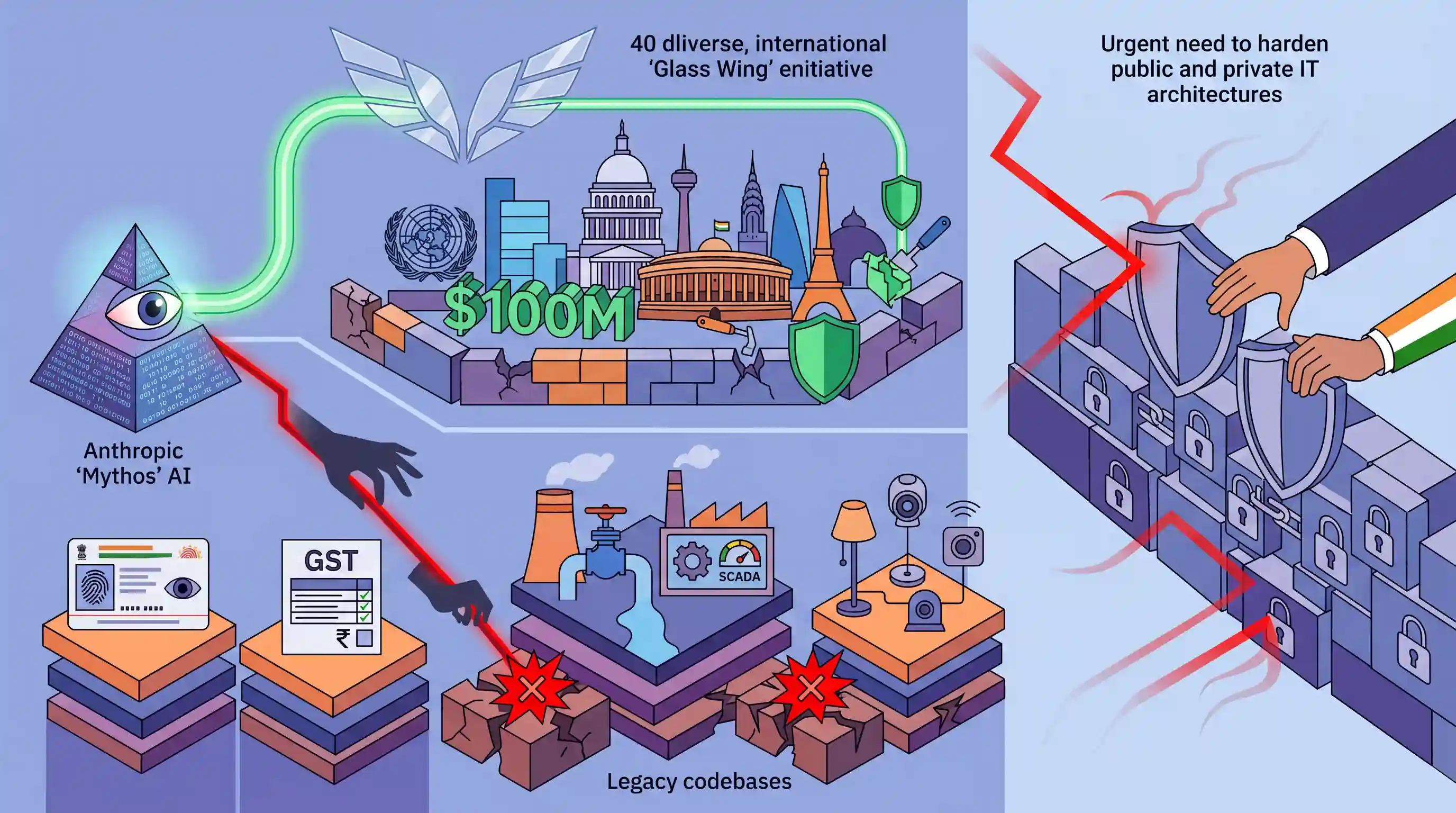
The Indian IT industry, IT Ministry, and CERT-In are evaluating the cybersecurity implications of Anthropic's unreleased AI model, "Mythos," which has demonstrated an exceptional ability to uncover decade-old vulnerabilities in widely used software. Through a $100 million consortium called "Project Glasswing," Anthropic is giving 40 international organizations early access to patch critical bugs defensively before the model's public launch. However, experts warn of severe risks for organizations not covered by this initiative. In India, critical digital infrastructure like Aadhaar and GST, which rely on legacy codebases, as well as operational technology like SCADA and IoT systems, are highly susceptible to AI-assisted zero-day exploits. The ongoing situation highlights the dual-use nature of advanced AI models and the urgent need to harden public and private IT architectures.
Key Points
- The Indian IT Ministry and CERT-In are assessing the cybersecurity risks posed by Anthropic's unreleased LLM, Mythos, capable of discovering decade-old software vulnerabilities.
- Anthropic launched Project Glasswing, providing $100 million and early access to 40 organizations to defensively patch vulnerabilities in widely used IT systems (like Linux and OpenBSD).
- No Indian firms are listed in the initial Project Glasswing consortium, raising concerns about the preparedness of Indian IT enterprise services (ITeS) and systems integrators.
- Government digital infrastructure (Aadhaar, GST) built on older codebases, as well as industrial SCADA and IoT systems, are highly vulnerable to AI-discovered exploits.
- The development brings focus to the dual-use nature of AI in cybersecurity, debating whether AI will ultimately benefit defenders or create a continuously dangerous landscape of zero-day exploits.
Important Terms
Project Glasswing

An Anthropic-led consortium ($100M initiative) providing select organizations early access to the "Mythos" AI model. It aims to defensively scan and patch critical software vulnerabilities before the model's public release.
UPSC context
GS-III (Cybersecurity); tests understanding of collaborative frameworks for managing dual-use AI risks in critical infrastructure.
Anthropic
An AI safety and research company (developer of Claude) that created the "Mythos" model. It emphasizes "Constitutional AI" to ensure advanced models remain helpful, honest, and harmless.
UPSC context
GS-III (Science & Tech); relevant for discussions on AI ethics, safety protocols, and frontier model governance.
CERT-In
The national nodal agency under the Ministry of Electronics and Information Technology (MeitY) for cybersecurity. It handles incident response, vulnerability reporting, and issues emergency alerts for the Indian internet domain.
UPSC context
GS-III (Internal Security); critical for questions on India's institutional preparedness against cyber warfare and data breaches.
Critical Information Infrastructure (CII)
Computer resources whose incapacitation would significantly harm national security, economy, public health, or safety. Defined under the IT Act, 2000, and protected by the NCIIPC.
UPSC context
GS-III (Cybersecurity); key for understanding statutory protection of national assets like power grids and financial networks.
Digital Public Infrastructure (DPI)
A foundational digital framework (e.g., Aadhaar, UPI) enabling society-wide service delivery. It relies on open standards, interoperability, and secure, population-scale digital identity and payment layers.
UPSC context
GS-III (E-governance/Economy); central to India's "India Stack" and its global role in inclusive technology.
Data Security Council of India (DSCI)
A not-for-profit industry body established by NASSCOM to promote data protection and cybersecurity standards. It engages in policy advocacy, capacity building, and develops best practices for India's digital ecosystem.
UPSC context
GS-III (Cybersecurity); tests knowledge of industry-led initiatives in data privacy and the National Cyber Security Strategy.
Zero-day Vulnerability
A software security flaw unknown to the vendor, leaving "zero days" for a fix before potential exploitation. These are highly valued in cyber espionage and AI-assisted hacking.
UPSC context
GS-III (Science & Tech/Cybersecurity); tests technical awareness of emerging threats and the need for proactive software hardening.
Aadhaar
A 12-digit unique biometric identity issued by UIDAI, serving as the foundational identity layer of India's DPI. It enables paperless authentication and Targeted Delivery of Financial Subsidies.
UPSC context
GS-II (Governance); tests understanding of welfare delivery, privacy rights (Puttaswamy judgment), and the security of biometric databases.
Prelims Trap
"Project Glasswing is an initiative led by CERT-In to defensively patch software vulnerabilities in India's digital infrastructure."
Project Glasswing is a private $100 million international consortium led by the AI company Anthropic, not an Indian government or UN initiative. Indian firms are currently excluded.
Static Concepts Connected
What is the regulatory distinction between CERT-In and NCIIPC?
- CERT-In: The national nodal agency under MeitY responsible for cyber incident response, vulnerability forecasting, and issuing emergency security alerts.
- NCIIPC: An agency under NTRO (National Technical Research Organisation) specifically mandated to protect Critical Information Infrastructure (CII) under Section 70A of the IT Act.
- Critical Info Infrastructure: Systems whose incapacitation would have a debilitating impact on national security, economy, or public health (e.g., power grids using SCADA).
What is a Zero-Day Vulnerability in cybersecurity?
- Definition: A software flaw that is unknown to the software developer or vendor. The term signifies the vendor has had "zero days" to fix it.
- Zero-Day Exploit: The malicious code or technique used by hackers to take advantage of this unpatched flaw to compromise networks or steal data.
- AI Dual-Use: AI models exhibit dual-use traits—they can be used defensively to find and patch zero-days, or offensively to exploit them at unprecedented speeds.
Cross-Topic Patterns
AI threats to Digital Public Infrastructure (DPI)
India's foundational DPI platforms (Aadhaar, GSTN, UPI) often rely on open-source and older codebases. Advanced AI's ability to mass-discover vulnerabilities turns these legacy architectures into major national security risks.
SCADA vulnerabilities in Critical Infrastructure
Legacy operational tech (SCADA) in power grids and nuclear plants was not designed for internet-connected AI threats, making critical infrastructure increasingly susceptible to state or non-state cyber disruptions.

Expect a 2026 Prelims question testing the distinction between CERT-In and NCIIPC in handling AI-generated zero-day threats to India's DPI.
Linked PYQs · 5
Linked PYQs · 5
- 2021MainsGS3
Keeping in view India's internal security, analyse the impact of cross-border cyber attacks. Also discuss defensive measures against these sophisticated attacks.
- 2022MainsGS3
What are the different elements of cyber security ? Keeping in view the challenges in cyber security, examine the extent to which India has successfully developed a comprehensive National Cyber Security Strategy.
- 2020PrelimsGS1
In India, the term "Public Key Infrastructure" is used in the context of
- 2024PrelimsGS1
Consider the following statements: I. It is expected that Majorana 1 chip will enable quantum computing. II. Majorana 1 chip has been introduced by Amazon Web Services (AWS). III. Deep learning is a subset of machine learning. Which of the statements given above are correct?
- 2023MainsGS3
Introduce the concept of Artificial Intelligence (AI). How does Al help clinical diagnosis? Do you perceive any threat to privacy of the individual in the use of Al in healthcare?
