रोजगार और प्रदूषण पर केंद्रीय बजट की विपक्षी आलोचना
स्रोत:द हिंदू ↗
क्यों मायने रखता है
The article links macroeconomic policy (Union Budget and State capital expenditure support) with practical governance issues like urban pollution and structural unemployment, offering a critical perspective necessary for evaluating budget effectiveness in GS-3.
सारांश
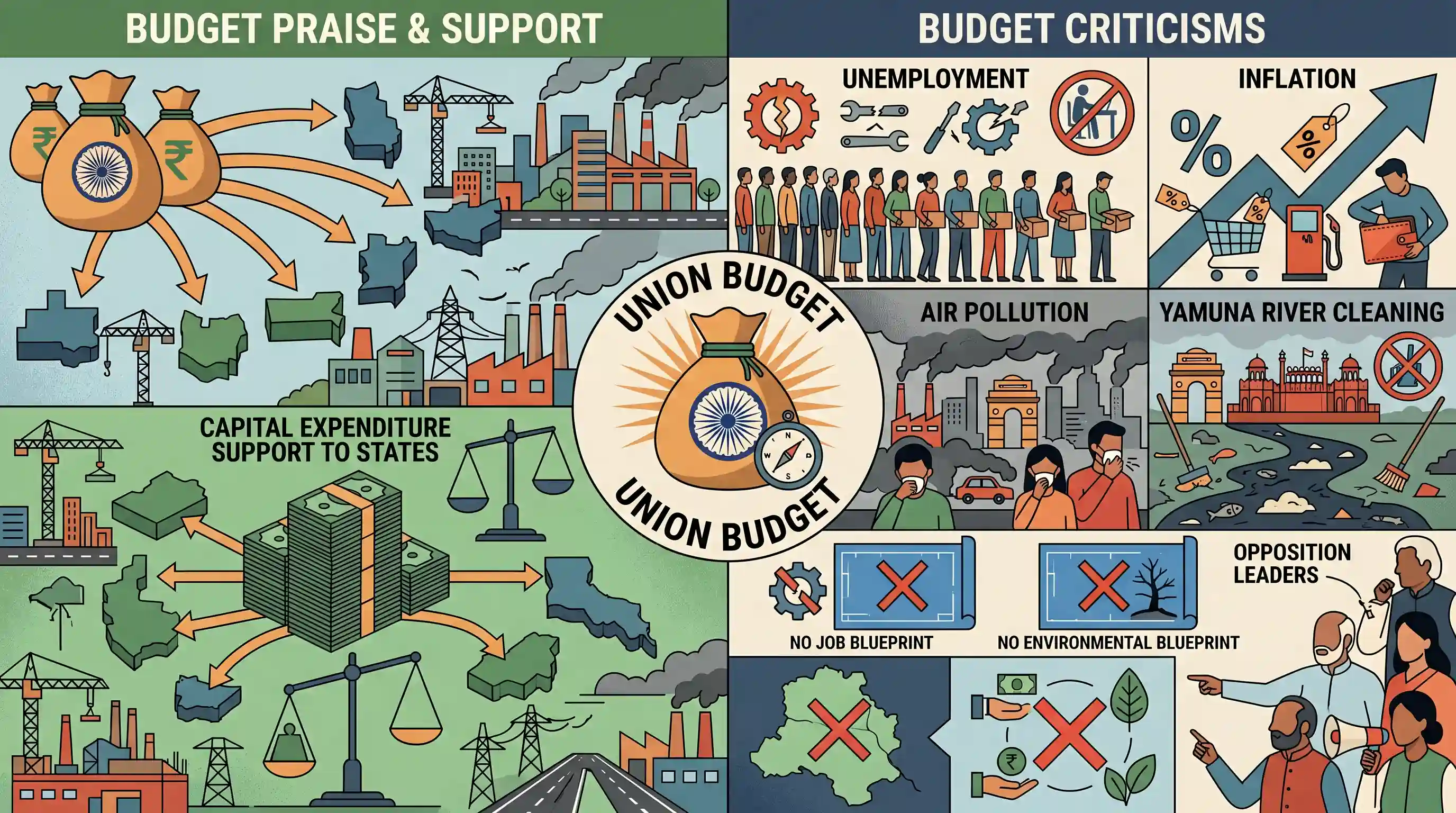
The Opposition, including AAP and Congress leaders, criticized the Union Budget for failing to address pressing public issues such as unemployment, inflation, air pollution, and the cleaning of the Yamuna river. While Chief Minister Rekha Gupta lauded the ₹1.4 lakh crore allocated for capital expenditure support to States, critics argued that the budget lacked a specific blueprint for job creation and environmental rehabilitation, particularly neglecting the unique financial and environmental needs of Delhi.
मुख्य बिंदु
- Opposition leaders criticized the Union Budget for failing to provide concrete blueprints on employment generation and inflation control.
- Lack of funding and initiatives for controlling severe air pollution and cleaning the Yamuna river in Delhi were heavily contested.
- Chief Minister Rekha Gupta highlighted the ₹1.4 lakh crore allocation for capital expenditure support to States as a major positive.
- Critics argued that the budget functions as a long-term vision but ignores pressing socio-economic and environmental challenges.
महत्वपूर्ण शब्द
Union Budget

The "Annual Financial Statement" mandated by Article 112, detailing the government's estimated receipts and expenditures for the upcoming financial year.
UPSC context
GS Paper III (Government Budgeting). Tests understanding of fiscal policy, resource mobilization, and constitutional requirements for legislative oversight of finances.
Capital Expenditure (Capex)
Government spending on assets that provide long-term benefits (e.g., infrastructure, machinery) or reduce liabilities (e.g., loan repayment), known for a high multiplier effect on GDP.
UPSC context
GS Paper III (Indian Economy). Tests knowledge of investment-led growth, its role in creating assets, and the distinction from revenue expenditure.
Fiscal Federalism
The constitutional system (Articles 268-293) governing the distribution of taxing powers, revenue sharing, and financial responsibilities between the Central and State governments.
UPSC context
GS Paper II (Constitution/Governance). Crucial for questions on Centre-State relations, the Finance Commission, and balancing regional autonomy with national fiscal stability.
Unemployment
A condition where individuals who are capable and actively seeking work are unable to find employment, often highlighting the "jobless growth" phenomenon in India.
UPSC context
GS Paper III (Employment/Growth). Tests analysis of structural economic issues, demographic dividends, and labor-intensive manufacturing versus service-led growth.
Inflation
A sustained increase in the general price level of goods and services, which reduces the purchasing power of money and is typically measured via CPI or WPI.
UPSC context
GS Paper III (Indian Economy). Relevant for evaluating monetary policy effectiveness and its impact on the cost of living and inclusive growth.
प्रारंभिक ट्रैप
The ₹1.4 lakh crore allocated for capital expenditure support to States is provided as statutory grants to ensure fiscal autonomy.
The Special Assistance to States for Capital Investment (SASCI) is provided as 50-year interest-free loans, not as statutory or tied revenue grants under Finance Commission recommendations.
संबंधित अवधारणाएँ
What distinguishes Capital Expenditure from Revenue Expenditure?
- Asset Creation: Capex creates productive physical or financial assets (e.g., roads, hospitals) or reduces liabilities. Revenue expenditure does not create assets.
- Multiplier Effect: Capex has a strong economic multiplier (approx 2.5x to 3x), meaning every ₹1 spent generates nearly ₹3 in long-term GDP growth.
- Standard Examples: Capital expenses include infrastructure building and state loans. Revenue expenses include salaries, subsidies, and interest payments.
How does the PLFS measure unemployment in India?
- Usual Status: Measures the employment status of an individual over a longer 365-day reference period, capturing chronic unemployment.
- Current Weekly Status: Measures the employment status over a 7-day reference period preceding the survey, capturing short-term fluctuations.
- Structural Nature: Unemployment in India is predominantly structural, caused by a persistent mismatch between labor force skills and modern industry demands.
अंतर-विषय पैटर्न
Capex loans tied to urban reforms
The Centre frequently ties portions of these 50-year interest-free Capex loans to specific state-level reforms, such as urban planning or scrapping old vehicles, directly blending fiscal federalism with environmental targets.
Yamuna pollution and interstate ecological flows
Delhi's environmental crises are inherently interstate. Yamuna's severe pollution is fundamentally linked to reduced ecological flows from upstream barrages (like Hathnikund) and agricultural practices in neighboring states.

Expect a 2026 Prelims question testing the exact conditions (50-year interest-free loans) of the Centre's Capex assistance to States.
संबद्ध PYQ · 4
संबद्ध PYQ · 4
- 2024MainsGS3
Industrial pollution of river water is a significant environmental issue in India. Discuss the various mitigation measures to deal with this problem and also the government's initiatives in this regard.
- 2023MainsGS3
Most of the unemployment in India is structural in nature. Examine the methodology adopted to compute unemployment in the country and suggest improvements.
- 2021MainsGS3
Distinguish between Capital Budget and Revenue Budget. Explain the components of both these Budgets.
- 2025MainsGS3
Explain how the Fiscal Health Index (FHI) can be used as a tool for assessing the fiscal performance of states in India. In what way would it encourage the states to adopt prudent and sustainable fiscal policies?
