International Space Station air leak and station safety
Source:The Hindu ↗
Why It Matters
The incident highlights the vulnerabilities and maintenance challenges of aging space infrastructure, which is highly relevant to understanding the operational lifespan of the ISS and the importance of India's upcoming plans to establish the Bharatiya Antariksha Station.
Summary
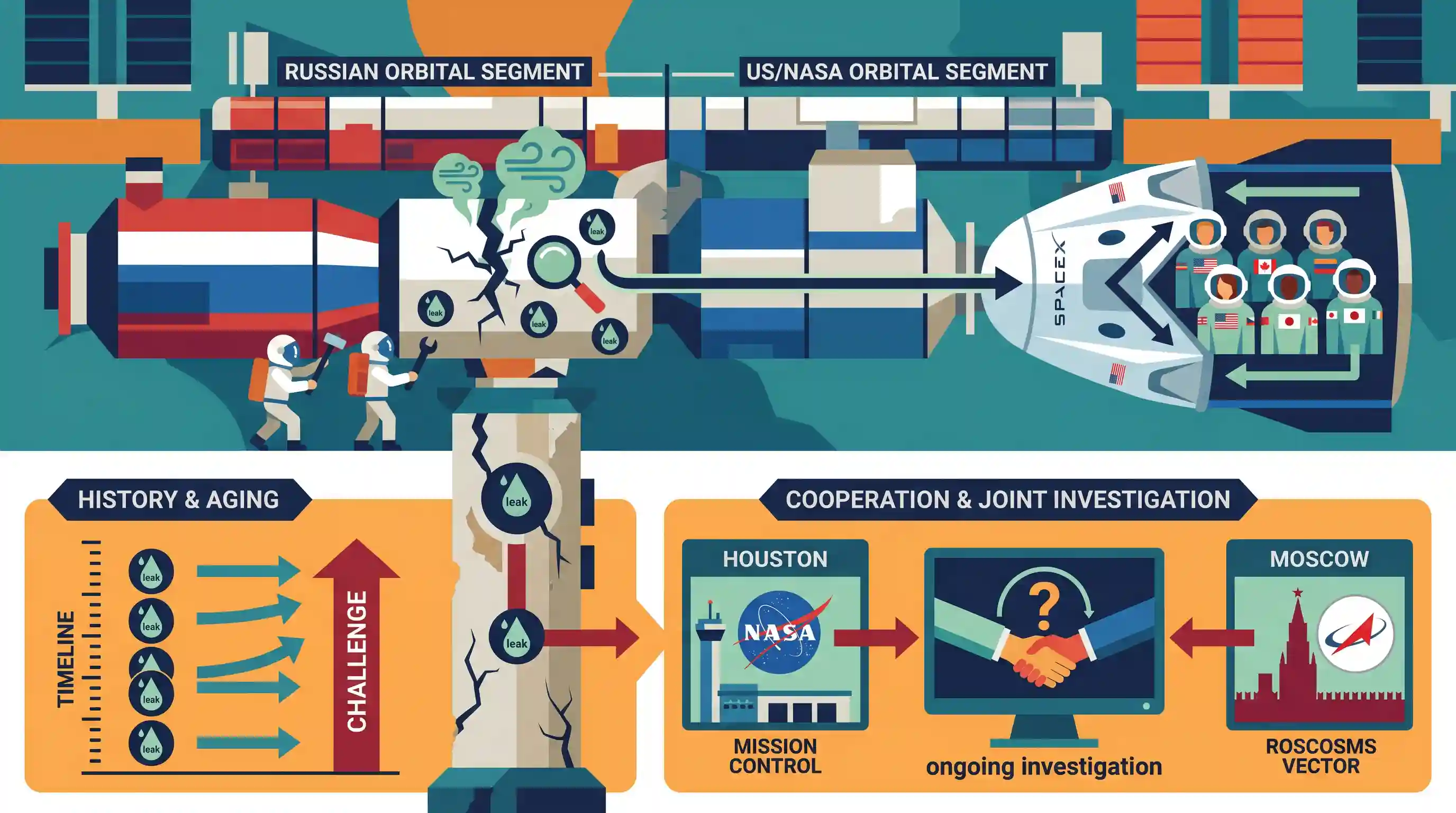
NASA ordered five astronauts to temporarily shelter in a docked SpaceX capsule after a new air leak was detected on the Russian side of the International Space Station (ISS). The precaution was taken while Russian cosmonauts worked to repair the crack. The incident highlights the growing challenge of maintaining the aging orbital laboratory, which has suffered multiple leaks in recent years, prompting ongoing investigations by NASA and Roscosmos.
Key Points
- A new air leak was detected on the Russian side of the International Space Station (ISS).
- Five astronauts were ordered to take shelter in a docked SpaceX Dragon capsule as a precautionary measure.
- Russian cosmonauts are working to carry out extensive repairs to fix the widening crack.
- The incident underscores the recurring issues of cracks and leaks due to the aging infrastructure of the ISS.
Important Terms
International Space Station (ISS)

A modular, habitable space station in low Earth orbit, serving as a microgravity research lab through cooperation between NASA, Roscosmos, JAXA, ESA, and CSA.
UPSC context
GS Paper III (Science & Technology); tests knowledge of international space diplomacy and the future of orbital research.
Roscosmos
The state corporation responsible for the Russian Federation's space flights, cosmonautics programs, and aerospace research; manages the ISS's Russian segment and Zvezda module.
UPSC context
GS Paper III (Science & Technology); relevant for bilateral space relations and management of aging orbital infrastructure.
NASA
The U.S. federal agency responsible for the civil space program, aeronautics research, and space exploration, leading the ISS partnership and the Artemis lunar missions.
UPSC context
GS Paper III (Science & Technology); central to global space governance, scientific missions, and public-private space partnerships.
SpaceX
A private American aerospace manufacturer and transport company that provides commercial crew and cargo services to the ISS using its Falcon rockets and Dragon capsules.
UPSC context
GS Paper III (Science & Technology); focuses on the increasing role of private players and commercialization in the global space sector.
Zvezda Service Module
The primary Russian service module on the ISS, providing life support, propulsion, and living quarters; the site of recent persistent air leaks in its transfer tunnel.
UPSC context
GS Paper III (Science & Technology); tests understanding of space station architecture and operational risks associated with structural aging.
Low Earth Orbit (LEO)
An orbit around Earth at an altitude between 160 km and 2,000 km, where the ISS and most artificial satellites reside for scientific and communication purposes.
UPSC context
GS Paper III (Science & Technology); fundamental concept for satellite deployment, space debris management, and orbital sustainability.
Prelims Trap
The ISS is a joint project among all major space-faring nations, including the USA, Russia, China, and India.
China and India are not ISS partners. China operates its own Tiangong station, and India is building the BAS. The ISS relies strictly on 5 partners: USA, Russia, Europe, Japan, and Canada.
Static Concepts Connected
Which are the currently operational orbital space stations?
- ISS (International): Jointly operated by NASA, Roscosmos, ESA, JAXA, and CSA. Set to de-orbit by 2030 due to aging infrastructure.
- Tiangong (China): Exclusively operated by China Manned Space Agency (CMSA) in Low Earth Orbit.
What is the Bharatiya Antariksha Station (BAS)?
- Indigenous Station: ISRO's planned independent space station designed to sustain Indian human spaceflight missions post-Gaganyaan.
- Timeline: First module (BAS-1) targeted for a 2028 launch, with full operational status expected by 2035.
- Orbit & Mass: Will operate in Low Earth Orbit (LEO) and will be significantly smaller than the ISS.
Cross-Topic Patterns
Geopolitics vs. Space diplomacy
The ISS remains one of the few active areas of US-Russia cooperation. Its interdependent modules require NASA and Roscosmos to collaborate continuously, despite severe terrestrial geopolitical conflicts.
End-of-life LEO disposal
NASA's plan to intentionally plunge the aging ISS into a remote ocean by 2030 connects directly to global space debris mitigation guidelines and the prevention of Kessler Syndrome.

Expect a 2026 multi-statement question contrasting the ISS's 2030 retirement with the operational timelines of China's Tiangong and BAS.
Linked PYQs · 1
Linked PYQs · 1
- 2019MainsGS3
What is India's plan to have its own space station and how will it benefit our space programme?
