ISRO Space on Wheels Initiative and Science Communication
Source:The Hindu ↗
Why It Matters
Demonstrates practical initiatives for science communication and rural education in the field of space technology. It is relevant for Prelims facts regarding ISRO's launch vehicles and satellites, and Mains points on fostering scientific temper as mandated by Fundamental Duties.
Summary
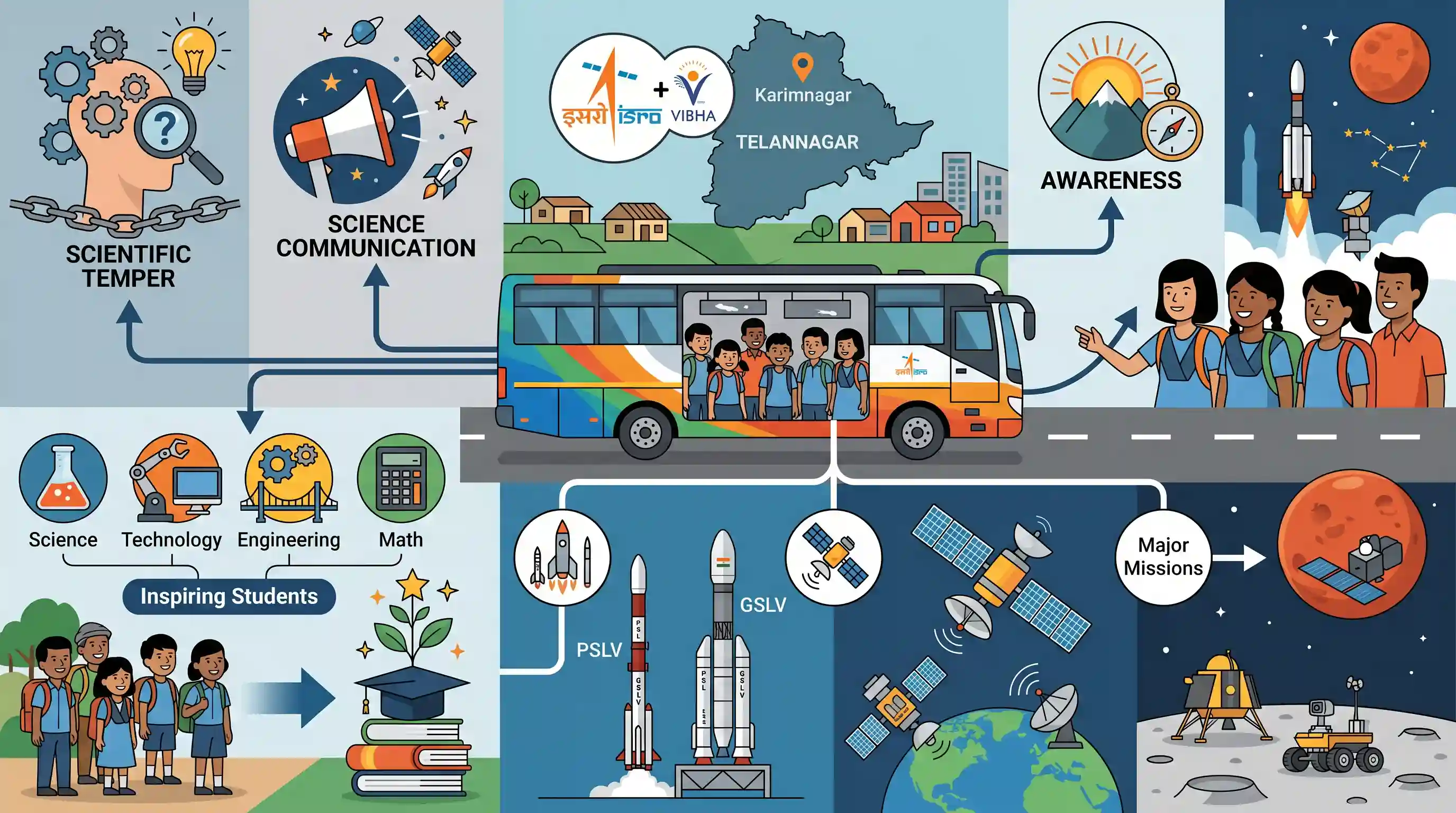
ISRO's 'Space on Wheels' mobile exhibition unit was stationed in Karimnagar, Telangana, to educate students about the Indian space programme. Organized in collaboration with Vijnana Bharati (Vibha), the bus features scale models of launch vehicles like the PSLV and GSLV, communication and remote sensing satellites, and major missions including Chandrayaan and Mangalyaan. The initiative aims to foster scientific temper, spread awareness about ISRO's space achievements, and inspire students in rural and semi-urban areas who cannot easily visit space facilities in major cities.
Key Points
- The 'Space on Wheels' mobile exhibition is a joint initiative by ISRO and Vijnana Bharati (Vibha) to showcase India's space achievements to school students.
- The custom-built bus features scaled-down models of ISRO's workhorse launch vehicles including PSLV, GSLV, and LVM-3.
- It also displays models of remote sensing satellites, communication satellites, and major missions such as Chandrayaan and Mangalyaan.
- The initiative aims to cultivate a scientific temper and inspire students from rural and semi-urban areas who may not have access to space museums in major cities.
Important Terms
ISRO

India's premier space agency under the Department of Space, responsible for space exploration, satellite launches, and developing indigenous technology like PSLV and GSLV to meet national needs.
UPSC context
GS Paper 3 (Science & Technology); focuses on achievements of Indians in science and development of indigenous technology.
Space on Wheels
A mobile exhibition initiative by ISRO, often in collaboration with Vijnana Bharati, using customized buses to showcase satellite models and launch vehicle technology to students in rural areas.
UPSC context
GS Paper 3 (Science & Technology); relevant for science communication and efforts to foster scientific temper among the youth.
National Remote Sensing Centre (NRSC)
An ISRO center in Hyderabad responsible for satellite data acquisition, processing, and dissemination. It plays a critical role in disaster management and earth observation applications.
UPSC context
GS Paper 3 (Science & Technology); focuses on the application of space technology for governance and disaster management.
Vijnana Bharati (Vibha)
A national science movement in India with a 'Swadeshi' spirit that collaborates with government bodies to popularize science and showcase India's scientific heritage and modern achievements.
UPSC context
GS Paper 3 (Science & Technology); relates to institutional support for science and the role of non-governmental organizations in science popularization.
Prelims Trap
Vijnana Bharati (Vibha) is an autonomous statutory body functioning under the Department of Space.
Vijnana Bharati (Vibha) is a non-governmental organization and a national "Swadeshi Science Movement" originating at IISc Bengaluru, not a statutory or government agency.
Static Concepts Connected
What are the primary differences between PSLV and GSLV launch vehicles?
- Target Orbits: PSLV mainly delivers remote-sensing satellites to Low Earth/Sun-Synchronous orbits, while GSLV places heavier communication satellites into Geostationary Transfer Orbits (GTO).
- Stage Configuration: PSLV is a four-stage vehicle using alternating solid and liquid propulsion. GSLV is a three-stage vehicle that critically relies on a cryogenic upper stage.
How is 'Scientific Temper' situated within the Indian Constitution?
- Fundamental Duty: Article 51A(h) explicitly obligates citizens to develop the scientific temper, humanism, and the spirit of inquiry and reform.
- Constitutional Origin: It is not an original constitutional provision; it was added under Part IVA by the 42nd Amendment Act in 1976 on the Swaran Singh Committee's recommendation.
Cross-Topic Patterns
Space Outreach & Constitutional Duties
UPSC frequently tests the intersection of polity and science. ISRO's outreach explicitly advances the fundamental duty of fostering scientific temper (Art 51A(h)) alongside technical capability building.
Non-State Actors in STEM
The ISRO-Vibha partnership reflects a broader governance trend of leveraging indigenous NGOs and science movements to decentralize STEM education and space awareness to rural tiers.

Expect a 2026 Prelims statement mixing ISRO's technical payload capacities (LVM-3/GSLV) with its non-governmental outreach collaborations.
Linked PYQs · 3
Linked PYQs · 3
- 2018PrelimsGS1
With reference to India's satellite launch vehicles, consider the following statements: 1. PSLVs launch the satellites useful for Earth resources monitoring whereas GSLVs are designed mainly to launch communication satellites. 2. Satellites launched by PSLV appear to remain permanently fixed in the same position in the sky, as viewed from a particular location on Earth. 3. GSLV Mk III is a four-staged launch vehicle with the first and third stages using solid rocket motors; and the second and fourth stages using liquid rocket engines. Which of the statements given above is/are correct?
- 2019PrelimsGS1
For the measurement/estimation of which of the following are satellite images/remote sensing data used? 1. Chlorophyll content in the vegetation of a specific location 2. Greenhouse gas emissions from rice paddies of a specific location 3. Land surface temperatures of a specific location Select the correct answer using the code given below.
- 2023MainsGS3
What is the main task of India's third moon mission which could not be achieved in its earlier mission? List the countries that have achieved this task. Introduce the subsystems in the spacecraft launched and explain the role of the Virtual Launch Control Centre' at the Vikram Sarabhai Space Centre which contributed to the successful launch from Sriharikota.
