Aditya L1 Mission Observations on Solar Storms
Source:The Hindu ↗
Why It Matters
Understanding space weather is crucial for protecting modern infrastructure (satellites, power grids). The article provides concrete examples of Aditya-L1's real-world utility, making it highly relevant for GS3 questions on ISRO's achievements and the practical applications of space technology. It also links directly to Prelims questions on the effects of solar flares.
Summary
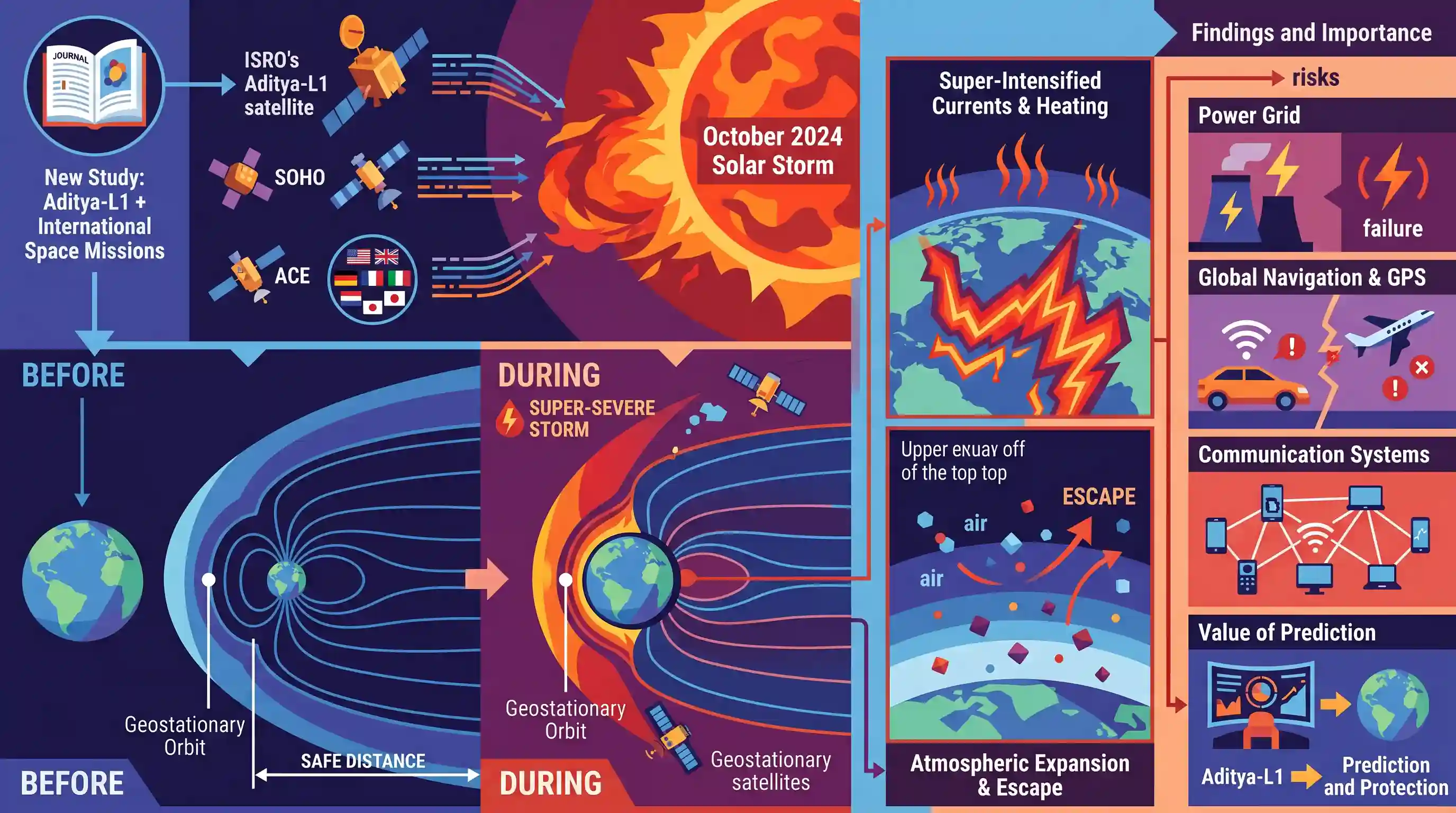
A new study utilizing data from ISRO's Aditya-L1 and international space missions has mapped how a severe October 2024 solar storm impacted Earth's magnetic field. The research, published in The Astrophysical Journal, shows that the storm severely compressed the magnetosphere, pushing it dangerously close to Earth and exposing geostationary satellites to damaging space conditions. The event also caused auroral currents to super-intensify, heating the upper atmosphere and triggering atmospheric escape. These findings highlight the importance of space observatories like Aditya-L1 in predicting space weather, which poses significant risks to global communication systems, navigation, and power grids.
Key Points
- Data from ISRO's Aditya-L1 and other international missions helped decode the impact of a major October 2024 solar storm on Earth's magnetic field.
- The study revealed that the solar storm strongly compressed Earth's magnetic field, pushing it unusually close to the planet and exposing geostationary satellites to harsh space weather.
- During the storm's turbulent phase, electrical currents in the high-latitude auroral region super-intensified, leading to heating of the upper atmosphere and enhanced 'atmospheric escape'.
- The findings underscore the critical need for continuous space weather monitoring to safeguard modern technological infrastructure like satellites, communication networks, and power grids from solar plasma eruptions.
Important Terms
Aditya-L1

India’s first dedicated space-based observatory to study the Sun. It is positioned at the Lagrange Point 1 (L1), 1.5 million km from Earth, to ensure an uninterrupted view of the Sun.
UPSC context
GS Paper 3: Science & Technology. Tests knowledge of indigenous space missions, solar physics, and India’s growing capabilities in deep-space monitoring.
Magnetosphere
The region of space surrounding Earth dominated by its magnetic field. It acts as a protective shield, deflecting the solar wind and preventing high-energy solar particles from stripping away the atmosphere.
UPSC context
GS Paper 1 (Physical Geography) & Paper 3. Tests understanding of Earth’s atmosphere, geomagnetism, and how solar phenomena interact with planetary defenses.
Solar Storm (Geomagnetic Storm)
A major disturbance in Earth’s magnetosphere occurring when there is an efficient exchange of energy from the solar wind into the space environment surrounding Earth, often caused by Coronal Mass Ejections (CMEs).
UPSC context
GS Paper 3: Disaster Management & S&T. Focuses on technological risks to GPS, power grids, and satellite communications.
Space Weather
The environmental conditions in near-Earth space, driven by solar activity (flares, solar wind, CMEs). It can affect the performance and reliability of space-borne and ground-based technological systems.
UPSC context
GS Paper 3: Science & Tech. Tests the ability to link astronomical events with practical impacts on global infrastructure and communication.
Lagrange Point 1 (L1)
A stable location in space where the gravitational pull of two large masses (Sun and Earth) equals the centripetal force required for a small object to move with them.
UPSC context
GS Paper 3: Space Technology. Essential for understanding orbital mechanics and the strategic placement of scientific satellites for continuous observation.
Dibrugarh University
A public university in Assam that collaborates with ISRO through schemes like RESPOND to conduct research on space weather and atmospheric physics, representing regional academic participation in national space goals.
UPSC context
GS Paper 3: Institutional Framework in S&T. Illustrates the role of academic-government partnerships (ISRO-University) in advancing indigenous scientific research.
Prelims Trap
"Aditya-L1 is positioned close to the Sun's corona to directly monitor solar storms."
Aditya-L1 orbits Lagrange Point 1 (L1), which is only 1.5 million km from Earth (just 1% of the Earth-Sun distance). It does not travel close to the Sun itself.
Static Concepts Connected
What makes Lagrange Point 1 (L1) ideal for solar observation missions?
- Gravitational equilibrium: Points where the gravitational pull of the Sun and Earth precisely equals the centripetal force required by a satellite to orbit with them, saving fuel.
- Uninterrupted view: A halo orbit around L1 provides a continuous, unhindered view of the Sun without any eclipses or occultations by Earth.
How do Coronal Mass Ejections (CMEs) impact Earth's environment and infrastructure?
- Magnetosphere compression: CMEs severely compress Earth's magnetic field, pushing it closer to the planet and exposing high-altitude geostationary satellites to harsh, damaging radiation.
- Atmospheric heating: Super-intensified auroral currents heat the upper atmosphere, causing it to expand. This increases drag on low-earth satellites and triggers 'atmospheric escape'.
- Grid disruptions: Geomagnetically induced currents can overload terrestrial power grids and severely disrupt radio communications, global GPS, and navigation networks.
Cross-Topic Patterns
Space weather & critical infrastructure
Extreme solar storms connect GS3 Space Tech to GS3 Disaster Management, as they threaten the resilience of terrestrial smart grids and global navigation systems.
Atmospheric escape & planetary evolution
Solar storm-induced 'atmospheric escape' links to how planets like Mars lost their atmospheres, a concept UPSC often explores in basic planetary science questions.

Expect a multi-statement Prelims question interlinking Aditya-L1's findings, magnetosphere compression, and 'atmospheric escape' mechanisms.
Linked PYQs · 3
Linked PYQs · 3
- 2022PrelimsGS1
If a major solar storm (solar flare) reaches the Earth, which of the following are the possible effects on the Earth? 1. GPS and navigation systems could fail. 2. Tsunamis could occur at equatorial regions. 3. Power grids could be damaged. 4. Intense auroras could occur over much of the Earth. 5. Forest fires could take place over much of the planet. 6. Orbits of the satellites could be disturbed. 7. Shortwave radio communication of the aircraft flying over polar regions could be interrupted. Select the correct answer using the code given below:
- 2025PrelimsGS1
Consider the following statements : Statement I: Scientific studies suggest that a shift is taking place in the Earth's rotation and axis. Statement II: Solar flares and associated coronal mass ejections bombarded the Earth's outermost atmosphere with tremendous amount of energy. Statement III : As the Earth's polar ice melts, the water tends to move towards the equator. Which one of the following is correct in respect of the above statements?
- 2016MainsGS3
Discuss India's achievements in the field of Space Science and Technology. How the application of this technology has helped India in its socio-economic development?
