ISRO Prepares for EOS 09 Earth Observation Launch
Source:The Hindu ↗
Why It Matters
Questions on ISRO's Earth Observation capabilities, remote sensing applications, and high-profile international joint missions (like LUPEX) are mainstays in both Prelims and GS3 Mains. Candidates must know the distinct roles of partner agencies in international collaborations and the specific utility of SAR technology.
Summary
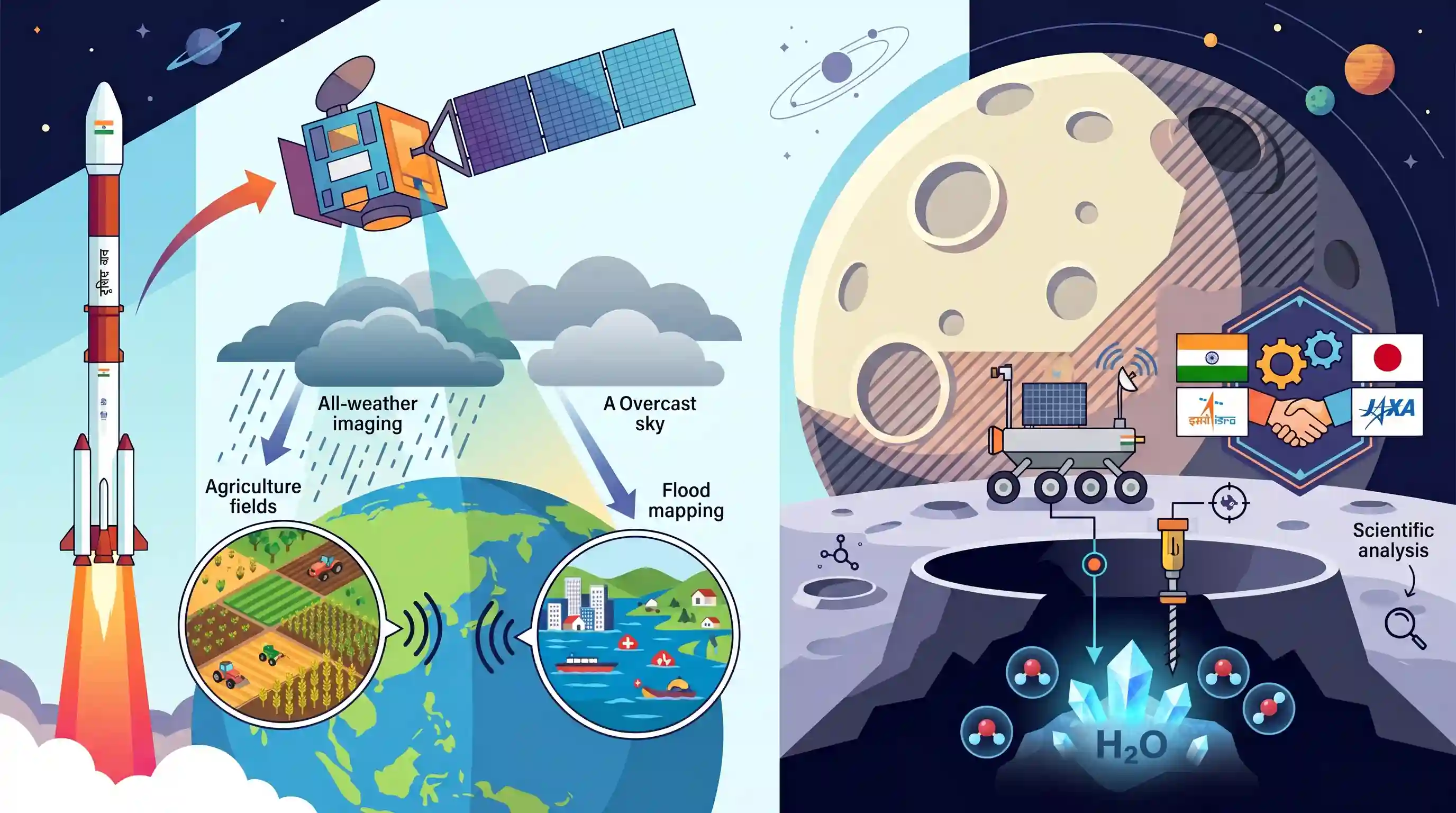
The article details ISRO's upcoming 101st launch mission, which will deploy the EOS-09 Earth Observation Satellite via the PSLV-C61 rocket. EOS-09 is a C-band Synthetic Aperture Radar satellite enabling all-weather imaging for applications like agriculture and flood mapping. The article also provides updates on LUPEX (Chandrayaan-5), a collaborative lunar mission between ISRO and Japan's JAXA to explore the Moon's south pole and permanently shadowed regions for water.
Key Points
- ISRO's 101st launch will feature the Earth Observation Satellite EOS-09 carried by the PSLV-C61 rocket.
- EOS-09 is an active antenna Synthetic Aperture Radar (SAR) satellite operating in the C-band, designed to provide high-quality, all-weather imaging for agriculture, hydrology, and flood mapping.
- LUPEX (Chandrayaan-5) is an upcoming joint uncrewed lunar mission between ISRO and Japan's JAXA.
- For the LUPEX mission, JAXA will supply the H3 launch vehicle and the rover, while ISRO will provide the lander to explore the lunar south pole.
- The primary goal of LUPEX is to investigate permanently shadowed regions of the Moon for water and lunar volatiles.
Important Terms
EOS-09 (RISAT-1B)

An Indian Earth Observation Satellite (RISAT-1B) equipped with C-band Synthetic Aperture Radar. It provides high-resolution, all-weather, day-and-night imaging for agriculture, disaster management, and national security surveillance.
UPSC context
GS Paper III (S&T); essential for questions on remote sensing, border security, and indigenous satellite technology.
LUPEX (Chandrayaan-5)
A joint ISRO-JAXA lunar mission (Lunar Polar Exploration) targeting the Moon's south pole. It aims to investigate water-ice abundance in permanently shadowed regions using an ISRO lander and a JAXA rover.
UPSC context
GS Paper III (Space Exploration); significant for topics on international space collaboration and lunar resource utilization.
Synthetic Aperture Radar (SAR)
A remote sensing technology that uses radar to create two-dimensional images or three-dimensional reconstructions of objects. It enables imaging through clouds, rain, and darkness, unlike traditional optical sensors.
UPSC context
GS Paper III (S&T); tested in Prelims and Mains regarding disaster management and surveillance capabilities.
PSLV-C61
The 63rd flight of India's workhorse Polar Satellite Launch Vehicle, using the 'XL' configuration. It was designated for ISRO's 101st mission to deploy the EOS-09 satellite into a Sun-Synchronous Orbit.
UPSC context
GS Paper III (S&T); relevant for understanding launch vehicle evolution and India's space launch frequency.
EOS-04 (RISAT-1A)
India's first dedicated radar imaging satellite in the EOS series (formerly RISAT-1A). Launched in 2022, it uses C-band SAR for applications like flood mapping and soil moisture monitoring.
UPSC context
GS Paper III (S&T); represents India's transition to a standardized 'EOS' naming convention for Earth observation.
Sun-Synchronous Polar Orbit (SSPO)
A nearly polar orbit around Earth in which the satellite passes over any given point of the planet's surface at the same local mean solar time.
UPSC context
GS Paper III (S&T); a core concept for Prelims regarding different types of satellite orbits and their uses.
Prelims Trap
"For the LUPEX mission, ISRO will provide the launch vehicle and the lunar rover."
UPSC frequently swaps agency contributions in joint missions. In LUPEX, Japan (JAXA) provides the H3 launch vehicle and the rover, while ISRO provides the lunar lander.
Static Concepts Connected
How does Synthetic Aperture Radar (SAR) differ from optical remote sensing?
- Active vs Passive: SAR generates its own microwave pulses to illuminate targets, while optical sensors rely on reflected sunlight.
- Weather Independence: Microwaves easily penetrate clouds, fog, and darkness, allowing 24/7 imaging which is impossible for standard optical cameras.
- Synthetic Aperture: SAR uses the satellite's forward motion to mathematically simulate a massive antenna, achieving extreme high-resolution terrain mapping.
Why are Earth Observation Satellites (EOS) typically placed in Sun-Synchronous Polar Orbits?
- Consistent Illumination: The satellite passes over any given point of the Earth's surface at the same local solar time, ensuring uniform shadows for comparing images over months.
- Global Coverage: By orbiting pole-to-pole while the Earth rotates beneath it, the satellite eventually maps the entire globe.
Cross-Topic Patterns
EOS & Monsoon Disaster Management
SAR satellites like EOS-09 are critical during the southwest monsoon, as traditional optical satellites are blinded by thick cloud cover during recurrent floods in regions like Assam or Kerala.
ISRO-JAXA Strategic Space Diplomacy
LUPEX (Chandrayaan-5) marks a major shift from ISRO's solo lunar ventures to strategic Indo-Pacific space partnerships, acting as a geopolitical counterweight to China's Chang'e lunar dominance.

Expect a paired-statement question in Prelims 2026 contrasting ISRO-NASA (NISAR) and ISRO-JAXA (LUPEX) mission objectives and components.
Linked PYQs · 2
Linked PYQs · 2
- 2018PrelimsGS1
With reference to India's satellite launch vehicles, consider the following statements: 1. PSLVs launch the satellites useful for Earth resources monitoring whereas GSLVs are designed mainly to launch communication satellites. 2. Satellites launched by PSLV appear to remain permanently fixed in the same position in the sky, as viewed from a particular location on Earth. 3. GSLV Mk III is a four-staged launch vehicle with the first and third stages using solid rocket motors; and the second and fourth stages using liquid rocket engines. Which of the statements given above is/are correct?
- 2023MainsGS3
What is the main task of India's third moon mission which could not be achieved in its earlier mission? List the countries that have achieved this task. Introduce the subsystems in the spacecraft launched and explain the role of the Virtual Launch Control Centre' at the Vikram Sarabhai Space Centre which contributed to the successful launch from Sriharikota.
