ISRO YUVIKA 2026 Programme for Rural Student STEM Capacity Building
Source:Indian Express ↗
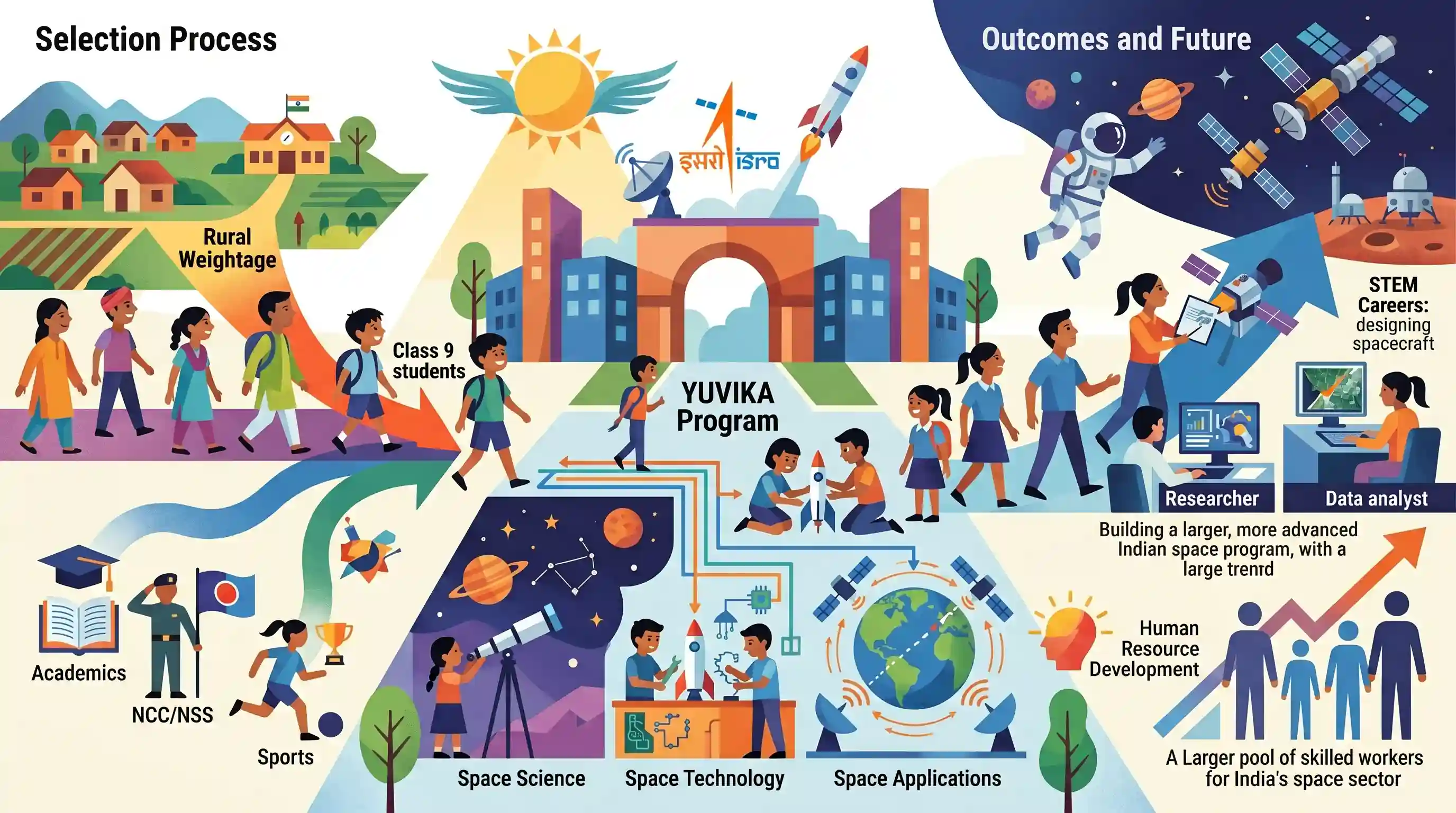
Why It Matters
YUVIKA serves as an excellent case study for Mains answers in GS2 (Education and Human Resources) and GS3 (Space Technology) to demonstrate how India is building future capacity and fostering scientific temper among the youth, particularly focusing on rural inclusion. It also represents a direct Prelims factual topic regarding ISRO's outreach initiatives.
Summary
The Indian Space Research Organisation (ISRO) has opened registrations for its annual 'YUVIKA 2026' (Yuva VIgyani KAryakram) initiative, a two-week residential summer programme aimed at Class 9 students. The program is designed to catch young minds early and impart fundamental knowledge about space technology, space science, and applications, thereby encouraging them to pursue STEM careers. The selection process takes a holistic approach, factoring in academic marks, extracurricular activities like NCC/NSS, and sports. Notably, it provides special weightage to students from rural (Panchayat area) schools to promote inclusivity in scientific education and build future capacity for India's space sector.
Key Points
- ISRO has announced the YUVIKA 2026 (Young Scientist Programme), a two-week residential training program for Class 9 students.
- The program aims to impart foundational knowledge in space technology, space science, and space applications to encourage students to pursue STEM (Science, Technology, Engineering, and Mathematics) careers.
- Selection parameters include Class 8 academic performance, an online quiz, participation in science fairs/Olympiads, sports, and membership in NCC/NSS/Scouts.
- A significant weightage of 15% is given to students studying in schools located in Panchayat areas, ensuring rural outreach and inclusive scientific capacity building.
- The initiative helps address the long-term need for skilled human resources in India's expanding space ecosystem.
Important Terms
Yuva VIgyani KAryakram (YUVIKA)

ISRO's "Young Scientist Programme" designed to impart foundational knowledge of space technology, science, and applications to Class 9 students, specifically targeting those from rural areas to encourage space-related careers.
UPSC context
GS Paper III (Science & Tech) and GS Paper II (Education); relevant for human resource development and space outreach.
Indian Space Research Organisation (ISRO)
India's premier space agency under the Department of Space, established in 1969 to develop indigenous space technology for national needs, including satellite communication, earth observation, and planetary exploration.
UPSC context
GS Paper III (Space Technology); essential for questions on indigenization, major missions (Chandrayaan/Gaganyaan), and technological self-reliance.
National Cadet Corps (NCC)
The youth wing of the Indian Armed Forces, established in 1948, which provides basic military training and fosters character, discipline, and leadership among school and college students.
UPSC context
GS Paper III (Internal Security); relates to youth empowerment and organizations contributing to national discipline and secondary defense.
National Service Scheme (NSS)
A Central Sector Scheme under the Ministry of Youth Affairs and Sports, aimed at developing the personality and character of students through voluntary community service and social welfare activities.
UPSC context
GS Paper II (Social Justice/Education); tests knowledge of the role of youth in community development and national integration.
Bharat Scouts and Guides
A voluntary, non-political, educational movement for young people in India, focused on character building, citizenship training, and physical development through outdoor activities and social service.
UPSC context
GS Paper II (Human Resource Development); pertains to non-formal education systems and citizen-building initiatives among Indian youth.
STEM Education
An interdisciplinary curriculum focusing on Science, Technology, Engineering, and Mathematics, intended to foster critical thinking and innovation while preparing students for the modern global workforce.
UPSC context
GS Paper II (Education) and GS Paper III (S&T); crucial for discussions on India's future economic competitiveness and innovation.
Prelims Trap
"YUVIKA is an initiative of the Ministry of Education aimed at promoting STEM careers among college students."
YUVIKA is conducted exclusively by ISRO, not the Ministry of Education, and it specifically targets Class 9 school students, not higher education candidates.
Static Concepts Connected
What constitutional provisions mandate the promotion of scientific temper in India?
- Article 51A(h): Makes it a fundamental duty of every citizen to develop scientific temper, humanism, and the spirit of inquiry and reform.
- Directive Principles: Though implicit, Article 48 mandates the state to organize agriculture and animal husbandry on modern and scientific lines, reflecting practical scientific application.
How does India categorize its space capabilities and focus areas?
- Space Technology: Development of launch vehicles (PSLV, LVM3), propulsion systems, and satellite platforms that enable physical access to space.
- Space Applications: Practical utilization of assets for telecommunication (INSAT), earth observation (Cartosat), and navigation (NavIC) for national development.
- Space Science: Deep space exploration, astronomy, and astrophysics missions like Chandrayaan, Aditya-L1, and AstroSat focused on discovery.
Cross-Topic Patterns
ISRO outreach + Rural equity
YUVIKA's 15% weightage for Panchayat schools links high-end space technology with grassroots inclusion, reflecting a broader governance trend of equitable STEM access.
Space commercialization + STEM pipeline
With the entry of private players via IN-SPACe, early capacity building programs like YUVIKA are vital to supply future spacetech startups with skilled domestic talent.

Expect a Prelims statement linking ISRO's YUVIKA with its exact Class 9 target group and specific 15% weightage for Panchayat schools.
Linked PYQs · 3
Linked PYQs · 3
- 2023MainsGS3
What is the main task of India's third moon mission which could not be achieved in its earlier mission? List the countries that have achieved this task. Introduce the subsystems in the spacecraft launched and explain the role of the Virtual Launch Control Centre' at the Vikram Sarabhai Space Centre which contributed to the successful launch from Sriharikota.
- 2023MainsGS2
Skill development programmes have succeeded in increasing human resources supply to various sectors. In the context of the statement analyse the linkages between education, skill and employment.
- 2016PrelimsGS1
'SWAYAM', an initiative of the Government of India, aims at
