NSIL to launch first dedicated commercial SSLV mission in 2026
Source:The Hindu ↗
Why It Matters
The dedicated commercialization of the SSLV through NSIL is a critical step in increasing India's share of the global small-satellite launch market. Additionally, the Space MAITRI mission highlights space sustainability (debris management) and deepens strategic bilateral technology cooperation between India and Australia under the broader Indo-Pacific partnership framework.
Summary
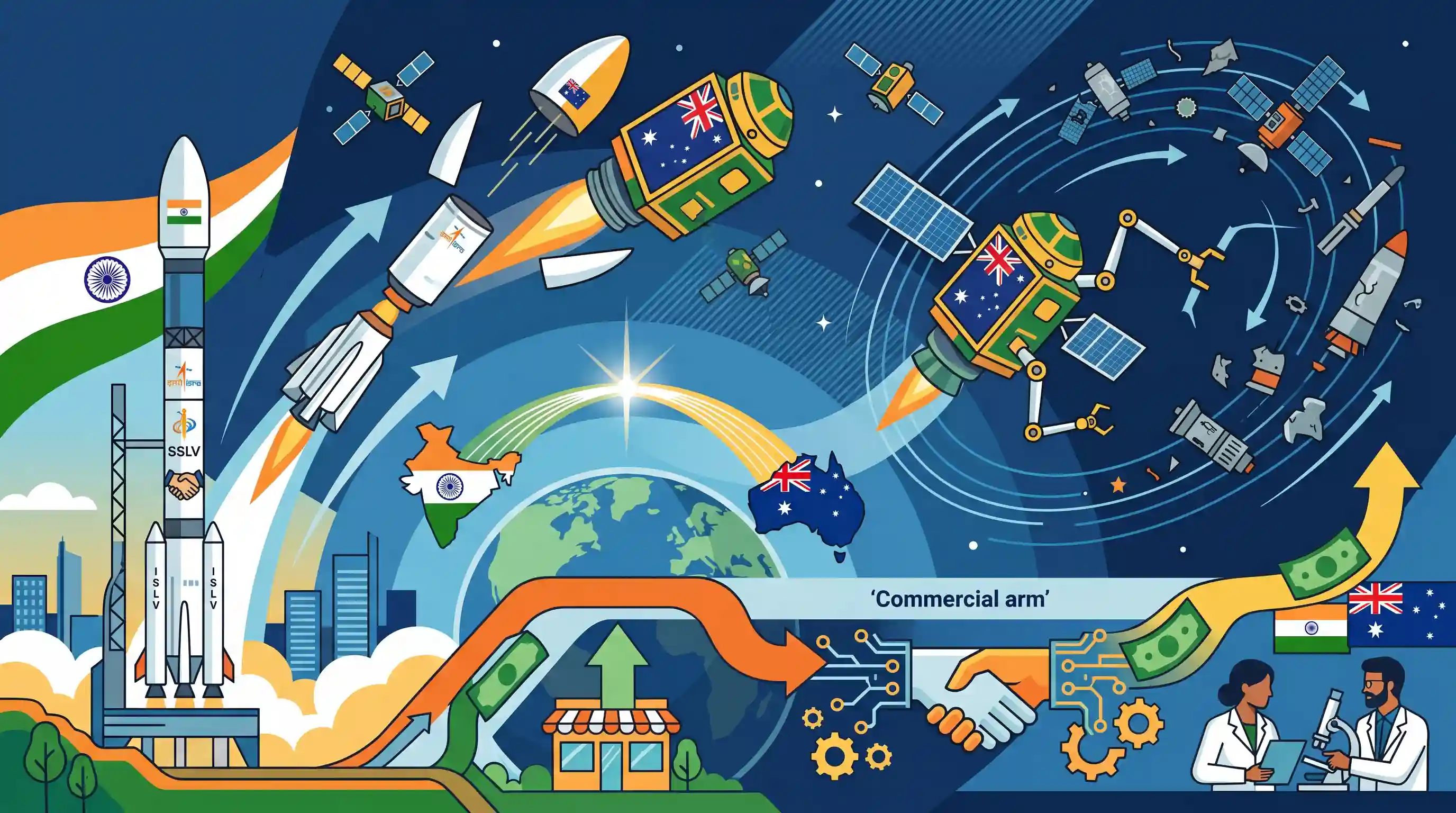
ISRO's commercial arm, NewSpace India Limited (NSIL), is set to launch its first dedicated commercial mission for the Small Satellite Launch Vehicle (SSLV) in 2026. Under the 'Space MAITRI' (Mission for Australia-India’s Technology, Research and Innovation) initiative, the SSLV will carry the 'Optimus' spacecraft, built by Australian firm Space Machines Company. Weighing 450 kg, Optimus is the largest Australian-built satellite to date and is designed for space debris management and in-space sustainability. The mission highlights the growing commercialization of India's space sector and the deepening strategic technology partnership between India and Australia.
Key Points
- NewSpace India Limited (NSIL) will conduct the first dedicated commercial mission of ISRO's Small Satellite Launch Vehicle (SSLV) in 2026.
- The mission will launch the 450 kg 'Optimus' satellite, the largest Australian-designed and built spacecraft to date, developed by Space Machines Company.
- The mission, named 'Space MAITRI', focuses on strengthening India-Australia bilateral cooperation in space technology.
- Optimus is designed to address space sustainability and provide space debris management services.
- The SSLV previously demonstrated its commercial viability by launching the 10-kg Janus nanosatellite on its SSLV-D2 flight.
Important Terms
Space MAITRI (Mission for Australia-India’s Technology, Research and Innovation)

A joint initiative between Australia and India focused on sustainable space operations, debris mitigation, and on-orbit servicing, featuring the launch of the Australian-built 'Optimus' spacecraft by ISRO's SSLV.
UPSC context
GS Paper II & III: Bilateral relations and Science & Technology; tests awareness of strategic technology partnerships and space sustainability.
NewSpace India Limited (NSIL)
A Central Public Sector Enterprise under the Department of Space and ISRO’s commercial arm, mandated to enable private industry participation and commercialize Indian space products and services.
UPSC context
GS Paper III: Indian Economy and Space Technology; tests understanding of the institutional framework for space commercialization.
Small Satellite Launch Vehicle (SSLV)
ISRO’s 3-stage solid-fuel launch vehicle designed for rapid, low-cost delivery of small satellites (up to 500kg) to Low Earth Orbit (LEO) on a launch-on-demand basis.
UPSC context
GS Paper III: Science & Technology; focuses on indigenous development and competitive advantages in the global small-satellite market.
Optimus Spacecraft
A specialized 450 kg Australian-designed orbital servicing vehicle intended for in-orbit inspection and space debris management, marking Australia’s largest satellite to date.
UPSC context
GS Paper III: Science & Technology; relevant for topics on space debris, sustainability, and international collaboration in orbital maintenance.
In-space Sustainability
Refers to the practice of minimizing waste and debris in orbit and providing services like satellite repair and refueling to ensure long-term usability of the space environment.
UPSC context
GS Paper III: Science & Technology and Environment; covers global efforts to manage space debris and the Kessler Syndrome.
Prelims Trap
NSIL acts as the single-window nodal agency to regulate and authorize private space sector activities in India.
NSIL is ISRO's commercial arm responsible for demand-driven missions. IN-SPACe is the regulatory, single-window nodal agency for private space activities. Aspirants often confuse the two.
Static Concepts Connected
How does the Small Satellite Launch Vehicle (SSLV) differ from PSLV?
- Payload capacity: SSLV can carry up to 500 kg to Low Earth Orbit (LEO); PSLV can carry up to 1,750 kg to Sun-Synchronous Orbit (SSO).
- Staging configuration: SSLV is primarily a 3-stage solid vehicle (with a liquid terminal module); PSLV is a 4-stage vehicle alternating solid and liquid stages.
- Turnaround time: SSLV is designed for 'launch-on-demand' with a quick 72-hour integration time, unlike PSLV which takes months to assemble.
What is the Kessler Syndrome in the context of space debris?
- Cascade effect: A theoretical scenario where the density of objects in Low Earth Orbit is high enough that collisions generate more debris, triggering a runaway chain reaction.
- Orbital threat: Such cascading collisions could render specific orbital bands unusable for future satellite deployments or human spaceflight for generations.
- Mitigation efforts: Addressed via active debris removal (like the Optimus mission) and ISRO's internal IS4OM (System for Safe and Sustainable Space Operations Management).
Cross-Topic Patterns
Space diplomacy in the Quad framework
India-Australia space ties (Space MAITRI) reflect deeper Quad tech-sharing, complementing NISAR (US-India) and LUPEX (Japan-India) in creating a cohesive Indo-Pacific space diplomacy framework.
FDI liberalization and Space Commercialization
The 2024 relaxed FDI limits (up to 100% in space components) directly boost NSIL’s commercial launch pipeline, attracting foreign private players to use India's space infrastructure.

Expect a 2026 Prelims multi-statement question contrasting SSLV/PSLV staging capabilities alongside NSIL vs IN-SPACe functional mandates.
Linked PYQs · 3
Linked PYQs · 3
- 2018PrelimsGS1
With reference to India's satellite launch vehicles, consider the following statements: 1. PSLVs launch the satellites useful for Earth resources monitoring whereas GSLVs are designed mainly to launch communication satellites. 2. Satellites launched by PSLV appear to remain permanently fixed in the same position in the sky, as viewed from a particular location on Earth. 3. GSLV Mk III is a four-staged launch vehicle with the first and third stages using solid rocket motors; and the second and fourth stages using liquid rocket engines. Which of the statements given above is/are correct?
- 2016MainsGS3
Discuss India's achievements in the field of Space Science and Technology. How the application of this technology has helped India in its socio-economic development?
- 2019MainsGS3
What is India's plan to have its own space station and how will it benefit our space programme?
