ISRO To Launch US BlueBird Satellite Using LVM3 Heavy Lift Rocket
Source:The Hindu ↗
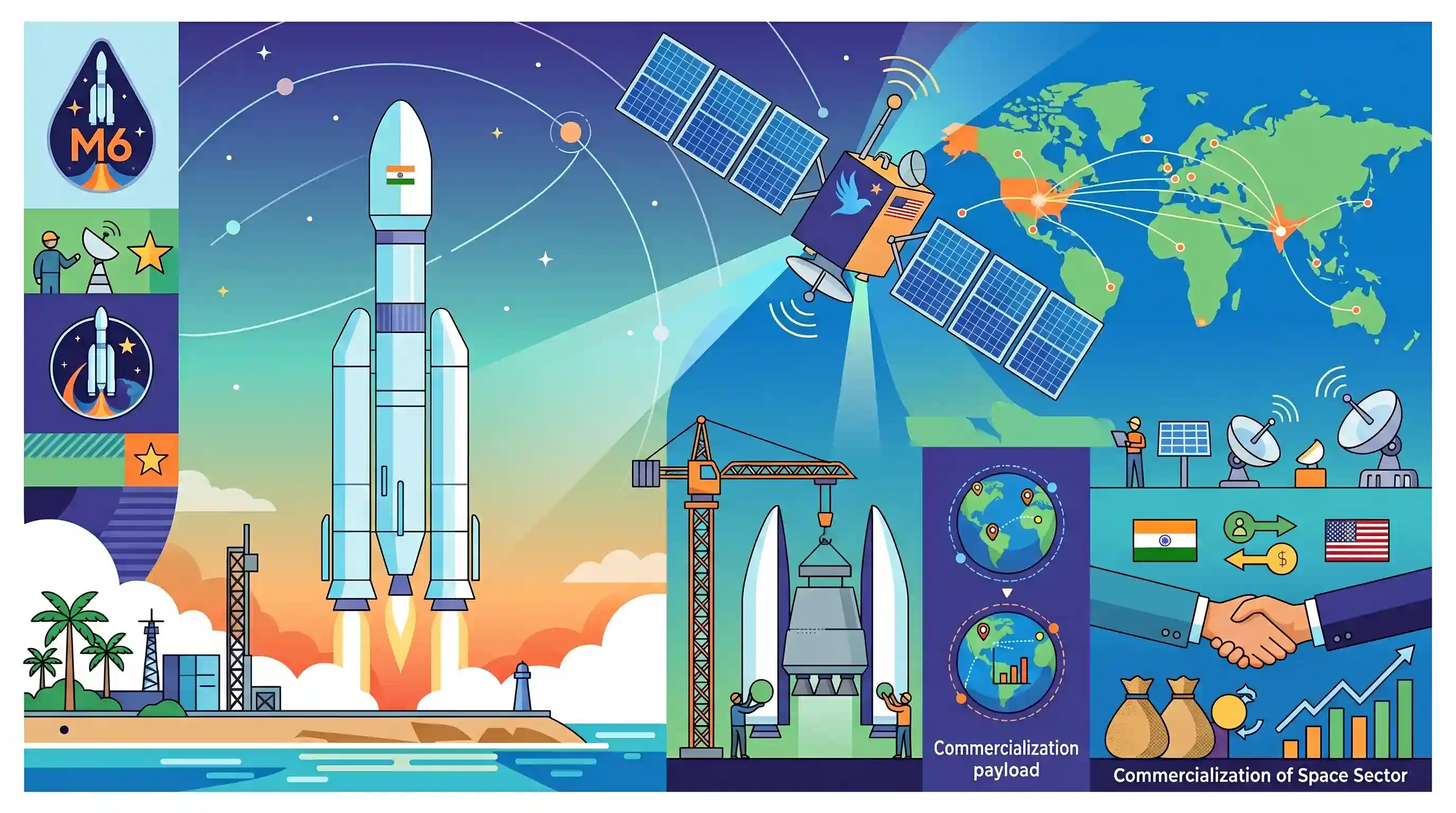
Why It Matters
Demonstrates the operational maturity of India's heavy-lift capability (LVM3) and its practical application for international commercial clients. This ties directly into India's strategic push to capture a larger share of the global space economy.
Summary
The Indian Space Research Organisation (ISRO) is set to launch the 'BlueBird' communications satellite on December 24 from Sriharikota. The 6,500 kg satellite, developed by the US-based firm AST SpaceMobile, will be deployed using ISRO's Launch Vehicle Mark-3 (LVM3) as part of the LVM3-M6 mission. This launch underscores India's expanding role and increasing competitiveness in providing commercial heavy-lift launch services to international clients.
Key Points
- ISRO is scheduled to launch the 6,500 kg BlueBird communications satellite on December 24 from Sriharikota.
- The satellite was developed by the US-based company AST SpaceMobile.
- The launch will be conducted using ISRO's heavy-lift launch vehicle, Launch Vehicle Mark-3 (LVM3), under the LVM3-M6 mission.
- The mission highlights ISRO's growing reliability and capacity in the global commercial heavy-lift satellite launch market.
Important Terms
LVM3 (Launch Vehicle Mark-3)

India’s heaviest three-stage rocket, formerly GSLV Mk-III. It uses solid (S200), liquid (L110), and cryogenic (C25) stages to deliver payloads up to 8,000 kg to Low Earth Orbit.
UPSC context
GS-3 (Science & Tech); central to India's heavy-lift capability, Gaganyaan, and commercial launch market competitiveness.
LVM3-M6 Mission
The 6th operational flight of ISRO's LVM3 (Dec 2025) that successfully launched the 6,100 kg BlueBird Block-2 satellite, marking India’s heaviest commercial payload launch to date.
UPSC context
GS-3 (S&T/Economy); tests awareness of ISRO’s commercial milestones and international strategic partnerships.
NewSpace India Limited (NSIL)
ISRO's commercial arm and a CPSE under the Department of Space. It manages satellite launches for global clients and commercializes indigenous space technologies through private industry partnerships.
UPSC context
GS-3 (Economy/Space Reforms); tests knowledge of institutional frameworks driving India’s growing space economy.
BlueBird Satellite
Advanced communication satellites featuring massive phased-array antennas (~2,400 sq. ft) designed to provide 4G/5G cellular broadband directly to standard smartphones from orbit.
UPSC context
GS-3 (Communication Tech); relevant for questions on bridging the digital divide and emerging satellite-to-mobile technologies.
Cryogenic Upper Stage (C25)
The final stage of the LVM3 rocket, powered by the CE-20 engine using liquid hydrogen and liquid oxygen. It provides high thrust for precise heavy-payload orbital insertion.
UPSC context
GS-3 (Science & Tech); tests technical understanding of indigenous high-performance rocket propulsion systems.
Direct-to-Device (D2D) Connectivity
A technology allowing standard mobile phones to connect directly to satellites for voice and data services, eliminating the need for traditional ground towers or specialized hardware.
UPSC context
GS-3 (Science & Tech); an emerging global trend in telecommunications with significant socio-economic implications.
Prelims Trap
"LVM3 has a maximum payload capacity of 4,000 kg, meaning it is fundamentally incapable of launching a 6,500 kg satellite."
LVM3's 4,000 kg limit applies only to Geosynchronous Transfer Orbit (GTO). For Low Earth Orbit (LEO), it can carry up to 8,000 kg, comfortably accommodating the 6,500 kg BlueBird.
Static Concepts Connected
What are the three stages of ISRO's Launch Vehicle Mark-3 (LVM3)?
- Solid strap-ons (S200): Two solid propellant motors providing massive thrust at lift-off.
- Liquid core (L110): Uses hypergolic liquid propellants and ignites during the atmospheric flight phase.
- Cryogenic stage (C25): Indigenous upper stage using liquid hydrogen and liquid oxygen for high orbital efficiency.
What distinguishes NSIL from IN-SPACe in India's space ecosystem?
- NSIL: A CPSE acting as ISRO's commercial arm, handling launch service contracts and technology transfer.
- IN-SPACe: An independent nodal agency established to promote, authorize, and regulate private space activities in India.
Cross-Topic Patterns
Satellite broadband and spectrum allocation
BlueBird’s direct-to-mobile space connectivity mirrors India’s ongoing regulatory debates on whether to auction or administratively allocate spectrum for satellite internet providers like Starlink and OneWeb.
Space Sector FDI Policy
ISRO's growing commercial heavy-lift track record complements the recent 100% FDI allowance in the space sector, aiming to position India as a lucrative global hub for end-to-end space missions.

LVM3's LEO vs GTO payload limits and NSIL's commercial mandate will likely merge into a multi-statement space technology question in 2026.
Linked PYQs · 2
Linked PYQs · 2
- 2018PrelimsGS1
With reference to India's satellite launch vehicles, consider the following statements: 1. PSLVs launch the satellites useful for Earth resources monitoring whereas GSLVs are designed mainly to launch communication satellites. 2. Satellites launched by PSLV appear to remain permanently fixed in the same position in the sky, as viewed from a particular location on Earth. 3. GSLV Mk III is a four-staged launch vehicle with the first and third stages using solid rocket motors; and the second and fourth stages using liquid rocket engines. Which of the statements given above is/are correct?
- 2016MainsGS3
Discuss India's achievements in the field of Space Science and Technology. How the application of this technology has helped India in its socio-economic development?
