ISRO schedules launch of NVS 03 navigation satellite
Source:Indian Express ↗
Why It Matters
The launch of NVS-03 highlights India's technological progress in developing indigenous satellite navigation systems (NavIC) and critical components like atomic clocks. For UPSC aspirants, understanding India's space program, launch vehicle mechanics (GSLV), failure analysis mechanisms, and strategic space infrastructure is vital for GS Paper III (Science & Technology).
Summary
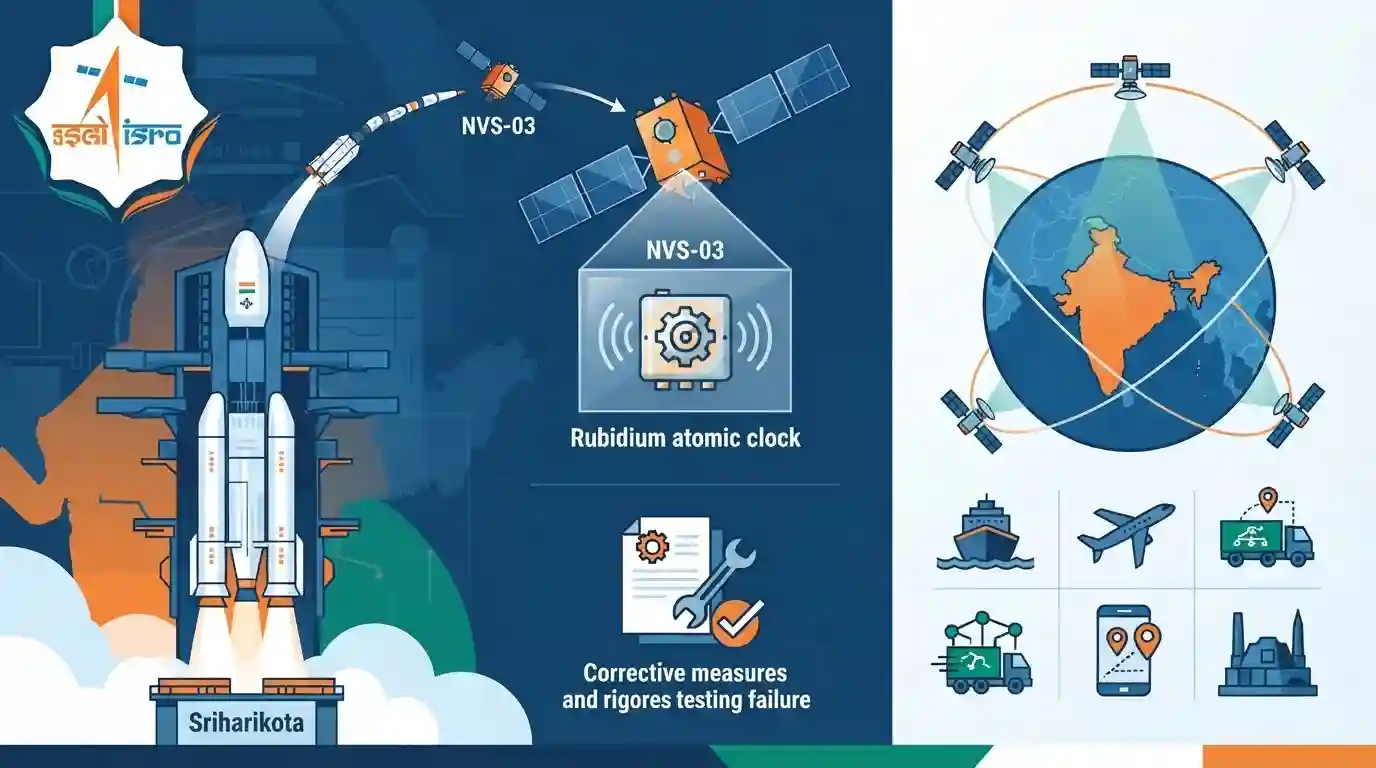
ISRO is scheduled to launch the NVS-03 navigation satellite onboard the GSLV-F18 vehicle from Sriharikota. Weighing approximately 2,250 kg, NVS-03 is the third satellite in the next-generation Indian Regional Navigation Satellite System (NavIC) series. It incorporates an indigenous atomic clock and follows critical reviews and corrective measures implemented after the NVS-02 mission failure, strengthening India's indigenous satellite navigation capabilities and strategic self-reliance.
Key Points
- ISRO is set to launch the NVS-03 navigation satellite, part of the next-generation IRNSS (NavIC) series, onboard the GSLV-F18 rocket from Sriharikota.
- The 2,250 kg satellite will carry an indigenous atomic clock alongside other navigation payloads to enhance timing accuracy and coverage up to 1,500 km beyond Indian borders.
- The mission follows extensive corrective measures recommended by an Apex Committee that analyzed the shortcomings of the previous NVS-02 mission, which faced issues during orbit-raising operations in January 2025.
- The launch highlights India's technological push toward indigenous strategic autonomy in critical space infrastructure like satellite navigation and precise timing systems.
Important Terms
Indian Regional Navigation Satellite System (NavIC)

India's independent regional satellite navigation system, formerly known as IRNSS, providing accurate position, velocity, and timing services across India and up to 1,500 km around its borders.
UPSC context
UPSC Prelims/Mains (GS Paper III): Space technology, satellite navigation systems, and strategic self-reliance.
Indian Space Research Organisation (ISRO)
India's national space agency responsible for planning, developing, and executing space exploration, launch vehicles, and satellite programs.
UPSC context
UPSC Prelims/Mains (GS Paper III): Achievements of Indians in science & technology and institutional framework of space research.
Static Concepts Connected
What are the key features, frequency bands, and coverage of India's NavIC system?
- Coverage Area: NavIC provides accurate position service within India and 1,500 km beyond its primary boundary.
- Frequency Bands: Operates on multiple frequency bands including L5, S-band, and the newer L1 band for civilian compatibility.
- Service Types: Features two services: Standard Positioning Service (SPS) for public use and Restricted Service (RS) for strategic users.
Cross-Topic Patterns
Atomic Clocks + Critical Minerals + Strategic Autonomy
The development of domestic Rubidium atomic clocks connects high-tech space indigenization with critical mineral sourcing (e.g., rubidium/cesium) and industrial self-reliance goals.

NavIC second-gen upgrades (L1 band, indigenous atomic clocks, 1500km range) are prime targets for multi-statement prelims Qs.
Linked PYQs · 3
Linked PYQs · 3
- 2025PrelimsGS1
GPS-Aided Geo Augmented Navigation (GAGAN) uses a system of ground stations to provide necessary augmentation. Which of the following statements is/are correct in respect of GAGAN? I. It is designed to provide additional accuracy and integrity. II. It will allow more uniform and high quality air traffic management. III. It will provide benefits only in aviation but not in other modes of transportation. Select the correct answer using the code given below.
- 2023PrelimsGS1
Which one of the following countries has its own Satellite Navigation System?
- 2026PrelimsGS1
Consider the following statements with regard to involvement of private entities in India's space programme : 1. The Indian National Space Promotion and Authorisation Centre (IN-SPACe) is an autonomous agency formed to facilitate participation of private entities. 2. Agnikul Cosmos launched the world's first flight using 3D-printed rocket engine. 3. Skyroot Aerospace has developed liquid fuel for GSLV. Which of the statements given above is/are correct ?
