ISRO CMS 03 Military Communications Satellite Launch
Source:The Hindu ↗
Why It Matters
The launch of a dedicated military communication satellite (GSAT-7R) underscores the growing integration of space capabilities into national defense strategies. For UPSC aspirants, this highlights the critical role of space assets in modernizing the armed forces, particularly in the context of C4ISR (Command, Control, Communications, Computers, Intelligence, Surveillance, and Reconnaissance) capabilities. It is highly relevant for GS Paper 3 sections concerning 'Awareness in Space' and 'Security challenges and their management in border areas'.
Summary
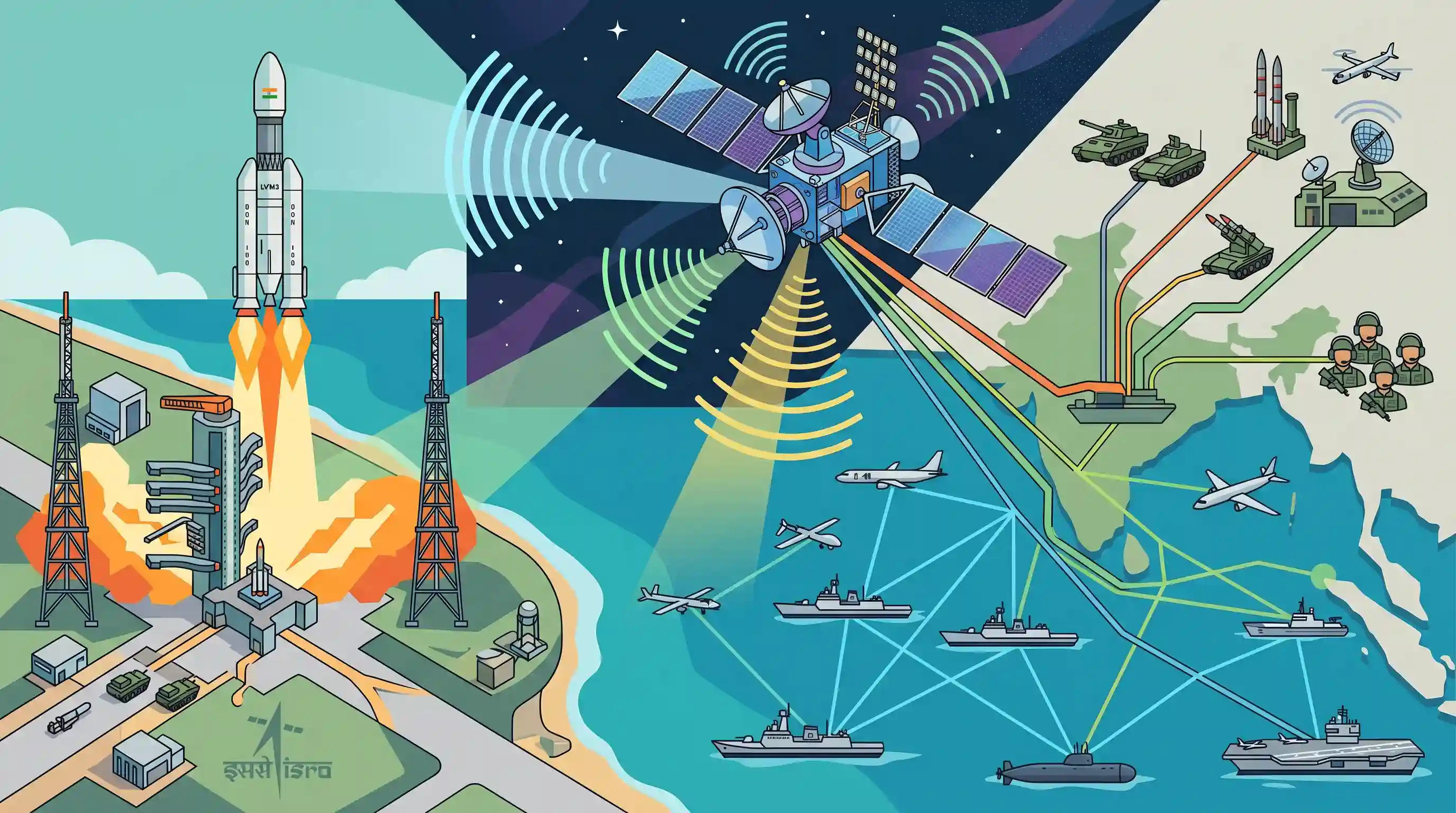
The Indian Space Research Organisation (ISRO) is set to launch the CMS-03 military communications satellite, also known as GSAT-7R, from the Satish Dhawan Space Centre in Sriharikota. The mission will utilize ISRO's Launch Vehicle Mark 3 (LVM3). As a dedicated space asset for the Indian armed forces, the multi-band communication satellite will significantly enhance the military's communication capabilities across the Indian landmass and a vast oceanic region.
Key Points
- ISRO is preparing to launch the CMS-03 (GSAT-7R) satellite, a multi-band communication satellite dedicated to the Indian armed forces.
- The launch will be executed using the heavy-lift Launch Vehicle Mark 3 (LVM3) from the Satish Dhawan Space Centre in Sriharikota.
- The CMS-03 will provide extensive communication coverage over a wide oceanic region as well as the Indian landmass.
- The deployment of this satellite is a significant step in boosting India's maritime and internal security by enhancing the defense communication infrastructure.
Important Terms
CMS-03 (GSAT-7R)

An advanced multi-band military communications satellite, also known as GSAT-7R, launched for the Indian Navy to enhance secure, real-time communication and surveillance across the Indian Ocean Region.
UPSC context
GS Paper 3: Science and Technology/Space; tests knowledge of dedicated military space assets and indigenous satellite capabilities.
Launch Vehicle Mark 3 (LVM3)
India's heaviest operational three-stage launch vehicle, capable of placing 4,000 kg class satellites into Geosynchronous Transfer Orbit; crucial for heavy-lift missions and future human spaceflights like Gaganyaan.
UPSC context
GS Paper 3: Space Technology; signifies India's self-reliance in heavy-lift technology and reduction in foreign launch dependence.
Maritime Domain Awareness (MDA)
The effective understanding of all factors associated with the maritime domain that could impact security, safety, or the economy; enhanced by GSAT-7R for blue-water naval operations.
UPSC context
GS Paper 3: Internal Security/Maritime Security; tests awareness of strategic frameworks for safeguarding India's vast coastline and IOR interests.
Geostationary Transfer Orbit (GTO)
A highly elliptical intermediate orbit used by launch vehicles to deposit satellites before they use on-board propulsion to reach their final circular Geostationary Orbit.
UPSC context
GS Paper 3: Science and Technology; a fundamental concept in orbital mechanics relevant to satellite deployment questions.
Multi-band Communication
The integration of multiple frequency ranges (UHF, S, C, Ku) in a single satellite to ensure secure, high-capacity bandwidth for diverse naval assets like submarines, ships, and aircraft.
UPSC context
GS Paper 3: Defence Technology; refers to technology that enables network-centric warfare and secure command-and-control.
Indian Space Research Organisation (ISRO)
India’s premier space agency responsible for developing and launching spacecraft and launch vehicles; it increasingly provides "dedicated space assets" for national security and defence.
UPSC context
GS Paper 3: Science and Technology/Institutions; the central body for all space-related current affairs and technological advancements.
Prelims Trap
"CMS-03 (GSAT-7R) is India's first dedicated military communication satellite."
GSAT-7 (Rukmini), launched in 2013, was the first. GSAT-7R (CMS-03) is its next-generation replacement. UPSC often tricks candidates by adding 'first' to new technology iterations.
Static Concepts Connected
What is the three-stage configuration of the Launch Vehicle Mark-3 (LVM3)?
- Solid Boosters: Two S200 strap-on motors using solid propellants provide the massive initial thrust required at lift-off.
- Liquid Core: Powered by twin Vikas engines (L110 stage) utilizing earth-storable liquid propellants for the intermediate phase.
- Cryogenic Upper Stage: The CE-20 engine (C25 stage) uses liquid hydrogen and oxygen, pushing 4000-kg payloads to GTO.
How is the GSAT-7 military satellite series classified among the Indian armed forces?
- GSAT-7 / 7R (Navy): Known as Rukmini (and its replacement 7R). It provides secure communications and Maritime Domain Awareness across the IOR.
- GSAT-7A (Air Force): Known as 'Angry Bird'. It enhances network-centric warfare by linking radar stations, airbases, and AWACS.
- GSAT-7B (Army): Upcoming dedicated satellite designed to meet the advanced terrestrial communication and border surveillance needs of the Indian Army.
Cross-Topic Patterns
Naval Satellites & SAGAR Doctrine
Secure IOR coverage enables real-time maritime tracking, bolstering India's role as a net security provider under the SAGAR doctrine and countering China's growing naval footprint.
Defence Space Agency (DSA) Integration
The shift to dedicated military satellites marks India's transition from civilian space reliance to robust tri-service assets, aligning directly with the mandate of the Defence Space Agency (DSA).

Match-the-following on GSAT-7 series (Navy/IAF/Army) paired with LVM3 payload limits to GTO vs LEO is highly probable for Prelims 2026.
Linked PYQs · 4
Linked PYQs · 4
- 2018PrelimsGS1
With reference to India's satellite launch vehicles, consider the following statements: 1. PSLVs launch the satellites useful for Earth resources monitoring whereas GSLVs are designed mainly to launch communication satellites. 2. Satellites launched by PSLV appear to remain permanently fixed in the same position in the sky, as viewed from a particular location on Earth. 3. GSLV Mk III is a four-staged launch vehicle with the first and third stages using solid rocket motors; and the second and fourth stages using liquid rocket engines. Which of the statements given above is/are correct?
- 2016MainsGS3
Discuss India's achievements in the field of Space Science and Technology. How the application of this technology has helped India in its socio-economic development?
- 2022MainsGS3
What are the maritime security challenges in India ? Discuss the organisational, technical and procedural initiatives taken to improve the maritime security.
- 2025MainsGS3
Why is maritime security vital to protect India's sea trade? Discuss maritime and coastal security challenges and the way forward.
